You want to quit your job and you do not have a plan
"Get a plan first" is advice that keeps men in jobs for years. The actual requirement is smaller and you can write it on one index card.
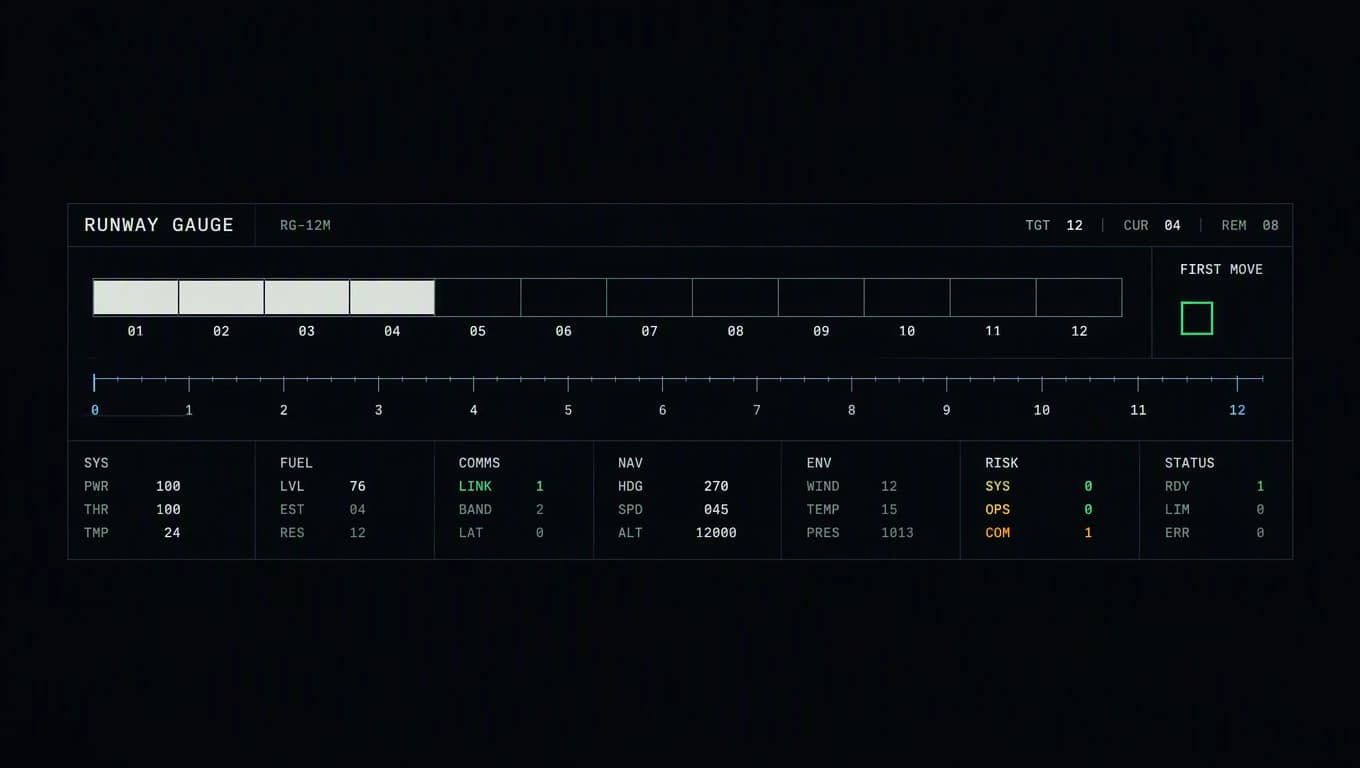
$ eldr --explain exit-without-a-plan
Everyone who tells you to have a plan before you quit has one thing in common: they are not the one sitting in your Monday. The advice is not wrong, exactly. It is just sized wrong, and the wrong size is what has kept you here for — what is it now, fourteen months? Eighteen?
Ask a man what plan he is waiting for and he will describe a full alternative career, funded, de-risked, with a start date. That is not a plan. That is a second job he is expected to build in the evenings while doing the first one at eighty percent because the other twenty percent is going into re-running this exact question.
The claim
The only plan quitting actually requires is a number of months and one falsifiable first move. Everything else people call a plan is a comfort object.
Months: how long you can pay for your life with no income, computed from your real spending, not your intended spending. One first move: a single action, doable inside two weeks of leaving, whose result you can check. "Talk to people" fails this test. "Send a paid-pilot proposal to the three firms who already asked me to freelance" passes it, because in two weeks you will know the answer and the answer is either money or a no.
That is the whole requirement. If you have a runway number and a checkable first move, the plan condition is satisfied and the thing stopping you is something else, which is worth knowing because you cannot solve a problem you have mislabeled for a year and a half.
Why the oversized plan is so attractive
Because it is unfalsifiable and it never ends, which makes it the safest possible place to store a decision you do not want to make. You cannot fail at building a plan. You can only be in the middle of it, indefinitely, and being in the middle of it reads to you and to everyone around you as responsibility.
The tell is repetition without movement. Count how many times in the last ninety days you opened the spreadsheet, looked at the same runway figure, felt briefly serious about it, and closed it. That number is not preparation. It is the carry cost of an open position, paid in the same attention you were going to use to get out.
The premortem instead
Gary Klein's premortem is the tool that does what the fantasy plan pretends to do, and it takes twenty minutes. Kahneman has praised it repeatedly. The move is simple and the wording matters: do not ask what could go wrong. Assume it is eleven months from now and the exit failed. Write the story of how.
Men who run this honestly produce the same three failures with unnerving regularity.
- The money went faster than the spreadsheet said, because the spreadsheet used intended spending and reality used actual spending plus one emergency.
- The first move never got made, because there was no date on it and freedom turned out to be mostly unstructured time.
- Someone at home was not actually on board, and the agreement everyone remembered having was never a conversation with numbers in it.
Each of those has a fix you can do this week, which is the point. A premortem converts dread into a short list of chores. That is the entire trick and it is why the tool has outlived every motivational framework released alongside it.
The case against this
Runway plus a first move is a dangerously low bar in a market where your specific skill takes nine months to place. A man with four months of savings and a checkable first move can satisfy this piece completely and still end up taking the worse version of his old job in the winter, with less leverage and a gap on the record.
That is correct, and it is the failure mode I would bet on if I had to bet. The sharper form of the objection: the plan requirement is not one-size, it scales with how illiquid your skill is. A contract developer and a research chemist are not running the same decision, and a piece that gives them the same threshold is being tidy at their expense.
So amend it. Runway is not a fixed number of months, it is two multiples of the honest time-to-place for your skill, and if you do not know that number, finding it out is your real first move — three calls to recruiters who place people like you, this week. If those calls say nine months and you have four, the position is HOLD and the read will say HOLD, and it will name the event that ends it, because a HOLD without an end date is just the plan fantasy with better manners.
What this does not claim
It does not claim quitting is good. It does not claim the job you dislike is the reason for the flatness you are calling boredom. Plenty of men leave, get the thing they wanted, and find the flatness waiting for them there. This instrument does not forecast and it does not cheerlead.
What it does is close the loop. A position, a window, the case against itself, and a logged outcome so that in six months you are working from a record instead of a mood. Two years of maybe is not caution. It is a decision — the decision to stay — made in a way that lets you avoid admitting you made it.
For entertainment and reflective purposes only. Not a substitute for professional financial, legal, medical or mental-health advice.