You want to put $40,000 into your own thing
The number is not the risk. The risk is that you have not written down what a failure looks like, so you will not be able to tell when you are in one.
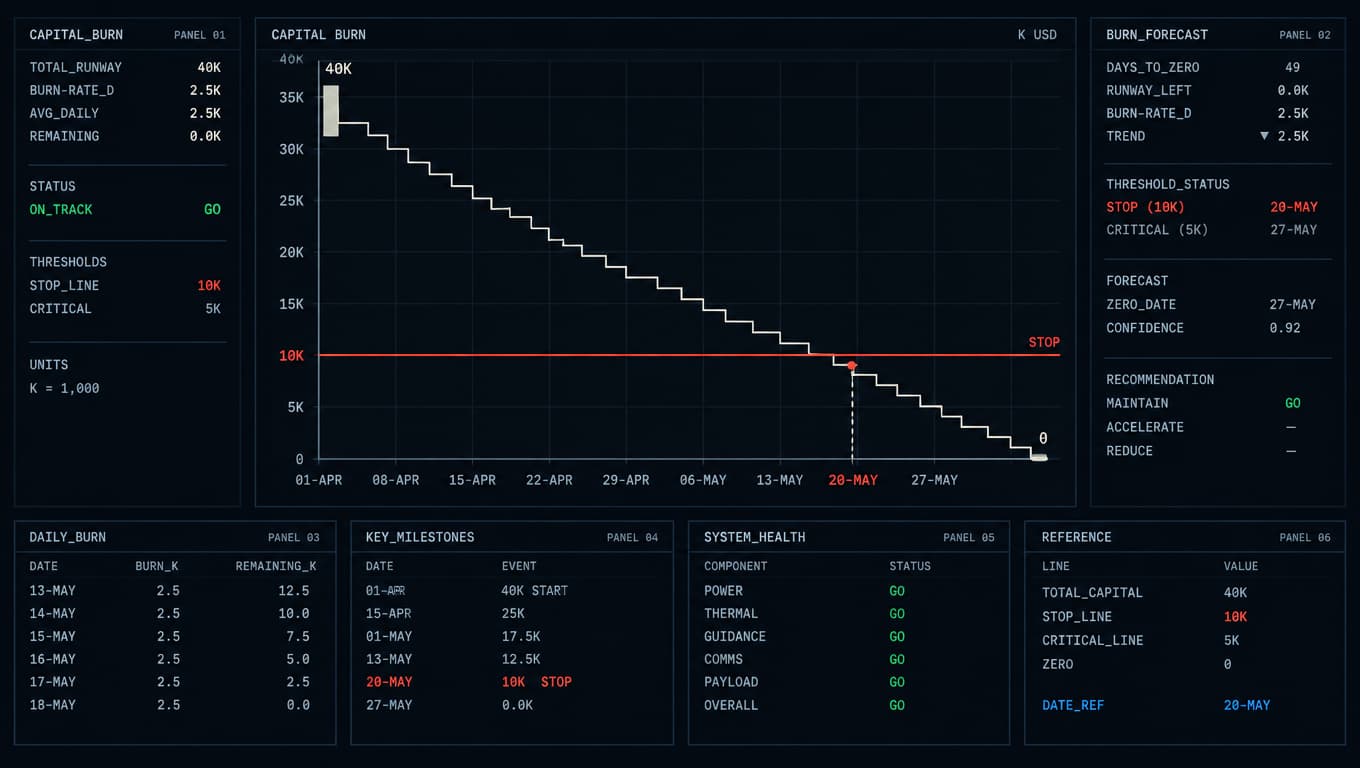
$ eldr --explain capital-at-risk
Forty thousand dollars in an index fund is a boring number. Forty thousand dollars in your own thing is a story about yourself, which is why the second one gets decided badly while looking like it got decided carefully.
You have almost certainly done the optimistic arithmetic. You have probably also done the pessimistic version, in the shower, in vague terms, and concluded that you could handle losing it. That conclusion is worth nothing, because "I could handle losing it" is a feeling about a number and not a plan for a state of the world.
The claim
A capital decision is not ready until you have written a stop condition with a date and a number on it. Not a target — a stop. The sentence that says: if by this date this metric is under this value, I stop spending and the experiment is over.
Falsifiable, and easy to check: go find your stop condition. If it does not exist in writing, you are not risking $40,000 on a business. You are risking an unbounded amount on a decision you have not made, because without a stop condition the natural behavior at month nine is another ten thousand.
That is the actual failure mode. Almost nobody loses forty thousand dollars. They lose forty, then twelve more because the first forty would otherwise have been wasted, then eight more because the twelve was so close, and by the time they stop they are sixty thousand down and eleven months behind, and the extra twenty was spent entirely on not having to conclude anything.
Writing a stop that holds
A stop condition has three parts and fails without any one of them.
- A date. "By 1 March" — externally fixed, not "when I have given it a fair go".
- A number. One metric, chosen before you start, that you cannot argue with after the fact. Paying customers, not signups. Revenue, not pipeline. Retention at week four, not enthusiasm on a call.
- A pre-committed consequence. What happens the day the number misses. Stop entirely, or one defined pivot with its own stop. Decide now, while you are not yet emotionally invested in the answer, because the version of you in March will be a worse judge of this than the version of you today, and he will have better arguments.
Then tell one person who will hold you to it and who does not benefit from your optimism. Not your co-founder. Not your wife, who has an interest in your morale. Someone whose only job is to read the sentence back to you on the date.
The comparison that actually matters
Not $40,000 in the business versus $40,000 in the index. The real comparison is:
$40,000 plus eleven months of your attention in the business, versus the index plus eleven months of attention on the career you already have.
The capital is the smaller half of that. Most men price only the money because the money has a number attached and the attention does not, which makes this a classic case of optimizing the measurable input. If you would not spend eleven months of undivided attention on the thing for free, the forty thousand is not the question.
The case against this
Stop conditions kill businesses that would have worked. Almost every company that matters looked dead at month nine by any metric its founder could have specified at month zero, and the ones that survived did so because somebody kept spending past the point where a disciplined spreadsheet said to quit. A rule that optimizes for not losing forty thousand dollars will reliably cost you the only outcome worth having.
This is the strongest objection on the page and it is at least partly true. Survivorship runs through it — we hear from the founders who pushed past the stop and won, not the far larger group who pushed past it and quietly went back to work with a hole in their savings — but the core point stands: a stop condition is a constraint, and constraints have costs in both directions.
The reconciliation I would defend: a stop condition is not a prohibition on continuing. It is a prohibition on continuing without a new decision. On the date, with the number missed, you are allowed to re-commit — but you must re-commit explicitly, with a fresh stop, having said out loud what you now believe that you did not believe in January. That is a completely different act from drifting forward, and the difference is precisely the difference between an investor and a man in a casino who is up on the evening.
What a read gives you here
A position, a confidence number, a window, and a counter-case that in money reads is usually about the metric you chose — because the most common defect in these files is a stop condition written against a number the founder can influence directly, which makes it not a stop condition at all. You do not get a forecast of whether the business works. Nothing gives you that. What you get is the loop closed, the terms written down while you are still calm, and a logged outcome you can grade yourself against in the spring.
For entertainment and reflective purposes only. Not a substitute for professional financial, legal, medical or mental-health advice.