Claim
The count is the instrument
One kept promise is not evidence of anything. Thirty are. The unit of this course is the count, and the count only exists if it is written somewhere you can see without deciding to look.
This is the difference between self-respect as an argument and self-respect as a document. An argument can be defeated on a bad morning by one recalled failure. A document cannot, because the failure is on it too, dated, at a ratio of one to twenty-nine.
What you are building is not a motivational device. It is an exhibit. Its function is to be consultable when your estimate of yourself is running low, and to be boring enough that you believe it.
Evidence
Why it cannot live in your head
Amos Tversky and Daniel Kahneman described the availability heuristic in 1973: we judge how common something is by how easily examples come to mind. Recall is not a random sample. It favors the recent, the vivid and the emotionally loaded.
Apply that to your own conduct and the output is predictable. Broken promises are vivid, they carry shame, and they arrive first. Kept ones are unremarkable by construction, because you did the thing, nothing happened, and there is no story. So an unwritten ledger over-weights failure systematically, and it does so more the worse you feel, which is exactly when you consult it.
Writing it down does not make you objective. It removes one specific distortion, by fixing the sample before your mood gets to choose it.
Action
Build it in ten minutes
One page, one file, one note. Not an app with streaks and a flame.
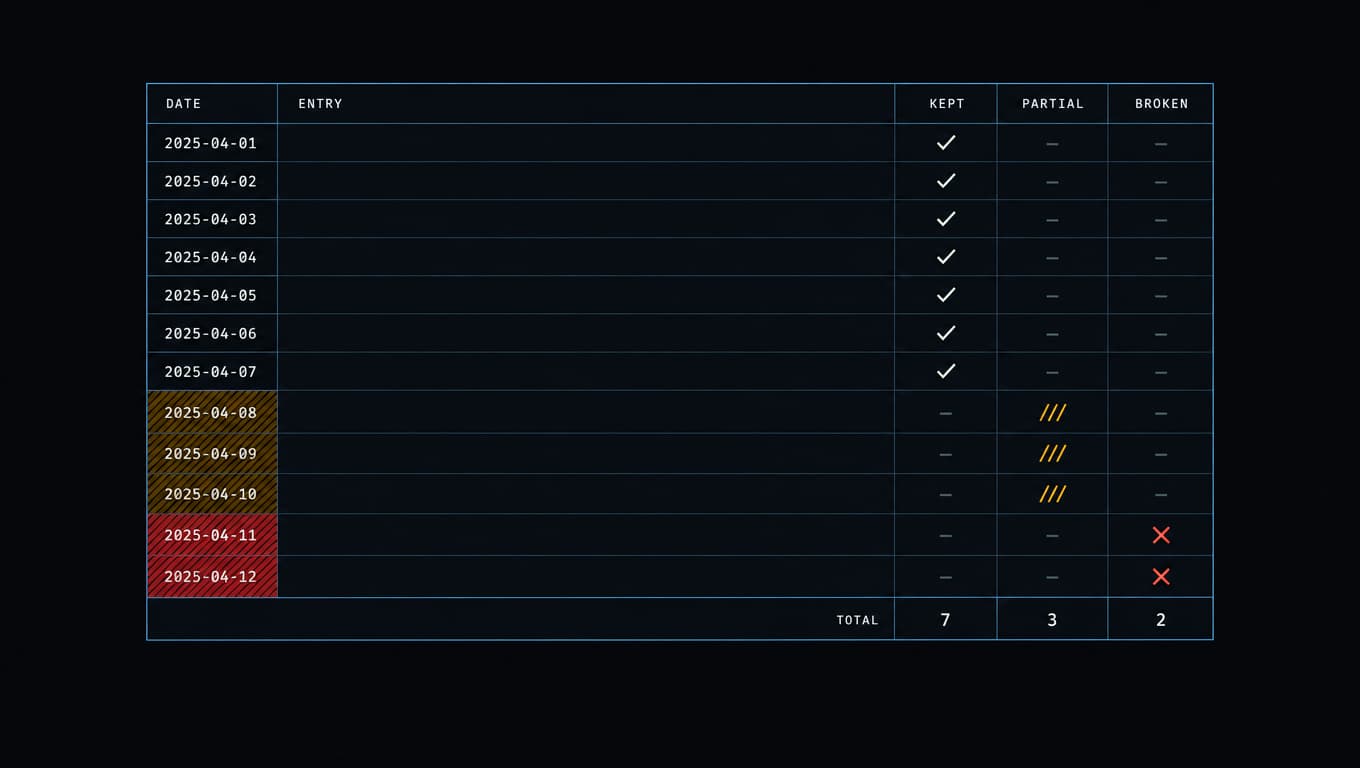
- Four fields per row: date, the promise as you resized it, result, and one word of context if the result was not kept.
- Three results only, kept or partial or broken. No fourth category and no scores out of ten.
- A count at the foot of each column, updated when you write a row. The count is the number you read, not the rows.
- Somewhere visible. If opening it requires a decision, you will open it on good days and not on bad ones, which inverts the point.
Backfill from your Day 2 audit. You should finish today with between eight and twenty rows already on the page and a count that is not zero.
Caution
The partial row is where men cheat
Partial exists because half-done is real, and it is also the category that eats a ledger. Two sessions of the three, four days of the seven, the email written and not sent. Grade those generously for a month and the count means nothing, and you will know it means nothing.
One rule, decided now rather than in the moment. Partial is when you did the thing and not the whole thing. Broken is when you did not start. 'I meant to' is broken. 'I got interrupted' is broken. 'I did two of three' is partial.
Partials do not go in the kept count. They go in their own column, where they serve a different purpose: a row that goes partial three times running is a sizing problem, and Day 3 tells you what to do with it.
Example
Forty-one rows and one real problem
Lukas had forty-one rows by his sixth week: thirty-one kept, six partial, four broken. He had come to this convinced that he never followed through on anything, and he had been saying that sentence about himself for years.
The ratio was not the useful part. The useful part was that all four broken rows were the same promise, and it was the only promise on the page he had never resized. It was a 5am start.
Everything he could not actually do was one thing, and he had been generalizing it across his whole character for six years. The page did not tell him he was fine. It told him the defect was one row wide.
Aside
Bookkeeping can be faked
A ledger you write, grade and audit yourself is exactly as honest as you are on the day. There is no independent verification anywhere in this system, and a man who wants a clean page can have one by Friday.
Two things make it harder to fake than it looks, neither of them a guarantee. The count is cumulative, so a fabricated row has to be maintained against a page that keeps getting longer. And the entries are dated and specific, so a false one is checkable against the rest of your life. You either went on Tuesday or you did not.
What is left over should be stated rather than hidden. This instrument works for a man who wants the truth about himself and is useless against one who does not. Nothing in these seven days changes that.