Claim
The promise was sized for a different man
Read your broken entries as specifications rather than as failures. Almost every one was written by the man you intend to be, and it fell due on the man who was actually standing there: tired, at seven in the evening, after a day that went badly.
Those are two different men with different capacities, and the first one keeps signing contracts the second one has to honor. He signs them in a good mood, usually on a Sunday, and he is generous with a resource he will not be the one spending.
That is a sizing error, not a character defect. It has a mechanical fix and the fix is unglamorous: make the promise small enough that the tired man at seven in the evening will keep it, then keep it.
Evidence
Where and when, not what
Peter Gollwitzer's 1999 paper in American Psychologist named the mechanism. An intention that specifies the situation, meaning when and where and what exactly you will do, outperforms an intention that specifies only the goal. The 2006 meta-analysis he ran with Paschal Sheeran across 94 studies put the effect at d = 0.65, medium to large by the conventions of that literature.
One caveat, in keeping with how this product treats its own evidence. Effect sizes in this field have come down under replication and publication-bias correction, so 0.65 is more likely a ceiling than a floor. The direction has held up better than the size.
What it buys you is concrete. 'Read more' has no situation attached, so nothing triggers it. 'Twenty pages before I open my laptop, at the kitchen table' has a time, a place and a first physical move, and the situation does the work your intention was failing to do.
Action
Shrink it until you would bet on it
Take the three most-broken entries in your audit. For each one, run this.
- State it with a time, a place and a first move. No promise survives without all three.
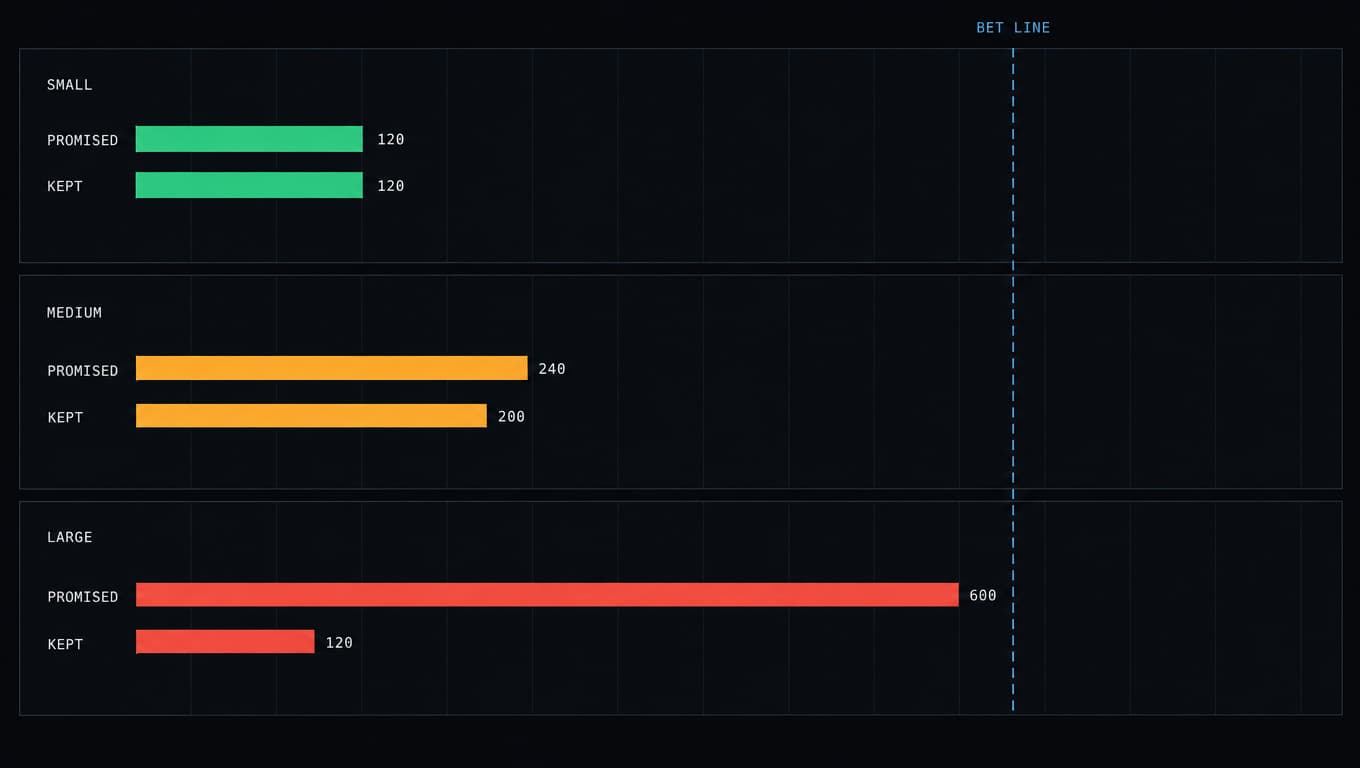
- Ask whether you would put fifty of your own dollars on your doing it this week. If the answer is no, it is still too big.
- Cut it until the bet is yes. Cut the duration, the frequency, the scope, whatever is load-bearing in the refusal.
- Write the small version down. That is the promise now. The old one is void, and voiding it deliberately is not the same as breaking it.
A promise you would bet money on is a promise you have priced. Most men have never priced one, which is why their ledgers read the way they do.
Example
Five sessions a week, six restarts
Kwame wrote down five gym sessions a week in January and attempted it six separate times that year. His longest run was nine days. By November the thing he was worst at was starting, because he had started so often.
The resize took twenty minutes. One session. Tuesday, 6:30pm, bag packed and standing by the door on Monday night. He objected that one session a week is not a training program, which was true and beside the point: the entry was no longer about training, it was the first true line in a ledger of false ones.
Eleven weeks later he was going three times a week and had added the extra two without writing them down. The small promise was the only one he had ever kept, so it was the only one that ever compounded.
Caution
Shrinking is not quitting
The literal-minded reading of today builds a ledger of trivia. Forty entries, all kept, none costing anything: drink water, make the bed, one push-up. The count goes up, nothing in your life changes, you notice, and the ledger quietly loses its authority because you know what is in it.
A promise has to cost something to be evidence. The test is whether the tired man at seven would rather not, and does anyway. Below that line you are collecting receipts for purchases you did not make.
So shrink to the point where the bet is yes, and not one step further. If every entry on your page is free, the sizing has overshot, and the fix is to add one that is not.
Aside
A promise to yourself is not really a promise
The strongest objection to the vocabulary: a promise has a counterparty who can hold you to it, nobody is holding you to these, and calling them promises borrows moral weight from a transaction that is not taking place.
Partly fair. The word is chosen deliberately, and it is chosen for what it does to the thing you are counting, because 'I promised' produces a different page from 'I planned'.
The defensible version is this. There is a counterparty. It is the man at seven in the evening who has to keep the promise, and the man on Sunday who signed it, and they are not the same man. One of them is repeatedly being sold out by the other. That is close enough to a transaction to be worth auditing.