Claim
The accusation is always general
Listen to the exact wording next time it arrives. It is never 'you missed the deadline on 3 March'. It is 'you are a failure', 'you always do this', 'nothing you start gets finished'.
That form is not incidental. A general accusation cannot be checked, so it cannot be refuted, so it survives any quantity of contrary evidence indefinitely. Whether or not you built it deliberately, it is built to be immune.
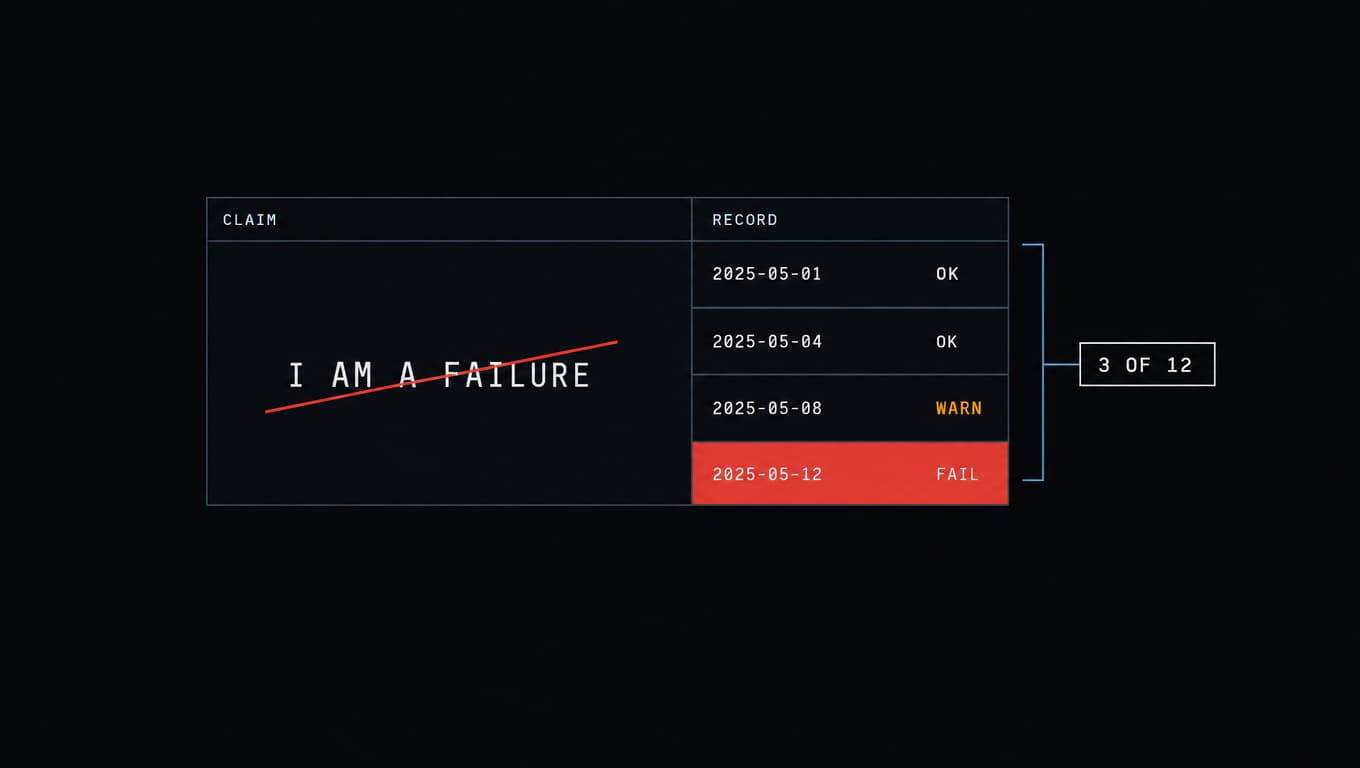
The move is not to disagree. Disagreeing is a mood contest against an opponent who sets the terms. The move is to treat it as a claim submitted for review and send it back for specifics: which thing, on what date, and what was the outcome.
Action
The four questions
When the sentence arrives, write it down verbatim, then answer these in writing.
- What is the specific behavior being alleged? One instance, not a pattern.
- What is the date?
- What is on the ledger from the same period that bears on it?
- If a colleague had done exactly this, what would you say the facts were?
The fourth question does more work than it looks like. Men apply an evidentiary standard to other people that they suspend entirely for themselves, and asking it in the third person restores the standard without any appeal to how you feel.
Evidence
Why specificity beats reassurance
This is the operation cognitive behavioral therapy calls examining the evidence, and it is worth naming what it does and does not rely on. It does not rely on the accusation being false. It relies on general claims being unfalsifiable and specific ones being checkable, so converting one into the other brings it within reach of a record.
The same structure runs elsewhere in this product. A read returns a position and then argues against it, and the counter-case has to name the thing it disputes. A counter-case that says 'this is probably wrong' gets discarded. One that says 'you have not verified the scope claim' can be checked by Thursday.
Reassurance fails for the mirror-image reason. 'You are doing fine' is as general as the accusation and carries less evidence, so it loses.
Caution
Two ways this goes wrong
The first is turning cross-examination into a pep talk. You write the accusation down, feel the pull toward comfort, and produce a page of encouragement with no dates on it. That is the affirmation again, in a costume, holding a clipboard.
The second is running it as a second prosecution. Some men demand the specifics and then supply them, twelve of them, all damning, and finish the exercise worse off with a documented case against themselves.
One discipline prevents both. One instance, one date, and the same period on the ledger read in full. Not the worst month. The same month. A cross-examination that reads only one side is not a cross-examination.
Example
One instance, three years old
Omar's recurring sentence about himself was 'you are the guy who lets people down'. Written out verbatim and put through the four questions, it survived about four minutes.
The only instance he could date was a wedding in 2023 that he canceled four days out. One instance, three years old. His ledger for the six weeks before he ran the exercise held nine kept commitments to other people, two of which had cost him a weekend.
He did not stop hearing the sentence, which is the part worth reporting. What changed was how long it held the floor. It arrives, he remembers that it has one example from 2023, and it gets about nine seconds instead of an afternoon.
Aside
When the specifics confirm it
Sometimes you run the questions and the evidence is there. Four dated instances in eight weeks, a pattern, no countervailing rows. The accusation was general and badly worded and substantially correct.
Do not go looking for a way out of that. What you have is no longer a mood, it is a finding, and a finding has a next move. It is a broken entry with a name on it, either sized wrong or avoided for a reason, and it goes back to Day 3 to be resized or forward to Day 6 to be refused outright.
This is the part the reassurance genre cannot do. An instrument that only ever returns 'you are being too hard on yourself' is not an instrument. Sometimes the honest output is that you were right about the facts and wrong about what they meant.
Caution
The one reading that is not a conduct problem
Day 2 said this ledger cannot touch depression, and that boundary was written for the man whose audit came back clean. Here is the same boundary from the other side, for the man whose record is genuinely poor.
If the instances you just dated fall inside a stretch when nothing you used to want was registering, you have not found a conduct problem with four examples in it. You have found the thing Day 2 described, and the reason it looks like a conduct problem is that the illness takes your function first and your function is what the ledger measures.
That goes to a clinician rather than back to Day 3. Resizing a promise will not touch it, and the confirmed accusation above is the worst possible thing to be holding while you decide.