Claim
Two fears, identical from the inside
One kind of fear is information: the deal is bad, the man is lying, the road is icy, the numbers do not add up. Your detector caught a real pattern faster than you could name it, which is the thing it is genuinely good at.
The other kind is noise. A false positive from a sensitivity setting that was never tuned for offices, dating or email. It feels exactly the same. Same surge, same certainty that this time it is serious.
No amount of introspection separates them, because the signal and the noise are generated by the same equipment and arrive in the same envelope. The only separator that works is external: make the fear state what it expects, then find out what happened.
Action
Make it predict
Write your fear as a prediction with three parts: what happens, how likely you think it is, and by when.
- What: "She says she has already made other plans."
- Likely: a number out of ten, written before you find out.
- When: a date, not "eventually".
Do five of those today, across five different fears, small ones included. Put the dates in your calendar and do not revise the numbers afterward. A prediction you edit after the fact is not a prediction.
The part men skip is the number. Writing 7 rather than "probably" is what makes this worth anything a month from now, because a word cannot be scored and a number can.
Evidence
Calibration, and what your log will show
Calibration is a boring, precise idea. You are calibrated if the things you call 8-out-of-10 happen about eight times in ten. It is the standard forecasters are graded against, and it is why the read in this product returns a confidence number instead of an adjective.
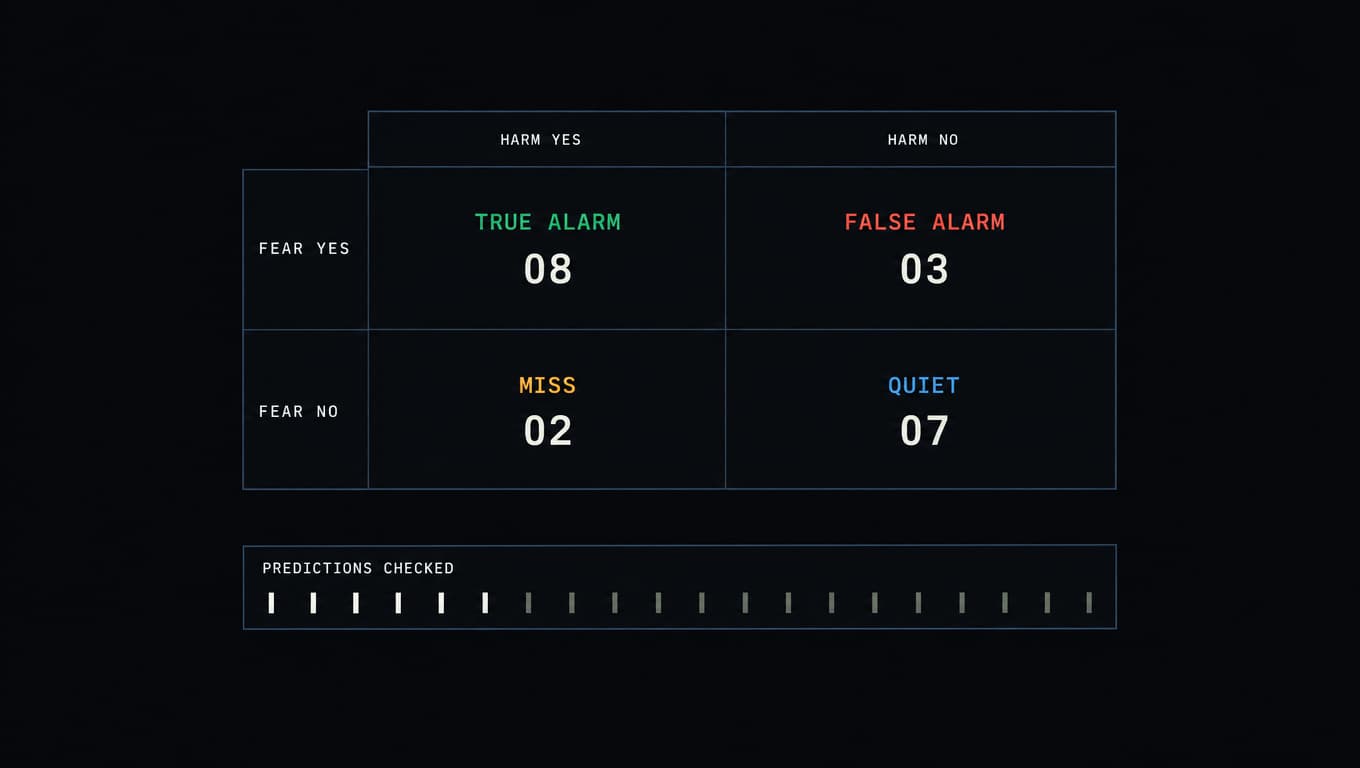
Run twenty predictions through a log and you get a table with four cells: fear fired and the thing happened, fear fired and it did not, no fear and it happened anyway, no fear and nothing. Almost all the volume sits in the second cell. That is your false-alarm rate, measured on your own data rather than asserted by a course.
The useful output is not "my fear is irrational". It is a number: at high dread, this detector is right about one time in six. That number came off your own data, and it will still be there the next time the surge insists this one is different.
Example
Marek scored two predictions and got a rate
Marek's fear had one sentence in it: if he told his manager the estimate was wrong, the manager would decide he could not handle the project. He wrote 8 out of 10 next to it before he said anything.
He told him on 14 January. The manager moved the date and asked for a revised plan by Friday. Nothing else happened.
His second prediction was the more interesting one, because it had a delay built into it: the conversation had cost him something invisible, and he would be left off the next piece of work. He was put on the next piece of work on 2 March.
Two data points do not make a calibration curve. What they gave him was a written record that at 8-out-of-10 dread his hit rate so far was zero in two, which is a different object from a vague sense that he is being dramatic.
Caution
Sometimes the fear is right
The failure mode of this day is a man who decides all fear is noise and walks into the thing it was warning him about.
Calibration cuts both ways. If your log shows you are right four times in five about a particular person, the detector has found a real pattern, and the response is to act on it rather than to expose yourself to it until you feel calm. There is no virtue in habituating to a bad partner or a fraudulent employer.
One trial settles nothing either. A prediction that fails once is a prediction that failed once. What you are building here is a rate across dozens of cases, and a man who reads two entries and declares himself cured is running the same unreliable trick as before, in the opposite direction.
Aside
Some predictions cannot be checked
A fear that predicts "they will respect me less" or "it will be awkward" cannot be scored, because you have no access to the measurement. Unfalsifiable predictions are not a minor category. They are most of what men actually carry.
Two options, both legitimate. Rewrite it into something observable, where respect becomes "he stops copying me on the client thread". Or accept that this one will never be settled and decide without it.
What does not work is keeping an unfalsifiable prediction in the file as though the log applied to it. That is how a log turns into a comfort object, which is the same failure the library piece on oversized plans describes in a different domain.