Claim
Relief is the payment
Avoiding the thing you are afraid of does not leave the fear where it was. It makes it stronger.
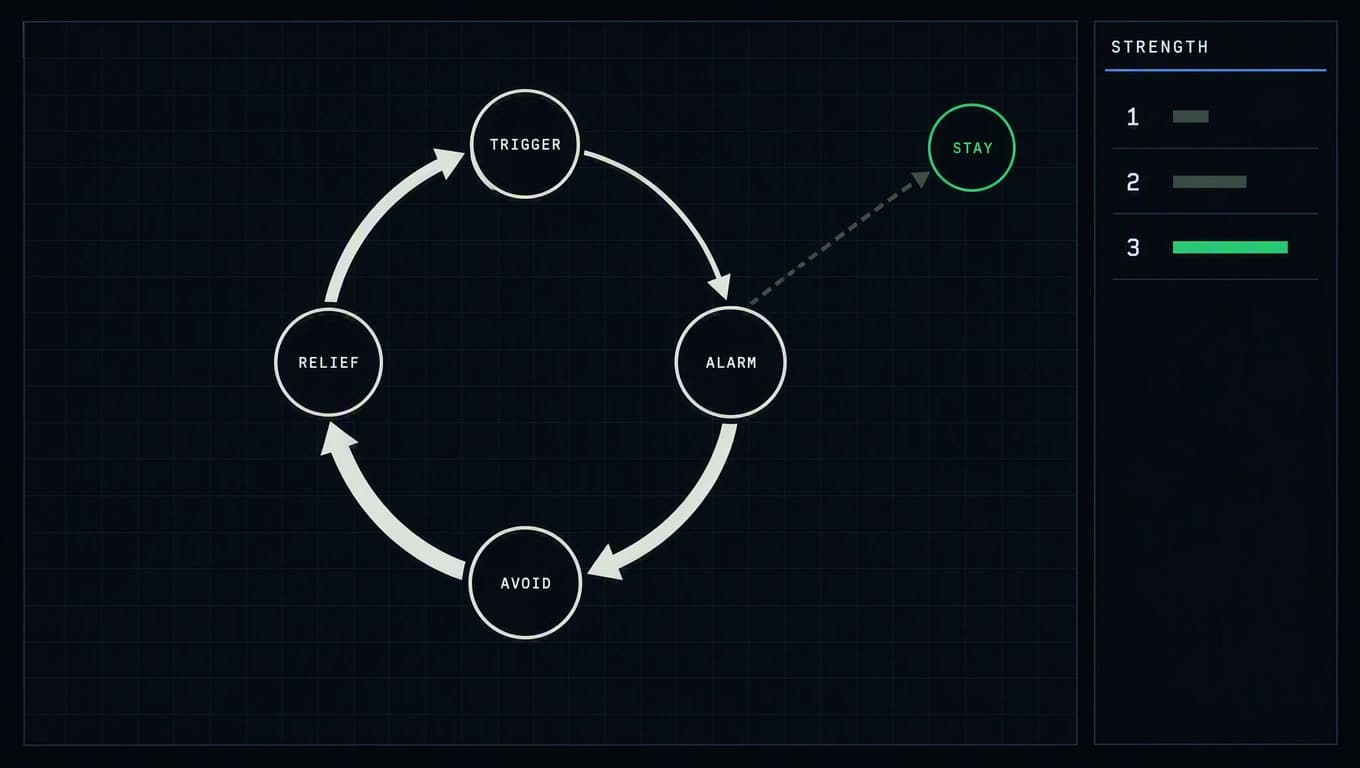
Here is the sequence. The trigger arrives, the alarm fires, you get out, and within seconds you feel relief. That relief is not neutral. It is a reward, delivered immediately, for the act of leaving, and immediate rewards are the most effective teaching signal your nervous system has.
Two things get learned at once. Leaving works, and the threat was real, because you never stayed long enough to find out otherwise. Every clean escape files another piece of evidence for a proposition that was never tested.
That is why the fear you have managed carefully for nine years has not faded. Fading requires disconfirmation, and you have been running a procedure that reliably prevents it.
Evidence
Mowrer named this in 1947
O. H. Mowrer's two-factor account separates how a fear is acquired from how it is maintained, and the second factor is the one that matters to you.
Acquisition can happen through a bad experience, through watching someone else's, or through being told. Maintenance is negative reinforcement: a behavior followed by the removal of something unpleasant becomes more frequent. Escape removes the surge, so escape becomes more frequent, and the loop is self-funding. It needs no new bad experiences to keep running.
The practical consequence is that the origin story is close to worthless. Men spend years trying to work out where a fear came from, assuming that finding the cause dissolves the effect. The cause is not what is feeding it. Your avoidance schedule for the last month is what is feeding it, and unlike your childhood, that is available for editing.
Example
Tariq did not make phone calls for fourteen months
Tariq described it as a preference. "I just work better over email."
What the preference cost, once he wrote it out: two invoices unpaid, because chasing them needed a call. A landlord dispute conducted over eleven emails across five weeks, which a nine-minute call resolved on 3 March. One job he did not apply for, because the listing said to call first.
He was not afraid of telephones. His prediction, once he wrote it down, was that he would be caught unprepared, say something stupid, and be heard doing it in real time with no chance to edit. Email removed that risk every single time, which is exactly why the prediction had gone untested for fourteen months.
The cost of the avoidance filled a page. The cost of the fear itself was nothing, because he never went near it.
Claim
Safety behaviors are avoidance in a coat
The half-measures are harder to see than outright avoidance and they do the same work.
A safety behavior is anything you do inside the feared situation to guarantee the bad outcome cannot happen: arriving so early that nothing can go wrong, scripting the first four sentences, bringing someone who talks for you, sitting near the door, drinking two before you speak.
The problem is not the behavior. It is the attribution. You get through the evening and the lesson your nervous system files is that it was survivable because you had the script, which leaves the original prediction fully intact and now protected by a rule.
A situation you survive with a crutch teaches you about the crutch.
Caution
What not to do with that
The first way men take this too literally is dropping every support at once, on day three of a course, to prove something. That produces one very bad evening and a fear with fresh evidence. Supports come off one at a time, starting with the least load-bearing.
The second way is more serious. Prescribed medication is not a safety behavior. Neither is a seat belt, or any measure that exists because the hazard is real. If a doctor put it there, the decision to change it belongs to that doctor and not to this course, and a man who stops taking something on the strength of a paragraph about crutches has misread the paragraph badly.
The test is whether removing it would expose you to a real hazard or only to an untested prediction.
Aside
Not everything avoided is worth approaching
This day argues that avoidance maintains fear, which is true, and it can be read as an instruction to approach everything, which is false.
You avoid plenty of things for good reasons and at no cost. You do not skydive, you do not go to the networking breakfast, you do not eat oysters. None of that needs fixing. A fear becomes a target only when the avoiding is charging you something you actually want: money, work, a relationship, the ability to make a phone call when it matters.
Run that filter before you build anything tomorrow. The list of things you are afraid of is long. The list of fears costing you something specific is usually three or four items, and those are the only ones worth a week of work.