Claim
Fear runs before you do
Fear is not a judgment about the world. It is the output of a detector that fires before you have finished reading the situation, and it reports in the only language it has: a body getting ready to fight something or leave.
The detector is fast and it is cheap. Those two properties are why it beat everything else in your head to the answer, and they are also why it is wrong so often. Speed costs accuracy. A system that has to answer in eighty milliseconds cannot also weigh context, and yours does not try.
The whole course follows from that. If fear were a verdict you would have to obey it. If it is a reading off an instrument, you can ask what the instrument's error rate is, and then you can go and check.
Evidence
Why it prefers false alarms
A detector gets tuned by the relative cost of its two errors. Missing a real threat once could remove you from the population. A false alarm costs a wasted surge and an awkward minute. If the first error is a thousand times more expensive than the second, the cheapest setting is one that fires on weak evidence and accepts a very high false-alarm rate.
That is the setting you have. It is not a fault and it is not a diagnosis. It means your fear signal was designed to be wrong most of the time in exchange for never being late.
One consequence is specific enough to act on: the strength of a fear tells you nothing about the probability of the thing. A 9-out-of-10 dread and a 2% risk sit together comfortably, because the number in your chest is a sensitivity setting and not an estimate.
Caution
Where this course stops
This course is not therapy and it treats nothing. It is tooling for ordinary fear: the call you have not made, the room you avoid. It is not treatment for a specific phobia, panic disorder, post-traumatic stress disorder, an anxiety disorder or depression, and no part of these seven days substitutes for a clinician or replaces treatment.
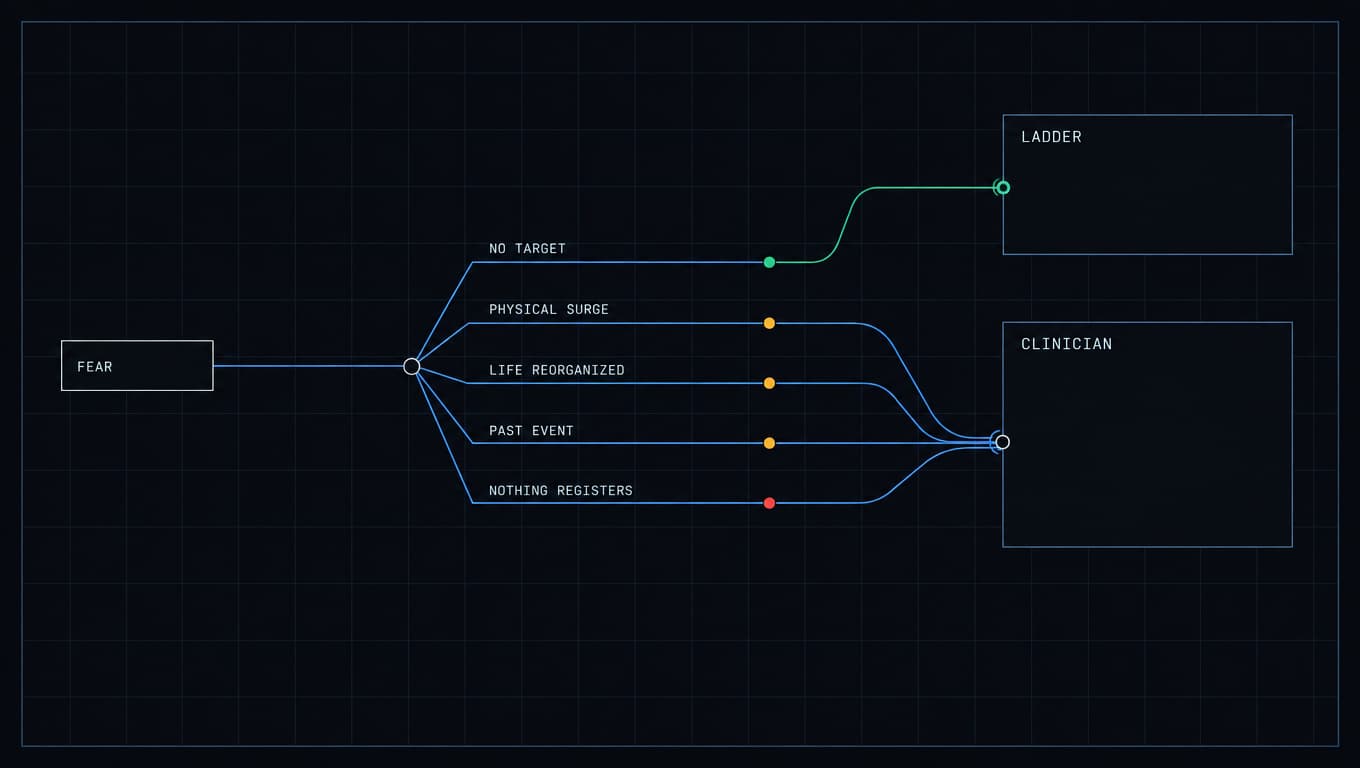
Five signs you are on the other side:
- The fear has no target, or the target keeps moving.
- It arrives with a physical event: a surge peaking in minutes, chest pain, the sense of dying.
- You have reorganized your life around it: routes, jobs, invitations.
- There is a specific past event it keeps returning to.
- Nothing you used to want registers any more, for two weeks or more. That is not fear, and a ladder for it is built for the wrong problem.
Any of those and the move is a professional, not a ladder. If you are thinking about hurting yourself, contact a local emergency service or crisis line today, or find a helpline in your country.
Evidence
How ordinary that referral is
The numbers matter here, because a referral should not read as a formality. The US National Comorbidity Survey Replication, the household survey Kessler and colleagues ran in the early 2000s, put lifetime prevalence at roughly 12.5% for specific phobia, about 4.7% for panic disorder, and around 29% for any anxiety disorder.
Round those off. Close to one man in three will meet the criteria for an anxiety disorder at some point in his life, and about one in eight for a phobia of something specific.
Set that against who actually goes. In the CDC's National Health Interview Survey for 2024, 10.9% of men had received counseling or therapy from a mental health professional in the past twelve months, against 16.9% of women. A large population qualifies and a small one goes. "See someone" is the statistically normal instruction. It sounds unusual because the men it applies to do not tell each other.
Action
Write the fear down as a target
Take the fear you opened this course for and write it as one line with two parts: what specifically you are afraid of, and what specifically you predict will happen.
Not "I'm anxious about work". That has no target and nothing in it to check. Something closer to: "If I tell my manager the estimate was wrong, he will decide I am not up to the job and I will be off the project inside a month." A target and a prediction.
Then check it against the five signs above. If it passes, you have the raw material for the rest of the week.
If you cannot write the second part at all, if there is no prediction in there and only a feeling that keeps arriving, write that down instead and take it to someone whose job it is. One line. Keep it where you can find it on day four.
Aside
The detector metaphor is a simplification
Calling it a detector is useful and not quite right. Joseph LeDoux, who did much of the animal work the popular version is built on, has spent the last decade arguing that the bodily alarm and the conscious feeling of being afraid are different systems, and that running them together confused both the science and the self-help stacked on top of it.
Why that matters here rather than in a seminar: the alarm is not available to argument. You cannot talk it down, and a man who tries concludes he is uniquely broken. The conscious part is available: the story you tell yourself about what the alarm means, and the decision to stay or go. That is the only part the next six days touch.
The honest version of the promise, then. This does not stop the surge. It changes what you do in the ninety seconds afterward.