Claim
Interested beats interesting
You have been trying to be interesting. Wrong target, and the more expensive one: being interesting needs material, timing and a subject you happen to know, produced fresh in every room.
Attention is the scarcest thing in any room, and the man who gives it reliably is doing something almost nobody does. Being interested is not the consolation prize for men with nothing to say. It is the higher-yield position, available immediately, requiring no material at all.
The reason is supply. Everybody in that room has a half-finished thought they have not managed to get through. Almost nobody has anyone who lets them finish it.
Evidence
You are not listening, you are drafting
The mechanism is plain enough that you can test it within the hour.
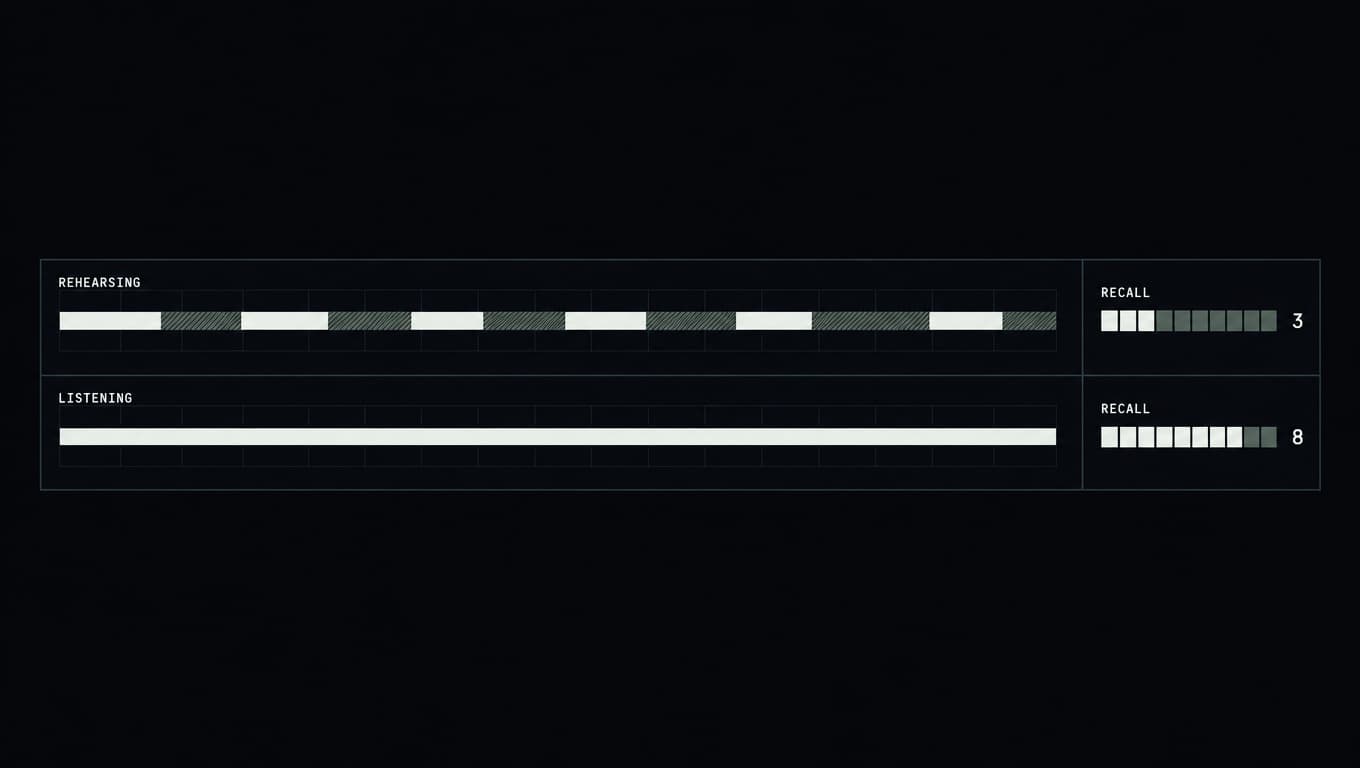
Producing language and parsing language draw on the same narrow resource. While you compose your next line, deciding what to say, checking whether it is stupid, waiting for a gap to say it in, you are not decoding the sentence arriving at you. You are hearing the sound and filing the gist.
The check: at the end of your next conversation, try to repeat the last full sentence the other person said. Not the topic. The sentence. Most men cannot, and the reason is not memory.
Drafting also produces the failure you already know. You say your line, it lands badly, and it lands badly because you wrote it four sentences ago against a conversation that has since moved.
Action
When you notice you drifted
You will lose the thread. Everybody does, several times a conversation, and the recovery is a move rather than a confession.
Say what you missed and ask for it. "Sorry, I lost you at the part about your brother." Then stop.
Men avoid this because they assume admitting it is worse than faking comprehension. It is the reverse. Faked comprehension means the next thing you say will be aimed at a conversation that has since moved, and he will notice that instead, without knowing why it felt off.
Do it once in your next conversation on purpose, whether or not you actually drifted. The point is to find out how little it costs.
Action
Say it back
Before you add anything of your own, put what he just said into your own words in one sentence, then let him correct it.
"So the problem isn't the money, it's that you'd have to move." Then stop.
Two things can happen. He confirms it, which almost always produces more detail than the original answer did, or he corrects it, which is better, because now you have the real version instead of your guess.
The move is also impossible to perform while drafting. That is the actual reason to use it. It is a check on yourself rather than a technique aimed at him.
Action
Carry one thing out
At the end of every conversation, before you are three steps away, fix one concrete fact: he is moving in August, his kid plays hockey, he cannot stand his manager.
Write it down if you need to. Most men would find that embarrassing and do exactly the same thing for work without a second thought.
Next time you see him, open with it. "Did the move happen?" It is four seconds of attention at the end of a conversation you were having anyway, and the reason to do it is that you wanted to know. A fact remembered in order to land well is a different move, and it reads like one.
Caution
Parroting, and the counseling voice
Two ways the say-back goes wrong.
The first is repetition without translation. He says the commute is killing him, you say "the commute is killing you". That is a parrot and people find it unnerving. Put it in different words or say nothing.
The second is tone. Delivered slowly, with sympathy, eye contact held a beat too long, the same sentence turns the kitchen into a counseling room, and a man describing a bad week does not want to be handled. Say it at the speed you would say anything else, as a plain check on what you heard, and carry on.
Aside
Listening is not enough
The counter-case, and it is strong. There are rooms where listening is the wrong move: a meeting where a decision is being made, or a first hour with people who will never see you again and have no idea what you do. In both, attention paid without any claim of your own makes you furniture. Pleasant, unremembered furniture.
Listening is how you find out where the conversation is. It does not substitute for saying something with your own weight behind it. If you finish this course able to draw anyone out and still unable to state a position in front of four people, you have taken half of it.