Claim
A gap is not a failure
The silence you are afraid of is real and it is shorter than it feels. Two seconds of nothing with a man looking at you is a genuinely unpleasant experience from the inside. From the outside it usually reads as a man thinking.
Gaps are read as composure far more often than they are read as failure, and everything you do to fill one costs you more than the gap did. The filling is the damage. Nobody remembers the pause. They remember the thing you said to end it.
Evidence
What two seconds actually is
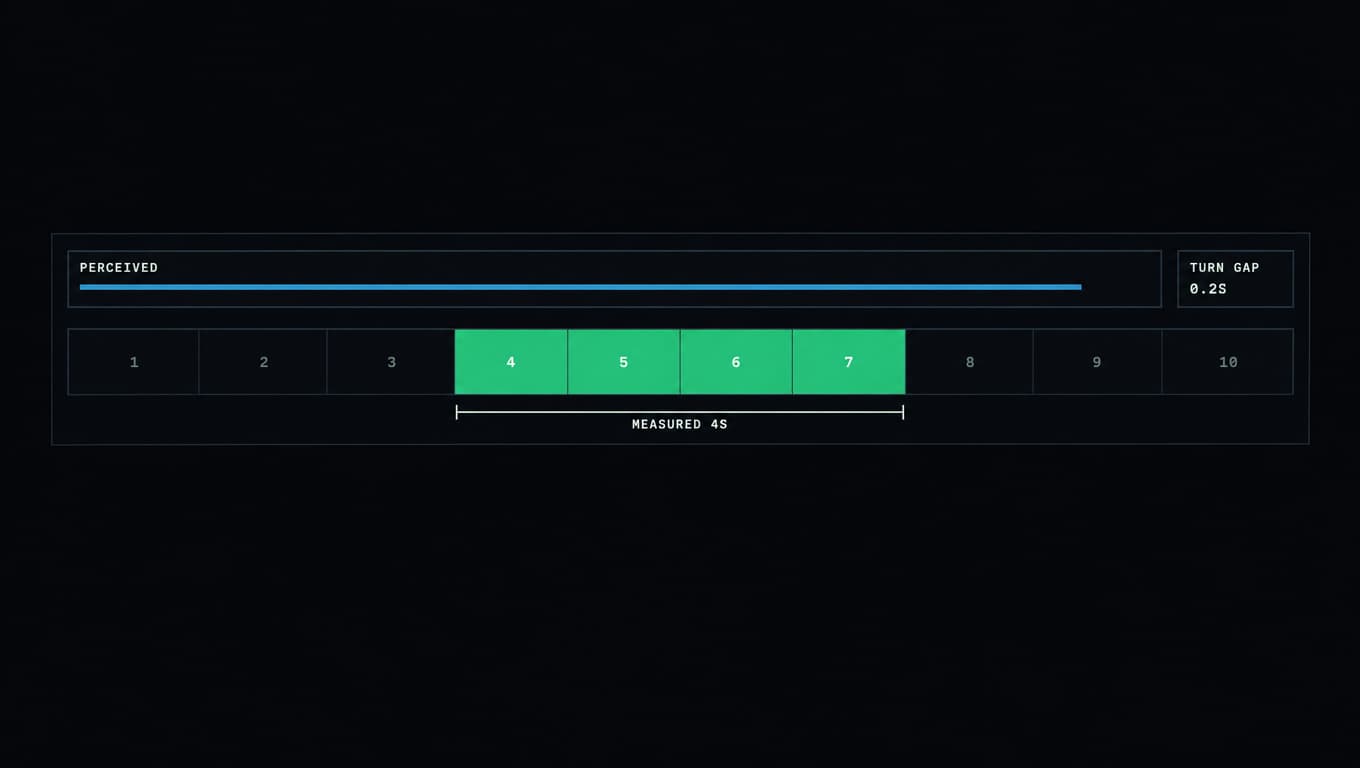
Stivers and colleagues (2009, PNAS) measured turn transitions in conversation across ten languages. The typical gap between one person stopping and the next starting came in around two tenths of a second, with a fairly narrow spread across very different cultures. Conversation runs on a tight clock and you have been calibrated on it since infancy.
That is why two seconds feels enormous. It is roughly ten times the normal interval. Your alarm is measuring accurately.
Koudenburg and colleagues (2011) showed the other half. A silence of about four seconds in a group conversation was enough to make participants feel the interaction had gone wrong and their standing in it was threatened. The discomfort is real and everybody in the group is feeling it. What is wrong is the conclusion you draw from it.
Action
Let it run
Next time a conversation stops, do three things in this order. Keep your face where it is, count two, wait.
Nine times in ten the other person starts. That is not a trick. He is under the same clock you are and the silence is costing him the same thing.
If nobody has started by three, reach backwards into the conversation rather than outside it. Ask about the last interesting thing he said. There is always something two minutes back that was left unfinished, and it beats the weather every time.
Example
Nineteen times in one hour
Vince knew he talked too much in meetings, and knew it while it was happening, which had never once helped. What changed it was a transcript he had made of a call for his own notes.
He counted his own behavior across that hour. Nineteen times he had answered his own question when the answer took more than a beat to arrive.
From the following Monday in March he ran one rule: ask, then say nothing until somebody else speaks. Three weeks later, two of the four people on that call were contributing to it regularly. He had assumed they had nothing to say.
The nineteen was the whole finding. He had been holding the floor by accident, in the gap, every time.
Action
Stop finishing sentences
You do this when you are ahead of the speaker and confident you know the ending. Sometimes you are right, which is what makes the habit durable.
The cost is not politeness. A man whose sentences get finished stops telling you the long versions, because the long version is the one that gets interrupted, and the long versions are where anything worth hearing lives.
For one day, catch yourself and let the sentence land. Count the saves. Men who count are usually surprised by the number, and the surprise is the point. Nobody notices himself doing this.
Caution
Weaponized silence
There is a version of this that goes wrong, and men who read about the power of silence go straight to it. The long held look. The refusal to respond. The pause deployed to make somebody else move first.
It is legible immediately and it is unpleasant to be on the end of.
The distinction is what the silence is for. Waiting because you have not finished thinking, or because he has not finished talking, reads as calm. Waiting in order to apply pressure is a tactic, and a course that taught you to run tactics on the people you are talking to would be a different and worse course than this one.
Aside
Some rooms run on overlap
Worth naming the exception, because the rule above is written for one kind of room. Plenty of groups run on overlap. Families, trades, certain cities, certain professions, where talking into the end of somebody's sentence is participation and a two-second gap reads as disapproval.
In that room the silence advice will make you look cold. So read the local clock before applying any of this: watch two people who are comfortable with each other for a minute and match their interval. The principle survives, which is that a gap is not an emergency. The specific count does not travel.