Claim
The follow-up is the conversation
Most men treat a question as a way to start a topic. It is not that. The first question is an instrument for finding out where the answer is, and the conversation happens in what you ask second.
The follow-up question does almost all of the work, and asking one is rarer than you would guess. Watch any group for ten minutes and count how often somebody answers and the next person replies with a statement about himself rather than a question about what was just said. The rate is high enough to be depressing, and it is your opening.
A follow-up is cheap. It needs no wit and no material. It needs you to have heard the answer, which is why Day 4 exists.
Evidence
Huang and colleagues, on question-asking
Huang, Yeomans, Brooks, Minson and Gino (2017) ran a set of studies on what question-asking does to how much people like each other. In online conversations where one side was instructed to ask more questions, partners rated the asker as more likeable. The effect concentrated in follow-up questions, meaning questions that took the previous answer as their subject, rather than in the raw count of questions.
They then took it into speed-dating data and found that asking more follow-ups predicted more agreements to a second date.
The mechanism they propose is responsiveness. A follow-up is evidence of attention, and it is difficult to produce without having paid any.
Action
Build the question out of three parts
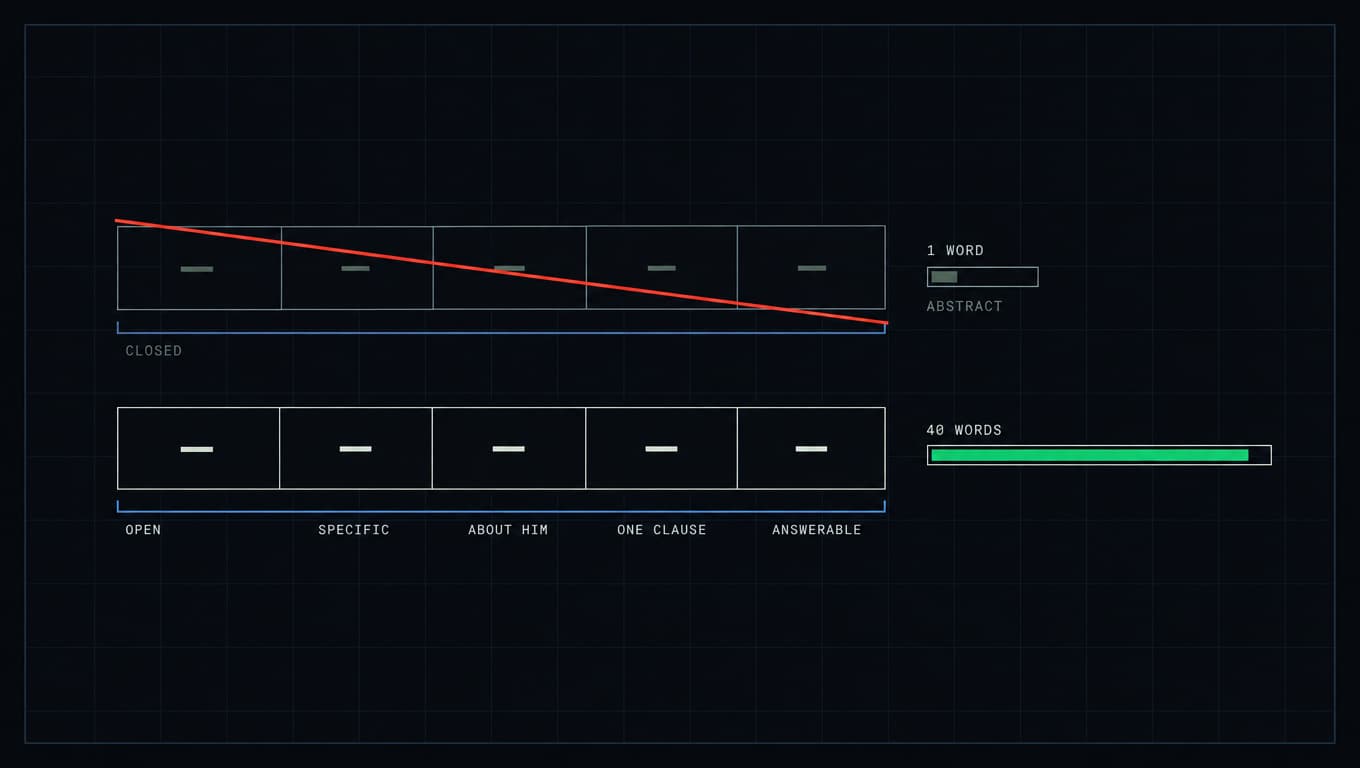
Assemble it from three parts and it will land almost every time.
- Specific beats abstract. "How's work" has no answer in it. "What are you actually doing this week?" has one waiting.
- Open beats closed. Anything answerable with yes needs a second question immediately, so build the second one into the first.
- About him beats about the topic. "What's the hardest part of that?" is about him. "Is the market bad right now?" is about the market, and the market will not be flattered.
Then wait. The question is finished when you stop talking, and a question followed by your own theory about the answer is not a question.
Action
When the answer comes back dead
You will get "good" and "yeah, fine". That is not a rejection. It is a badly aimed question coming back.
Ask one more, narrower and about him. "What part of it?" or "Since when?" If that also comes back dead, change target: drop the subject entirely and ask about something else, or leave.
Two dead answers is information. Either he does not want to talk about this, or he does not want to talk. Both are facts about the situation and neither is a fact about you. The mistake is the third question on the same dead subject, which converts a neutral outcome into the thing you were afraid of.
Example
Eleven doors, none entered
Anders went to the same monthly industry dinner four times. For the first three his whole approach was to ask people what they did for work. On the third night he counted eleven of those conversations, and afterwards he could not name one person in the room.
At the fourth dinner in May he made one change. Ask what they did, ask what the hardest part of it was, then stop talking. He spoke to four people instead of eleven, left with two phone numbers and a coffee in the calendar, and described it as the same room at a quarter of the effort.
Eleven openers is not eleven conversations. It is eleven doors opened and none entered.
Caution
Interview mode
Run this as a protocol and you have built an interview. The tell is that nothing you learn changes what you ask next: question, answer, unrelated question, and the other person begins to feel processed.
The fix is not fewer questions. It is answering some. Trade. He tells you the hardest part of his job, you say what the hardest part of yours is in two sentences, then ask the next thing.
A conversation with questions running one way is a deposition, and men who have just discovered question-asking overshoot into it almost without exception. If he has not asked you anything in ten minutes, that is the reading on the gauge.
Aside
Questions are also a place to hide
The case against today. A man uncomfortable being known can ask questions all evening and say nothing about himself, and everybody in the room will describe him as a good listener while nobody knows him. It works for years at a stretch. It is the most socially rewarded form of hiding available.
Question-asking makes people like you. It does not make them know you, and the thing you actually want, somebody to call on a bad Tuesday, runs on being known. Take today as the way in. Days 6 and 7 are about what you do once you are through the door.