Claim
Two ratios do most of the work
The first is the length of your torso against the length of your legs. The second is the width of your shoulders against the width of your waist.
Almost every piece of styling advice you have heard is one of these two ratios in disguise. Tucking a shirt raises the visible waistline and lengthens the leg. A higher trouser rise, meaning the distance from the crotch seam to the waistband, does the same thing more strongly. A structured shoulder widens the top against the waist. None of this changes your body, and all of it changes where a viewer reads the divisions.
Action
Measure your own two ratios
Stand in front of a mirror in fitted clothing and take one photograph, straight on, phone at chest height.
On the photo, mark three points: the top of your shoulder, your natural waist, which is the narrowest part of your torso and is usually above your belt, and the floor. Compare the shoulder to waist distance against the waist to floor distance. If the upper section is longer, you are long in the torso and short in the leg, and the reverse if shorter. Write down which you are. That single fact resolves more clothing questions than any amount of reading.
Evidence
Why rise matters more than anyone tells you
Trouser rise is the measured distance from the crotch seam to the top of the waistband, and over the last twenty years mass market rises have fallen by several centimeters.
The effect is mechanical. A low rise puts the waistband below your natural waist, which visually shortens the leg and lengthens the torso, and on a man who is already long in the torso it produces the squat silhouette he then blames on his height. A higher rise moves the division up and the leg reads longer. Rise is printed in the measurements of most online products and is the number men least often check.
Claim
Proportion rules for smaller details
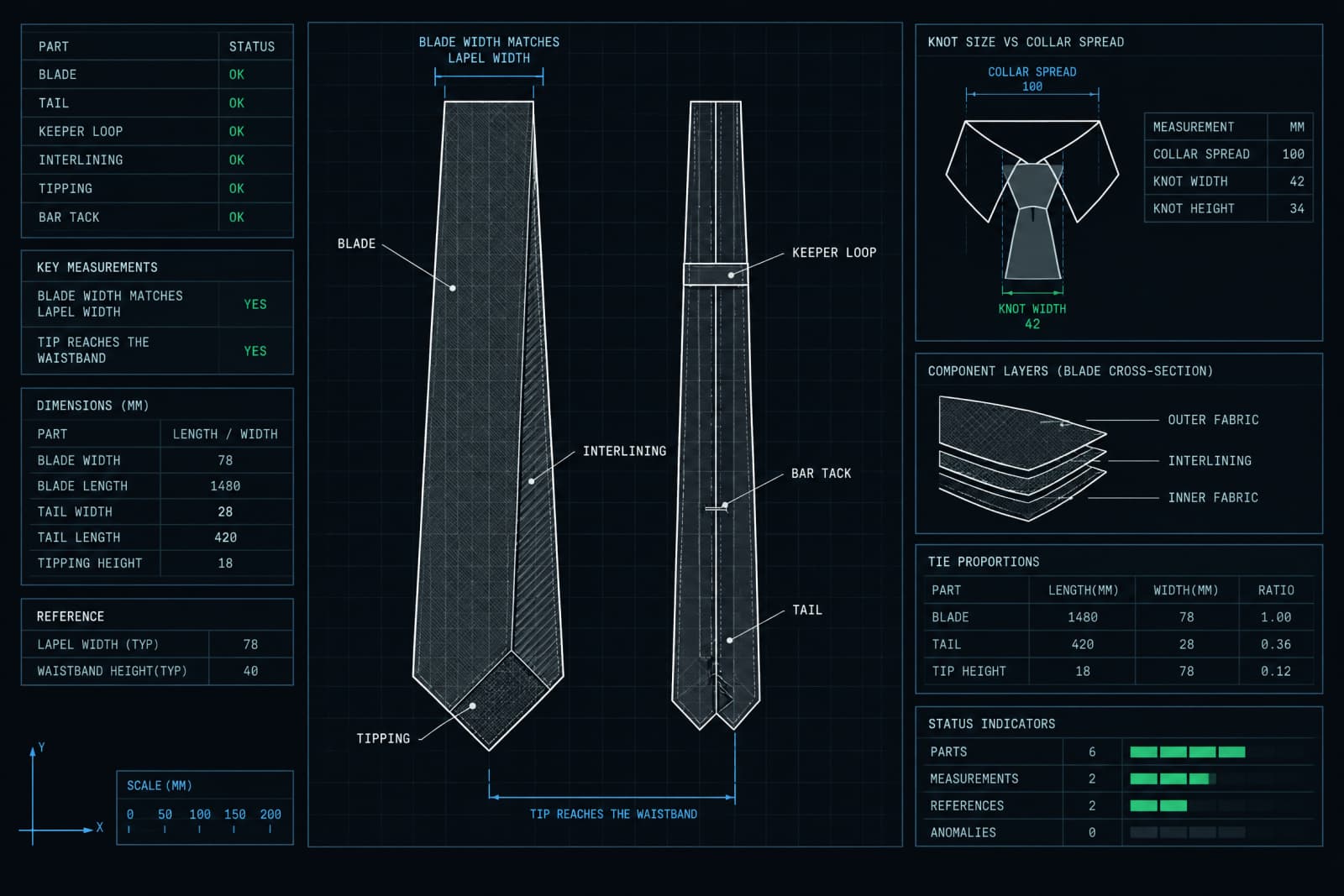
Two examples worth knowing, because both are checkable in a mirror. A tie blade should be roughly the width of your jacket lapel, and the tip should reach your waistband, neither above it nor hanging past. A jacket should be long enough to cover your seat, and a hem shorter than that shortens your torso and widens your hips.
These are not eternal laws of beauty. They are conventions built around the same two ratios, and they exist so that the divisions of your outfit line up with the divisions of your body instead of cutting across them at random.
Example
Tobi is 170 centimeters tall and had concluded he simply looked wrong in tailoring. His photograph showed a long torso, short legs, and trousers sitting on his hips.
He changed two things. He moved to a higher rise, which put the waistband at his natural waist, and he stopped wearing his shirts untucked. His legs now read as roughly half his height rather than clearly less, and two colleagues asked whether he had lost weight. He had not. He had moved one horizontal line up by about seven centimeters, which is the least glamorous and most effective adjustment in this entire course.
Caution
Do not try to correct your body
Proportion work goes wrong when it becomes a project of concealment: the man who only wears black to look thinner, or piles on structure to look bigger, and ends up in a costume that says he is managing something.
The better framing is emphasis, not correction. If you are broad, wear things that let you be broad rather than things that hide it. If you are slight, stop buying clothes cut for someone 15 kilograms heavier. Clothes that acknowledge your actual shape look calm. Clothes fighting your shape look anxious, and other people read the anxiety without identifying the cause.
Aside
Honest limits of the rules
The lapel and waistband rules I just gave are conventions from mid-century Western tailoring, not findings. Plenty of well dressed men break them on purpose, and in other traditions they do not exist at all.
What I would defend is narrower: consistency of line reads as deliberate, and inconsistency reads as accidental. If you break a proportion rule, break it decisively and repeatedly so it becomes a choice a stranger can see. A tie that is two centimeters short of your waistband looks like an error. One worn markedly short, with a matching silhouette everywhere else, looks like a decision. Both are unconventional and only one of them looks unconvincing.