Claim
Four checkpoints, in order of importance
For any tailored garment, four things decide whether it looks right, and they are worth more attention than everything else combined.
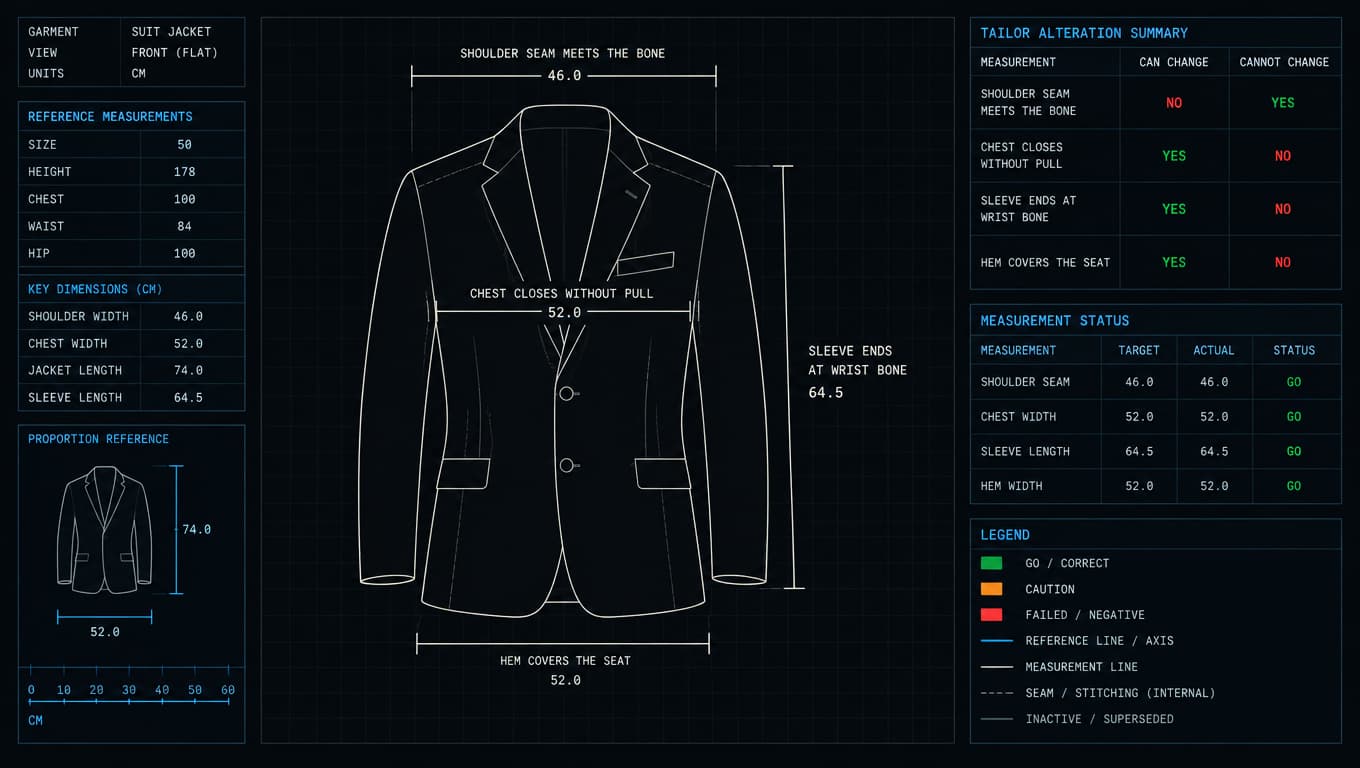
The shoulder seam should sit where your shoulder bone ends, not past it and not short of it. The chest should close with no horizontal pulling at the button. The sleeve should end at the wrist bone, showing a small amount of shirt cuff. The trouser hem should meet the shoe with as much or as little fold as you have chosen deliberately. Get those four right in a cheap jacket and it will read better than an expensive one with the shoulders wrong.
Evidence
Why the shoulder is the one that decides it
The shoulder is first on that list for a mechanical reason. The sleeve is attached to the body of the jacket around a curved seam called the armhole, and the top of the sleeve, the sleeve head, is shaped and often padded to sit on that curve.
Changing the shoulder width means unpicking the sleeve, recutting the shoulder line, and resetting the sleeve head so it still hangs correctly. Most tailors charge more for that than for any other alteration and many decline it. Everything else on the list is routine work by comparison, which is why you buy for the shoulders and adjust the rest.
Claim
Break is a decision, not a default
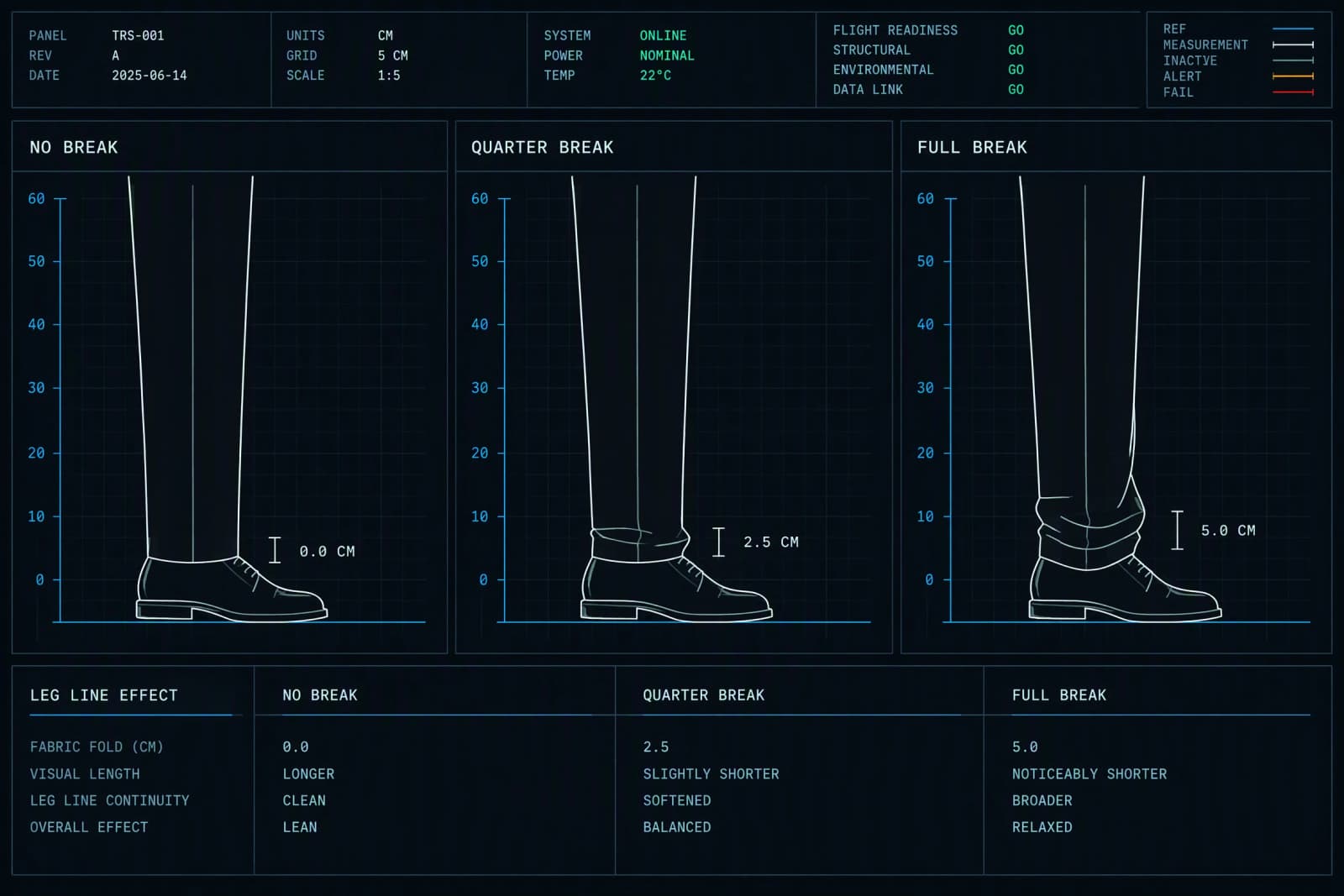
The break is the fold of fabric that forms where the trouser hem meets the shoe. No break means the hem just touches, with the fabric stopping clean. A quarter break gives one soft dent. A full break gives a visible fold, sometimes two.
None of these is correct in general and all of them are correct for someone. A shorter man usually gets a longer, cleaner leg line from no break or a quarter, because a stack of fabric interrupts the line at the ankle. A heavier fabric hangs better with a little more break. The failure is having no opinion and accepting whatever length the shop hemmed.
Action
Audit everything you own with a mirror and a phone
Put on every jacket and every pair of trousers you own, one at a time. For each, check the four points and write a verdict on a list: fits, alterable, or wrong.
Two tests that catch what the mirror hides. Photograph yourself from the front and the side, because you stand differently when looking at your own reflection. And raise both arms halfway: if the whole jacket lifts off your back and the collar rides up, the armhole is cut too low, and that is not fixable. Expect to condemn two or three things. That is the point of doing it.
Example
Sam owned four suit jackets, two of which he never wore and could not explain why. The audit took him fifty minutes.
Both unworn jackets had shoulder seams roughly two centimeters past his shoulder bone, which he had never noticed and could not unsee afterwards. One of the two he liked turned out to be the cheapest thing he owned, bought in a hurry, with the shoulders correct by accident. He gave away the two, had the sleeves shortened on the cheap one for the price of two coffees, and stopped buying jackets in his usual size without checking that seam.
Caution
Slim is not the same as fitted
The decade of very slim cuts left a lot of men equating tight with well fitted, and they are different things. A jacket that pulls into an X shape at the button is too small, not fashionably fitted. Trousers that show the outline of your phone are too tight regardless of what the mannequin looked like.
The working test is movement. Sit down, reach forward, cross your arms. If the fabric protests, the garment is smaller than you are. Well fitted means the cloth follows your shape while still allowing you to be a person who does things.
Aside
Where the four checkpoints do not apply
These rules come from tailored clothing, and plenty of good clothes are deliberately not tailored. A field jacket, a heavy overshirt, a fisherman sweater and most outerwear are cut generously on purpose, and applying the shoulder rule to a parka will make you buy one too small to wear a jumper under.
The transferable idea is intention rather than measurement. A garment designed to be roomy should look roomy everywhere, evenly, and not accidentally tight in one place. If you cannot tell whether something is oversized by design or just too big, look at where the shoulder seam falls: on a deliberately oversized piece it drops well past the bone and the whole silhouette follows it.