Claim
A buffer is not savings, it is insurance you underwrite yourself
An emergency fund is cash held specifically so that a shock does not force a decision. It is not for a holiday and it is not part of your investments.
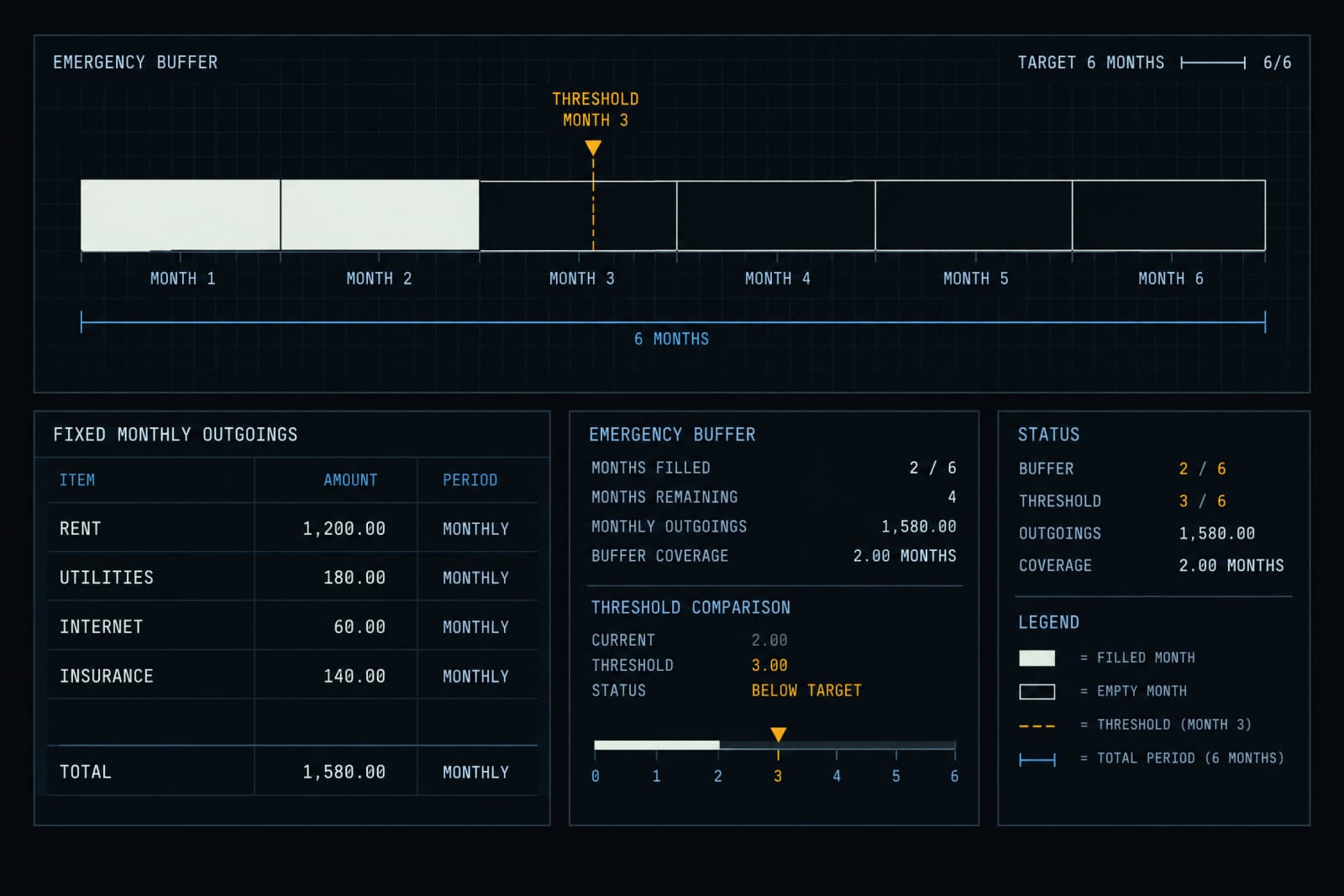
Its size is not a personality question, it is arithmetic from day 2. Take your fixed monthly outgoings, not your total spending, because in a bad month the variable spending falls on its own. Multiply by the number of months you would need to replace your income. That is the number.
Evidence
Where the months come from
The common advice is three to six months. The range exists because the real driver is how long it takes to replace your income, and that varies enormously by field.
A contract developer in a city with open roles might genuinely place in six weeks. A specialist in a field with four employers in the country should assume six months and plan for nine. Government labor statistics in most countries publish median duration of unemployment; look yours up rather than guessing. Add months if your income is variable, if you are the only earner, or if you have dependents. Subtract if you have a second household income that covers the fixed floor on its own.
Action
Size it and put it somewhere boring
Multiply your fixed monthly total by your honest months to replace income. Write the target figure down.
Then put the money where two things are true: you can reach it within a few days, and it is not in the same account you spend from. A separate savings account at the same bank is enough. Instant access matters more than the interest rate here, because the whole point is availability under stress. If your buffer is not yet full, set the target and add to it monthly before anything else. If it is already larger than the target, the excess is what day 5 is about.
Example
Priya and Sam both earn well and both had 4,000 in cash when Sam's contract ended in February. Their fixed outgoings were 3,100 a month.
They had five weeks of floor, not the "few months" they had assumed, because they had been sizing the buffer against their salary rather than against their committed costs. Sam took the first offer that arrived at the end of March, which paid 15% under his previous rate. The money was not the problem. The five week horizon was, because it converted a hiring decision into a forced move with a deadline neither of them had chosen.
Claim
Known future costs are not emergencies
A sinking fund is money set aside for something you know is coming but cannot pay from one month of income: the annual insurance renewal, new tires, the trip you have already agreed to attend.
Keep it separate from the buffer, because mixing them is how a buffer quietly empties. If the car service comes out of the emergency fund, the fund is no longer sized for an emergency and you will not notice until one arrives. The arithmetic is the same as day 2: take the annual total of known costs, divide by twelve, and treat that as a fixed monthly transfer into its own account.
Caution
Two ways this goes wrong
The first is building a twelve month buffer while carrying a 24% card balance. Cash earning 2% while debt costs 24% is a guaranteed loss of 22% a year on that money. Hold one month of floor for safety, clear the expensive debt, then finish the buffer.
The second is treating the buffer as a target to admire. It is not an achievement, it is a tool with a size, and once it is the right size, adding to it further is just a slow leak of the kind you measured on day 1.
Aside
What a buffer cannot do
A cash buffer handles a gap in income or a one-off cost. It is a poor answer to a catastrophe, and the honest word for what covers those is insurance: income protection, disability cover, term life if someone depends on you, whatever the equivalent is in your country.
Insurance is the transfer of a risk you cannot absorb to someone who can, in exchange for a premium. It is unglamorous, it is usually cheaper than men assume when bought young, and the terms differ so much between countries that any specific advice here would be wrong somewhere. Find out what your employer already provides before buying anything, because a lot of men pay twice for the same cover.