Claim
The rate is the product
APR means annual percentage rate: the yearly cost of borrowing, including most compulsory fees. It is the number that tells you what the money costs. The monthly payment tells you only how long you have agreed to pay it.
Two loans with identical monthly payments can differ by thousands in total cost, because one runs for three years and the other for seven. When a seller talks about affordability and will not print the rate on the same page, that is the tell.
Evidence
Why a minimum payment can be a trap you can verify with a calculator
Take a card balance of 5,000 at 24% APR. In the United States, where the advertised APR is a nominal annual rate, 24% divides into 2% a month, so next month interest is about 100. In the United Kingdom and the European Union, APR is required to be the effective annual rate, so a 24% card is closer to 1.81% a month and about 90 here. Check which convention your statement uses; the lesson survives either way.
Card minimum payments are commonly set around 2% of the balance in the US, and as interest plus about 1% in the UK. On the US pattern the minimum here is also 100, so the payment and the interest are the same size and the balance barely moves. That is not a metaphor, it is the arithmetic that makes revolving credit profitable. Pay 250 instead and 150 of it lands on the balance, and next month interest is lower, which is compounding running in your favor for once.
Claim
Order by rate, with one human exception
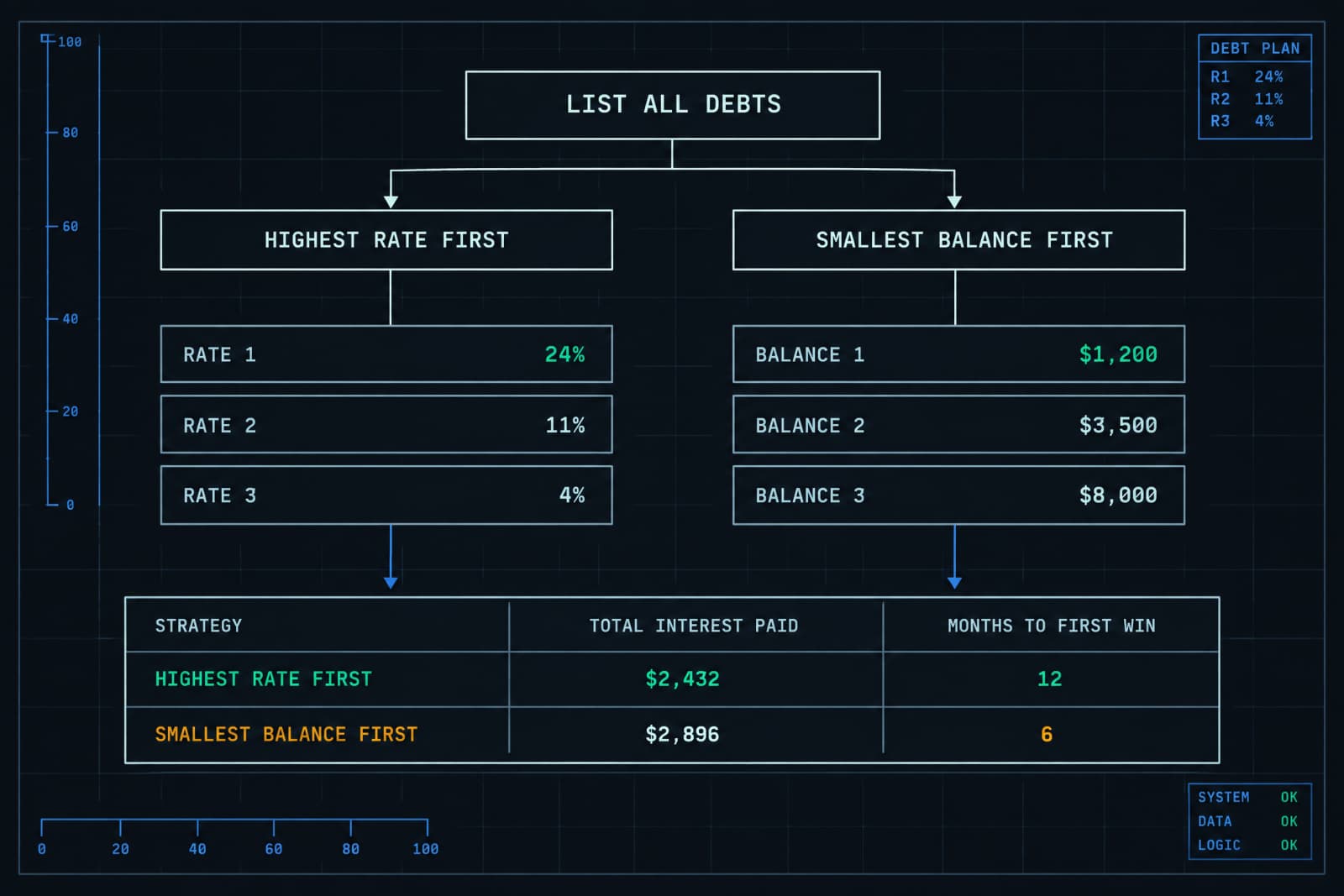
List every debt with its rate and pay the minimum on all of them while attacking the highest rate first. This is arithmetically optimal: you are buying back the most expensive money first, so you pay the least total interest.
The exception is behavioral. Some people need a debt to disappear entirely to keep going, and clearing the smallest balance first delivers that. It costs more in interest and it works for people who would otherwise stop. If you know which of those two men you are, choose accordingly. If you do not know, start with the rate.
Action
Build the debt table
One row per debt: what it is, the balance, the APR, the minimum payment, and the lender. Include everything. Card balances, car finance, student loans, the phone paid in instalments, the money you owe your brother.
Sort the table by APR, highest at the top. Then draw a line at about 8%. Above it, clearing the debt beats any use of the money that is not an employer match, because paying off an 8% debt is a guaranteed 8% and no investment is guaranteed anything. Below it, the case for clearing early stops being obvious and starts depending on what else the money could do. Day 6 uses the same line, so use one number in both places. Keep the table with your day 1 page.
Example
Ben had three balances: 6,200 on a card at 22%, 9,000 of car finance at 7%, and 14,000 of student debt at 3%. He had been paying extra off the student loan for two years because it was the largest number and it bothered him most.
When he wrote the table out by rate, the ordering was obvious in about thirty seconds. He moved the extra 300 a month from the student loan to the card. The card cleared in nineteen months instead of never, because it had been sitting near the minimum. His total debt figure fell more slowly at first, which he found genuinely unpleasant, and he paid roughly 2,400 less interest over three years than his original plan would have.
Caution
Consolidation is not repayment
Moving three balances into one loan at a lower rate is genuinely useful. It also feels like progress while the amount owed is unchanged, and the cleared cards are still open.
The common failure is running the balances back up within a year, which leaves the consolidation loan plus new card debt. If you consolidate, close or freeze the cleared accounts the same day, and check the new loan for an arrangement fee and for a longer term that quietly raises total interest even at the lower rate.
Aside
Not all debt deserves the same hostility
The moral framing of debt as failure is unhelpful and it makes people hide numbers from themselves. Debt is a tool with a price. At 24% it is an expensive tool and clearing it beats almost anything else you could do with the money. At 2% on a long fixed term, with inflation at 3%, the lender is effectively paying you to hold it, and rushing to clear it early can be the worse move.
Some debt is also buying something real: a qualification that changes your earnings, a vehicle that lets you work. Judge the rate and what it bought, then judge whether you would take the same loan again on the same terms. That second question is the useful one, and it is not the same as asking whether you feel bad about it.