Claim
You are paid for taking risk, not for being clever
When you buy a share you own a fraction of a company and a claim on its future profits. The reason shares return more than cash over long periods is that the buyer is accepting the possibility of losing money, and people have to be compensated to do that. Economists call the gap the risk premium.
That has an uncomfortable consequence. The return is not a reward for insight. It is rent for sitting through the volatility, which means the main thing required of you is the ability to not sell during the bad years.
Evidence
Diversification and the cost of fees
An index is a defined list of holdings, such as the largest companies in a country, weighted by a stated rule. An index fund buys that list mechanically, so nobody is paid to choose. The point is that a single company can go to zero and the list cannot, which removes the risk specific to one firm while keeping the market risk you are actually being paid for.
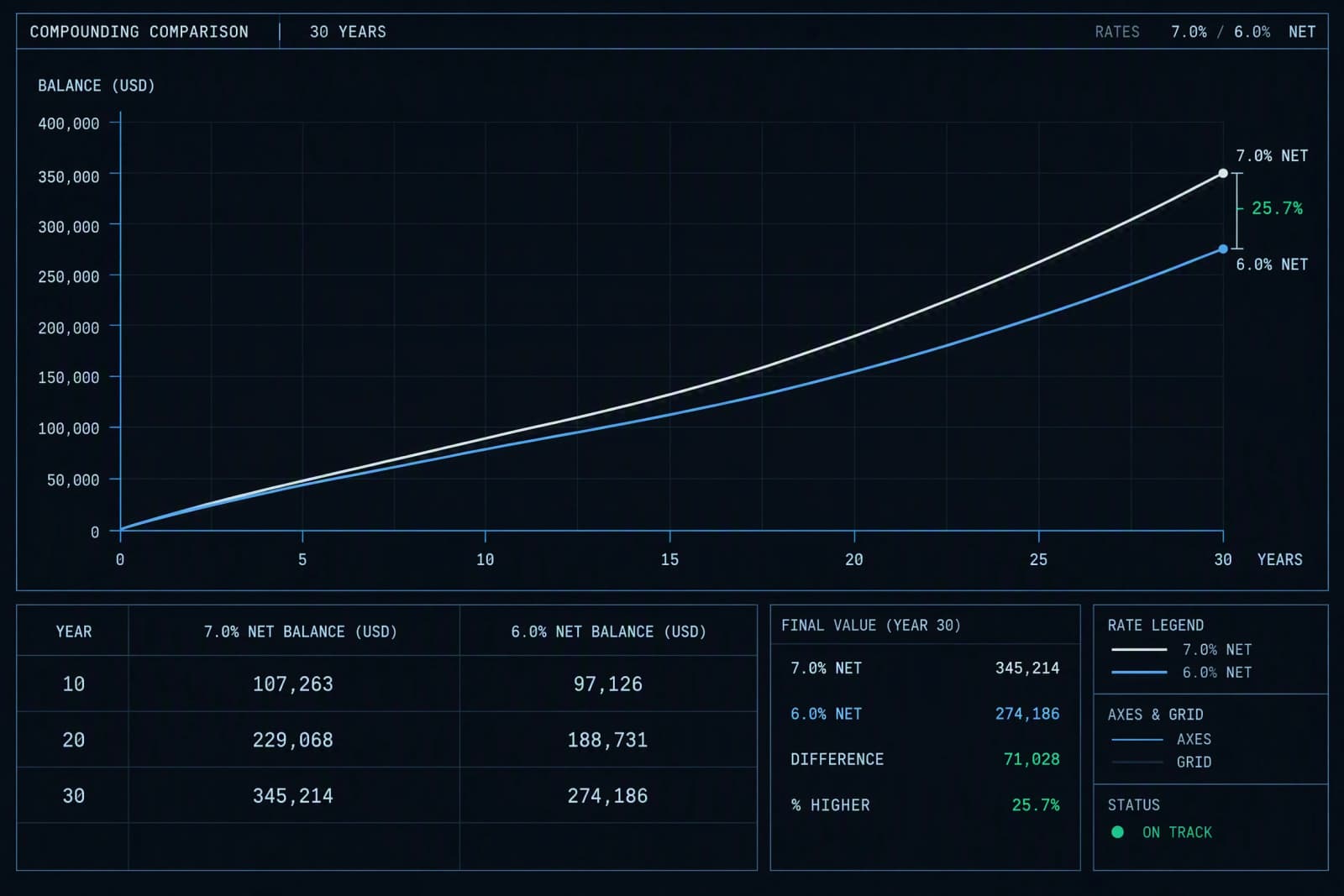
Fees are the part men ignore, and the arithmetic is brutal. Compare 7% a year with 6% after a 1% fee over thirty years: the first multiplies your money by about 7.6, the second by about 5.7. That one percentage point costs roughly a quarter of the final balance. The expense ratio is the annual percentage the fund charges you, and it is published.
Claim
Time in, not timing
Waiting for a better entry point is a forecast, and the previous decision about cash applies: the waiting has a price. The usual professional advice is to invest on a schedule regardless of the level, which removes the decision rather than improving it.
There is a second reason beyond humility. Money you will not need for twenty years can sit through a fall. Money you need in two years cannot, which is why the buffer came first. The horizon decides how much risk is appropriate, not your confidence.
Action
Find one fee
Take any investment account, pension or savings product you already hold. Find two numbers in its documents: the ongoing charge or expense ratio of the fund, and any separate platform or administration fee.
Add them. Then apply the arithmetic above to your own balance: multiply the balance by the total percentage to see what you pay this year in currency. Most men have never looked. Some find 0.1% and some find 2.4%, and the difference over a career is not marginal. Write both numbers on your day 1 page.
Example
Marcus started investing in October, put in 900 a month, and by the following March his account was down about 14%. He asked me whether he should stop the transfer until it recovered.
That question contains a forecast and he had not noticed. Stopping until recovery means buying only at higher prices, which is the opposite of what he thought he was doing. He kept the transfer. Eleven months later the balance was above where he started, and the units he bought in the bad months were the cheapest he has ever bought. He still describes that March as the worst part of the whole exercise, which is the honest version: the mechanism works and it does not feel good while it is working.
Caution
Index does not mean safe
A broad index fund removes company-specific risk. It does not remove market risk, and it never claimed to. Broad markets have fallen by a third and taken years to recover, more than once.
So the phrase "low risk index fund" is wrong in a way that hurts people: they hold it for eighteen months, watch a 25% fall, sell, and conclude the whole idea is a scam. If a 30% fall in your invested money would force you to sell, you are holding too much of it, and the answer is a bigger buffer or a smaller position, not a cleverer fund.
Aside
The honest case against passive investing
Two real objections. The first is that index weighting by company size means you automatically own more of whatever has already risen, which in some decades concentrates a "diversified" fund in a handful of very large firms. Check what proportion of any index sits in its top ten holdings before calling it diversified.
The second is that the past returns everyone quotes come mostly from one country in one unusually good century. Nobody can promise you the next thirty years look like the last ninety. This is why I have described a mechanism and its price rather than a recommendation: the mechanism is sound, the historical number is a hope with a wide error bar, and anyone quoting it to two decimal places is selling.