Claim
Not drinking needs no explanation to anyone
State this plainly before any evidence. A man who does not drink owes nobody a reason, and the correct response to being asked why is a short sentence and a change of subject.
The reasons people have are various and private: health, medication, sport, religion, a family history, an ex-problem, or simply not liking it. None of them is anyone else's business, and a room that requires a justification is a room with a problem. If you are the one asking, stop asking. Day 6 covers both sides of this in practice.
Evidence
The protection claim did not survive correction
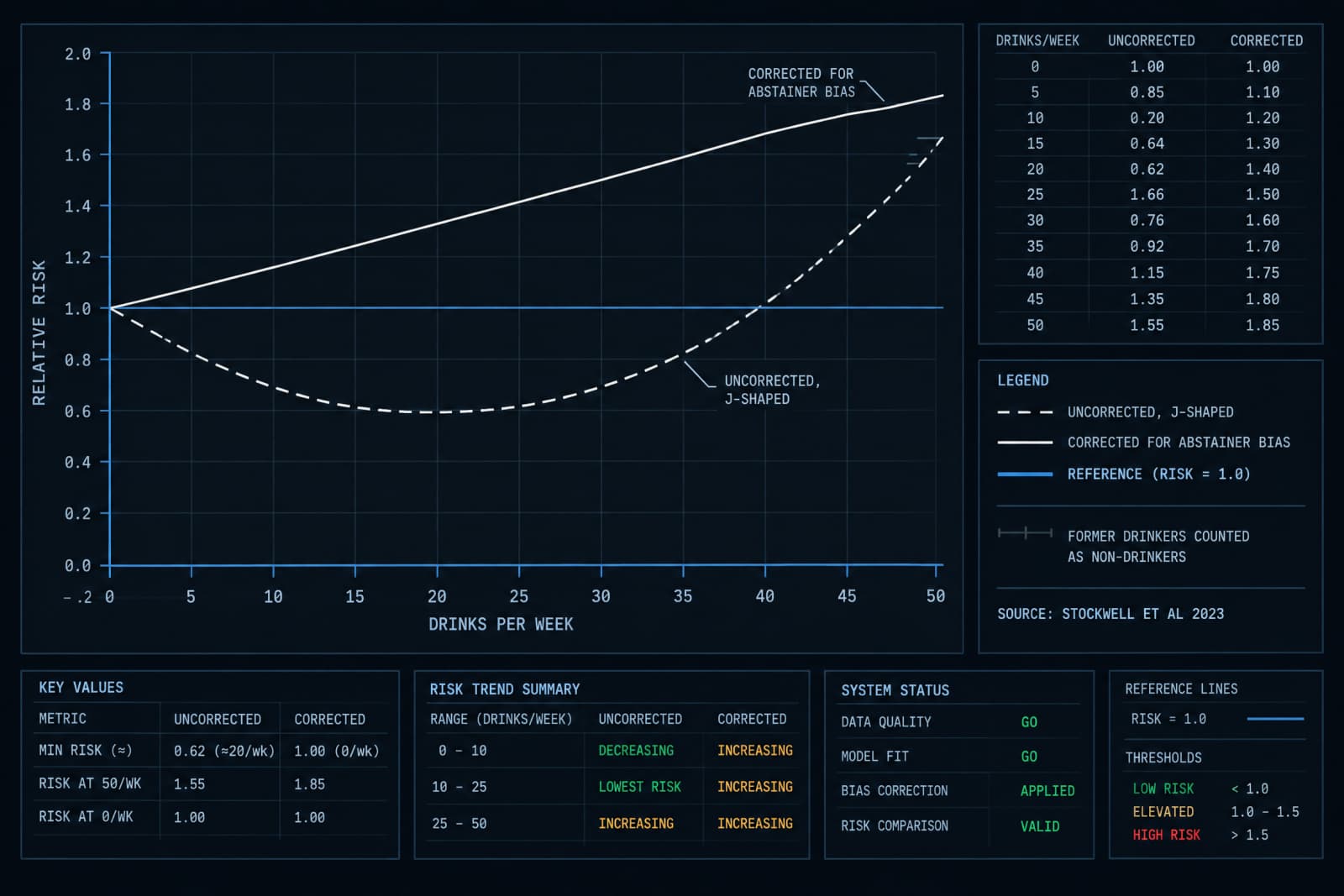
For thirty years the standard line was that light drinking protected the heart, based on studies showing a J-shaped curve where light drinkers looked healthier than abstainers.
That curve had a known flaw: the non-drinking comparison group contained former drinkers, including people who had stopped because they were ill. In 2023 Jinhui Zhao, Tim Stockwell and colleagues published a meta-analysis in JAMA Network Open covering 107 studies and around 4.8 million people, and once the analysis was restricted to people followed from a younger age with former drinkers properly separated, the apparent protection at low doses disappeared. The remaining risk curve rises from zero rather than dipping.
Evidence
Where the official guidance now sits
Two anchors. Alcohol has been classified as a Group 1 carcinogen by the International Agency for Research on Cancer since 1988, the same category as tobacco and asbestos, and in January 2023 the World Health Organization stated there is no safe level of alcohol consumption with respect to cancer risk.
In the same month, Canada published new guidance built as a risk continuum rather than a limit: low risk at one or two standard drinks a week, increasing risk from three to six, and substantial risk above that. Other countries still publish higher weekly figures. The direction of revision, everywhere, has been downward.
Claim
The costs you will actually feel are nearer than cancer
Population risk is abstract at 34. The effects you can verify yourself inside a month are sleep, training and mood.
Sleep from day 1. Training from the same block. Mood is the one men least connect: alcohol is a depressant, and the day after a heavy evening reliably produces low mood and anxiety that most people attribute to whatever else is happening in their life. If you want one experiment worth running, take four weeks off and watch those three variables rather than your weight. It is a cleaner piece of evidence about your own body than any meta-analysis.
One exception, stated before the instruction rather than after it. If you drink every day, or if you have ever felt shaky, sweaty or sick the morning after stopping, do not stop abruptly on your own. Withdrawal from physical dependence can be medically serious, including seizures, and it is managed safely and routinely with medical help. Talk to a doctor first. Day 7 covers this again at the point where it matters most.
Action
Write your own position down
One paragraph, dated. What you are choosing: not drinking at all, drinking on specific occasions only, or a weekly number you have picked with the evidence above in front of you.
Then one sentence on why, for yourself rather than for anyone else. This is not a pledge and nobody is going to hold you to it. It exists because a decision you have written down is much harder to drift away from than one you assume you are making, and because when someone asks you at a wedding you will already know your own answer.
Caution
Two ways men get this wrong
The first is deciding to moderate without ever naming a number, which in practice means no change at all. Moderation without a figure is a mood.
The second is the all or nothing swing: three weeks of nothing, one heavy night, and a conclusion that willpower has failed. One night is a data point rather than a verdict, and treating it as a verdict is what turns a normal lapse into a reason to stop trying. Write the number, miss it, write it again. The men who end up where they wanted are the ones who kept the page rather than the ones who never missed.
Aside
The honest argument on the other side
The strongest case against everything above is that risk is not the only axis a life is measured on. The absolute risk increase at one or two drinks a week is small, the social and cultural value is real for many people, and a man who eliminates every small pleasure with a hazard ratio attached has optimized his way into a narrower life.
There is also a fairness point. The same evidence base that produced the corrected curve is drawn from observational studies with all their limits, and the confidence intervals at low intake are wide. What I would not concede is the reverse claim: nobody can now tell you that drinking a little is good for you. The choice is between a small cost you accept knowingly and none, and it is genuinely yours.