Claim
Every drink is the same drug at a different dilution
Beer, wine, whisky and everything else deliver one active compound: ethanol. The differences in flavor are real and the differences in effect are almost entirely a matter of how much ethanol arrives and how fast.
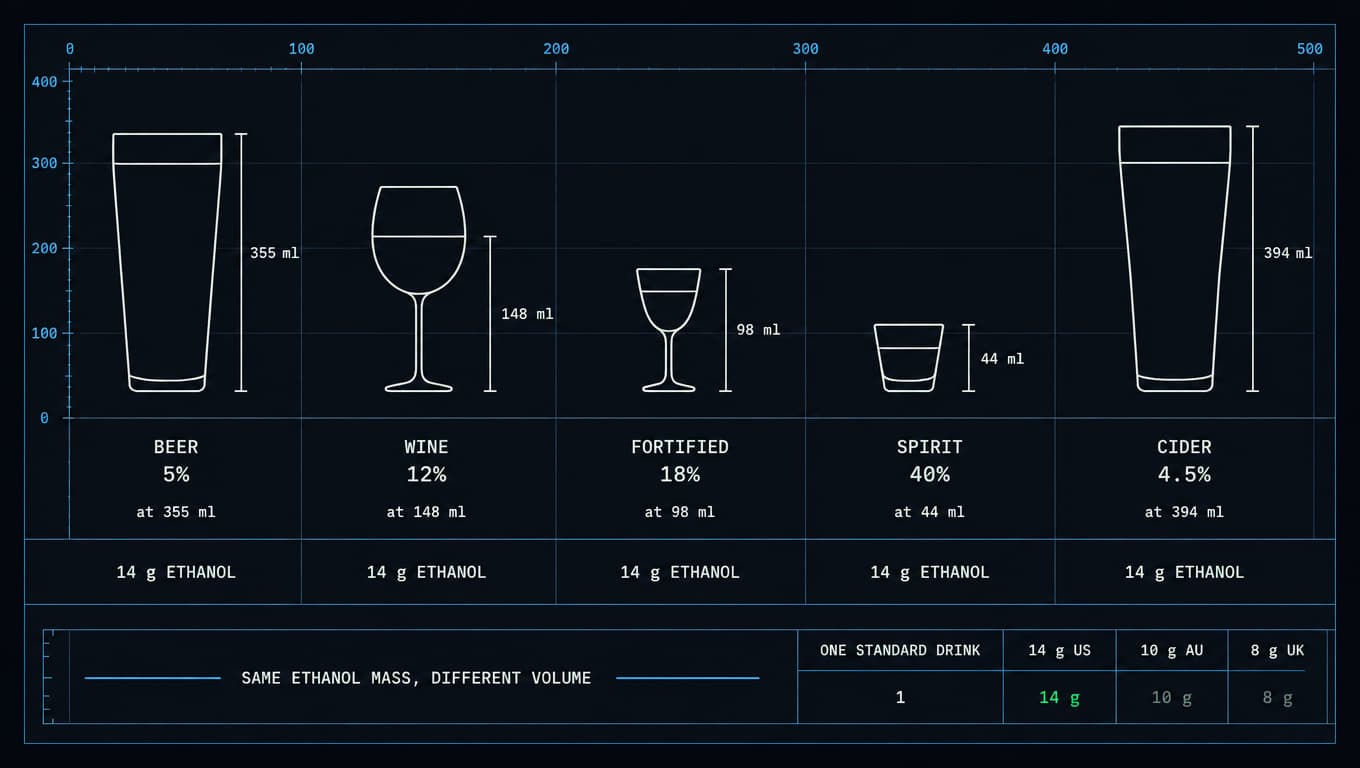
That is why the standard drink exists as a unit. A standard drink is a fixed mass of pure ethanol, and the definition varies by country: about 14 grams in the United States, 10 in Australia, 8 in a United Kingdom unit. A small glass of wine, a bottle of beer and a single measure of spirits are engineered to land near the same figure, which is the only reason they are treated as equivalent.
Evidence
Clearance is a fixed rate, and nothing speeds it up
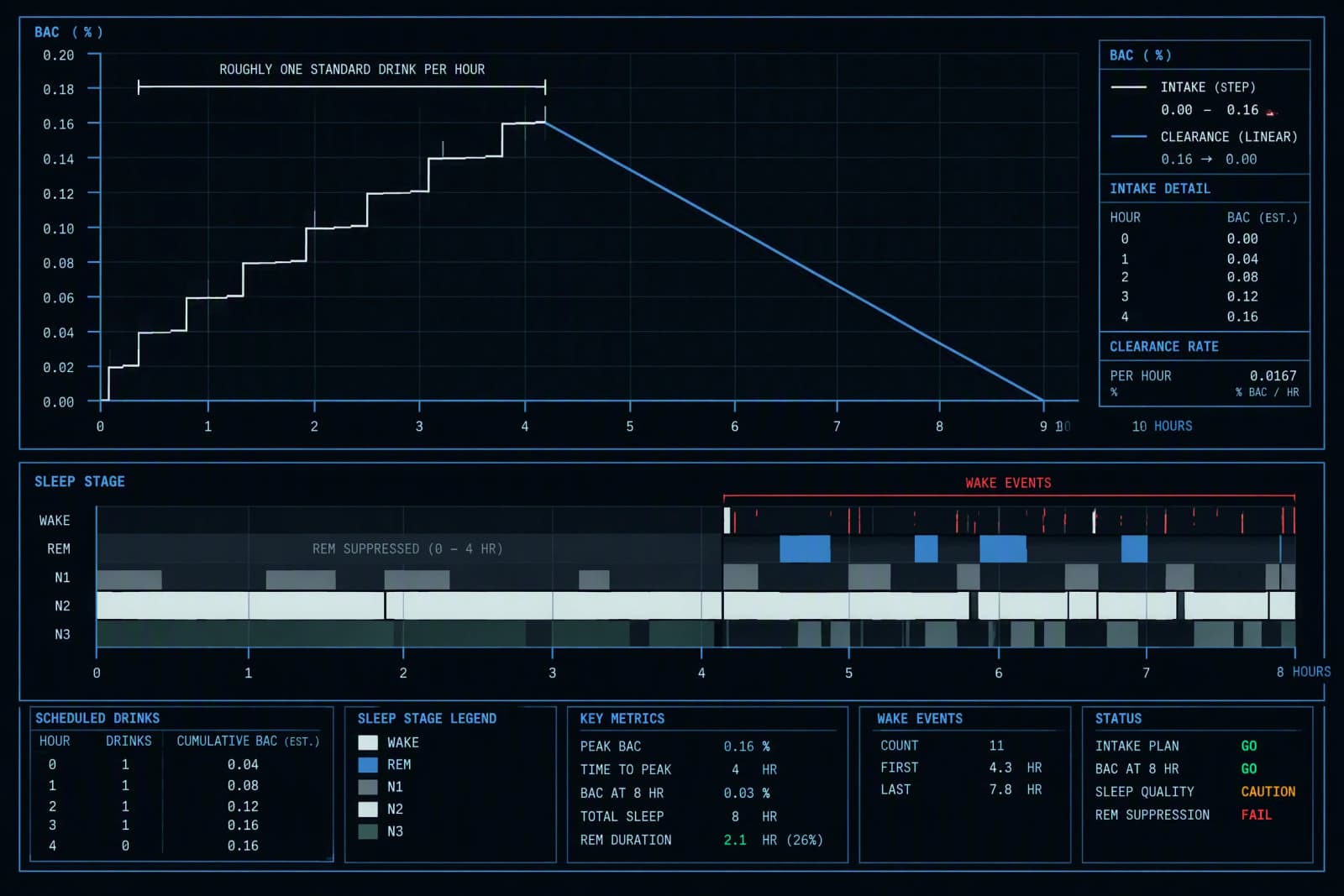
Your liver oxidises ethanol at a roughly constant rate, around one standard drink an hour for most adults, using enzymes that are already working at capacity. Once intake exceeds that rate, the surplus circulates until the liver gets to it.
This is the mechanism behind the only hard fact in this course: coffee, a cold shower, food, exercise and sleep do not accelerate clearance. Coffee makes a drunk man an awake drunk man. The number of hours is the number of hours, which is what makes any arithmetic about driving or working the next morning straightforward rather than a matter of how you feel.
Evidence
What it does to sleep, which is the cost men notice least
Alcohol shortens the time it takes to fall asleep, which is why it has a reputation as a sleep aid, and then degrades the rest of the night. It suppresses rapid eye movement sleep in the first half, and as it clears, the second half becomes fragmented with more waking and lighter stages.
The result is a full night in bed that does not restore you, and the effect appears at ordinary social doses rather than only at heavy ones. If you train, this compounds: work including a 2014 study by Parr and colleagues in PLOS ONE found that alcohol after exercise blunted the muscle protein synthesis response. You did not lose the session. You lost part of the adaptation you trained for.
Claim
Judgment degrades before you can detect it
The first functions affected are the ones that would notice the problem: risk assessment, inhibition, and the ability to hold a plan against an impulse. Coordination and speech go later, which is why they are useless as a gauge.
So self-assessment at two drinks is not evidence. The instrument doing the assessing is the instrument that is impaired. This is not a moral point, it is why every serious decision rule about alcohol is set in advance and in units rather than in the moment and by feel, which is what day 7 is about.
Example
Nathan had worn a sleep tracker for two years and never looked at it against his calendar. One evening he sorted the nights by his own resting heart rate and compared them with the days he had been out.
Every night after two or more drinks showed the same shape: he fell asleep faster, his resting heart rate ran several beats higher until morning, and the second half of the night broke up. He had been blaming a bad mattress and a stressful quarter. Nothing in that finding required a study, and nothing about it was visible without the two datasets next to each other, which is why day 1 ends with an arithmetic task rather than an argument.
Action
Count last week in standard drinks
Find your own national standard drink or unit definition, then convert last week into that unit. The arithmetic: volume in milliliters multiplied by the alcohol percentage, divided by 100, multiplied by 0.789, gives grams of ethanol. Divide by your national figure.
A 500 milliliter beer at 5% is 19.7 grams, so about 1.4 US standard drinks or 2.5 UK units. Do the whole week. Most men are surprised in one direction or the other, and either result is worth having, because every remaining day of this course assumes you know your own number rather than your impression of it.
Aside
What the pharmacology does not settle
Nothing above tells you what to do. Ethanol is a toxin the body clears at a fixed rate, and people have used it socially in nearly every literate society for thousands of years, which means the calculation has never been purely medical.
A glass of wine with a meal you cooked for someone is a real thing with a real value, and a course that pretends otherwise would be lying to make a cleaner argument. What I would insist on is that the cost side be stated in numbers rather than waved at, which is what day 2 does. Then the trade is yours to make with the figures in front of you.