Evidence
Fermented or distilled
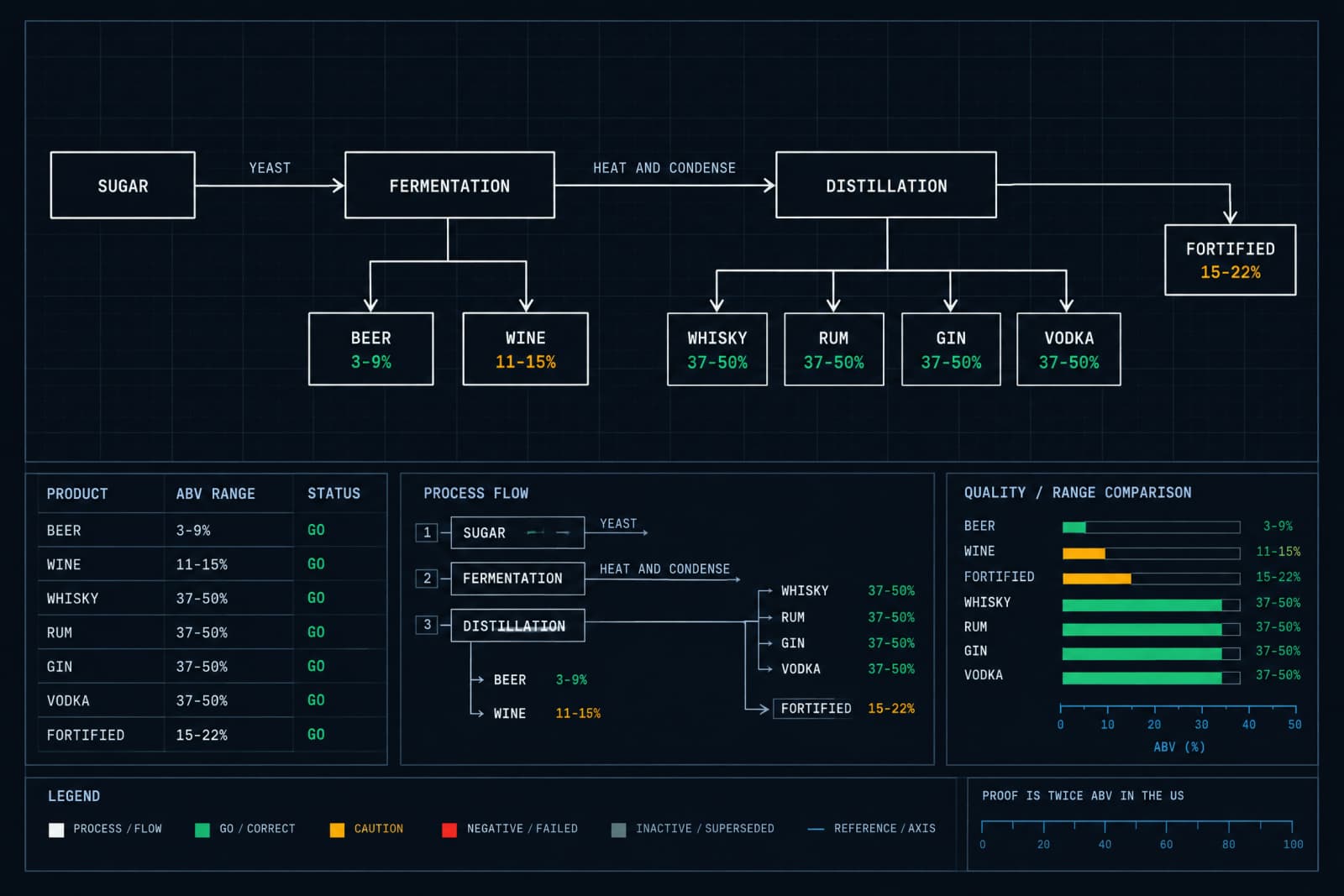
Yeast eats sugar and produces ethanol. That is fermentation, and it stops on its own at somewhere between 12 and 16% alcohol, because the yeast is killed by its own product. Everything made only by fermentation sits under that ceiling: beer from grain, wine from grapes, cider from apples, sake from rice.
Distillation is a second step. Heat a fermented liquid, collect the vapour, condense it, and you have separated ethanol from most of the water. That is how spirits reach 40% and above. Whisky, rum, gin, vodka, brandy and tequila differ in what was fermented first and what happened after, and they are all the same operation.
Claim
The ceiling explains the glass
Serving sizes are not tradition, they are arithmetic. If a wine is 13% and a whisky is 40%, then roughly three times as much wine delivers the same ethanol, which is exactly what the glasses are sized for.
Two terms while we are here. ABV means alcohol by volume, the percentage printed on every bottle. Proof, in the United States, is twice the ABV, so 80 proof is 40%. Fortified wines such as port and sherry sit between the two categories: fermented, then strengthened with added spirit, which is why they land around 18 to 20% and are served in smaller glasses.
Evidence
Where flavor actually comes from
Four sources cover almost everything. The raw material: which grape, which grain, which fruit. The fermentation itself, since different yeasts throw off different compounds, which is most of what distinguishes a Belgian beer from a lager.
Then wood. Time in a barrel adds vanilla and spice compounds and, in a used barrel, whatever was in it before. Then additions and aging: botanicals in gin, which is neutral spirit flavored with juniper and other plants, or years in a bottle for wine. When someone describes a whisky as tasting of dried fruit, they are usually describing a barrel rather than anything from the grain.
Claim
Price and quality are loosely related at best
Above a modest floor, price tracks scarcity, marketing, age statements and packaging more than it tracks what is in the glass. Blind tastings routinely fail to reproduce the price order, including with expert panels.
The practical version: the gap between a very cheap bottle and a mid-priced one is usually obvious, and the gap between mid and expensive is frequently not. Spend your attention on finding the category you like, which day 4 is about, and then buy near the bottom of the range within that category until you can reliably tell the difference in a blind comparison.
Action
Read three labels properly
Take three bottles, yours or in a shop, one fermented and one distilled at minimum. For each, write down the ABV, the raw material, and whether it says anything about wood or aging.
Then work out the standard drinks in the whole bottle using day 1 arithmetic. A 750 milliliter bottle of 13% wine holds about 77 grams of ethanol, which is five and a half US standard drinks. That figure is useful for exactly one reason: it converts the bottle from a unit of hospitality into a unit you can count, which is what makes day 7 possible.
Caution
Category confidence is the cheapest form of showing off
This day gives you enough vocabulary to sound informed, which is a trap. Nothing is less pleasant at a table than a man who has recently learned what ABV means.
The rule from the etiquette course applies exactly: knowledge is for reducing other people discomfort, not for ranking them. Use it to order something the table will enjoy, to help someone who does not know what to pick, or to keep quiet while someone enjoys a thing you would not have chosen. Nobody has ever been grateful for a lecture about barrels.
Aside
Non-alcoholic versions are now a real category
Worth saying in the day about kinds: dealcoholised beer and wine, and distilled non-alcoholic spirits, have improved enough in the last few years that they are no longer a joke, and the beers in particular are frequently indistinguishable in a pint glass.
Two honest caveats. Low or no alcohol wines are still weaker than the beers, because removing ethanol from wine takes away structure that is harder to replace. And some products are sweetened heavily to compensate, so read the sugar figure if that matters to you. If you are cutting down rather than stopping, this category is the single most useful development available to you, and it removes most of the social friction day 6 deals with.