Claim
Spend where construction is doing work
Money buys something real in a small number of categories: shoes, outerwear, knitwear, and anything that will be altered and kept. In those cases you are paying for materials and assembly that determine how long the thing lasts and how it holds its shape.
It buys much less in t-shirts, basic socks, anything in a trend cut, and anything whose appeal is a visible logo. A plain cotton t-shirt at ten times the price is not ten times better, and the fabric may be identical. The rule is not spend more, it is spend where the construction is visible in how the item behaves after a year.
Evidence
A shoe example you can inspect in a shop
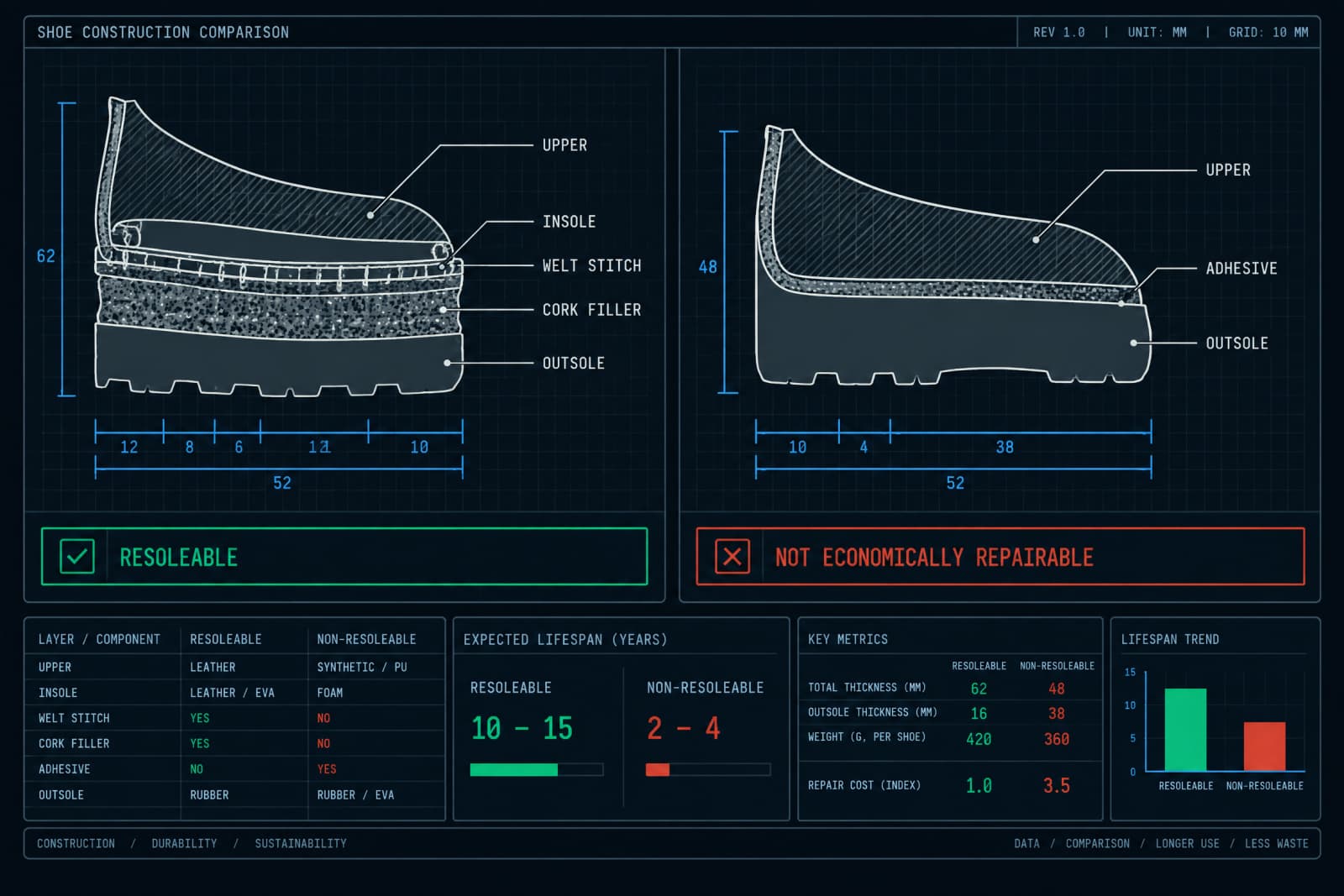
Turn any leather shoe over. If there is a line of stitching running around the edge of the sole, it is likely welted, meaning the upper and sole are sewn to a strip of leather, which allows a cobbler to replace the sole without rebuilding the shoe. If the sole is smooth to the upper with no stitch, it is cemented, meaning glued, and when that sole wears through the shoe is finished.
So one pair of welted shoes resoled twice can outlast four or five cemented pairs. Whether that is cheaper depends on the prices in front of you, and the point is that you can now compare them on a mechanism rather than on a brand.
Action
Do the cost per wear arithmetic
Take the most expensive garment you own and the cheapest thing you wear constantly. Estimate how many times you have worn each and divide the price by that number.
A 400 coat worn 200 times over four winters costs 2 a wear. A 60 shirt worn four times costs 15 a wear. This arithmetic is the only honest way to compare a cheap thing you do not wear with an expensive thing you wear daily, and it reliably embarrasses both the frugal man and the extravagant one. Run it on five items and write the numbers down, because they will change what you buy next more than any principle will.
Evidence
Two fabric myths worth killing
First, the Super number on wool, as in Super 120s, describes the fineness of the yarn, not the quality or durability of the cloth. Higher numbers mean finer fibers, which feel smoother and crease and wear out faster. For a suit you will wear weekly, a lower number is usually the better buy, and the marketing runs in the opposite direction.
Second, pilling is mostly about fiber length rather than price. Knitwear made from short staple fibers will pill whatever it cost. You cannot see staple length in a shop, so use the practical proxy: a tight, dense knit that springs back when stretched holds up better than a loose fluffy one that feels lovely for three weeks.
Example
Adrian spent 320 on a pair of welted boots after years of buying 70 pairs that lasted a winter each.
Four years in he has had them resoled once for 65, which is a total of 385 over roughly 600 wears, or about 65 pence a wear. His previous pattern was 70 a year with the shoes looking bad by February. He is careful to say the boots are not four times better to wear. They are about the same to wear, they look better after four years than the cheap ones did after four months, and the arithmetic came out in their favor only because he wears them almost every day in winter.
Caution
Buy it for life is a slogan with a survivorship problem
The stories you hear are about the coat that lasted twenty years. Nobody writes about the expensive jacket that was ruined in month three, went out of fit after the owner gained ten kilograms, or simply stopped being worn because he did not like it as much as he thought.
Three checks before any large purchase. Have you worn something like it at least fifty times in the past two years. Does it work with your base neutrals from day 3. Would you buy it at that price if the label were blank. If you cannot answer yes three times, wait a week, and notice how often the wanting evaporates.
Aside
Most of this assumes money you may not have
Cost per wear is sound arithmetic and it requires capital. If you cannot put 320 into boots, the advice to buy quality once is not useful, and repeating it is a class assumption dressed up as wisdom.
The version that works on a small budget is different and honest: buy fewer items, buy secondhand where the construction is visible in your hands, prioritize fit over everything since alterations cost little against the difference they make, and spend what you do have on the one or two categories you use every day. A well altered secondhand jacket with the shoulders right beats a new one with the shoulders wrong, at a fifth of the price, every time.