Claim
One break is one entry
You will miss one. The ledger will read broken on a row you cared about, and what follows is more dangerous than the miss.
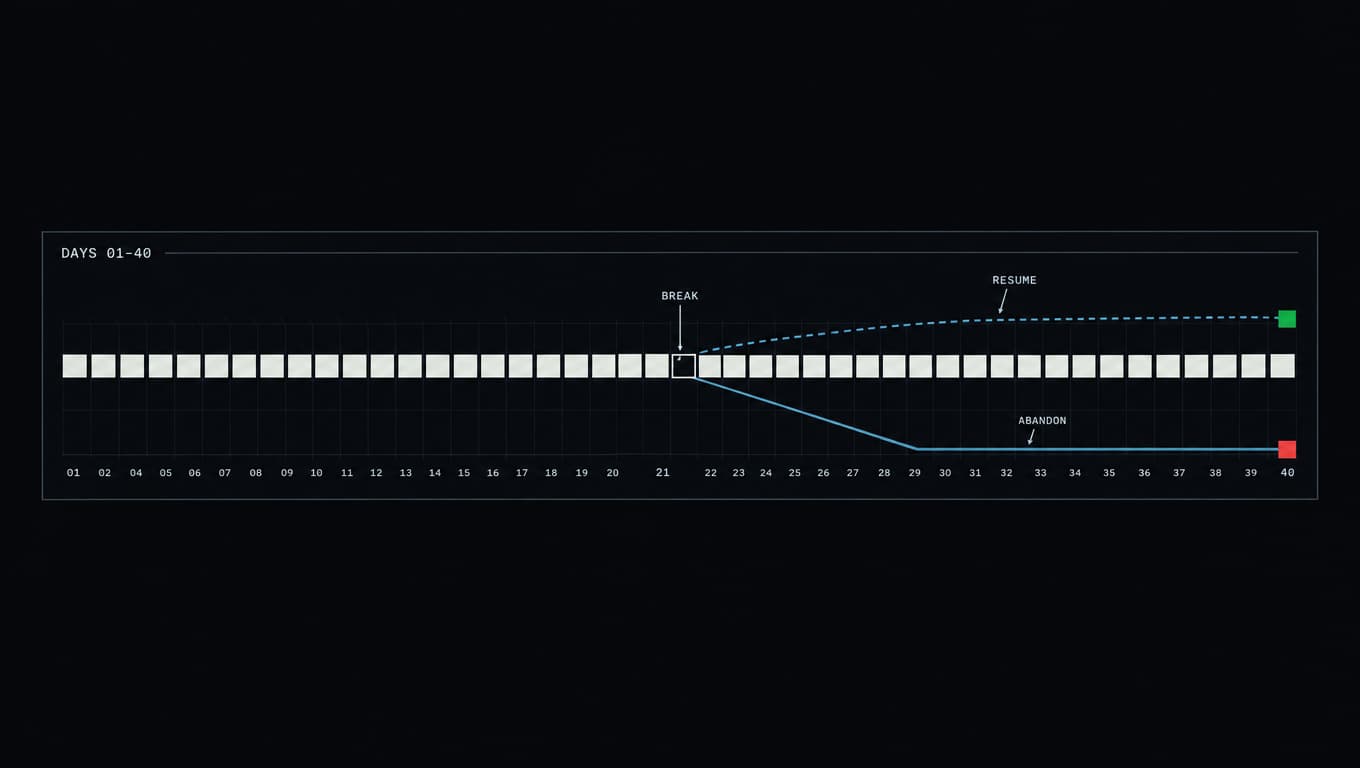
What follows, for most men, is not another miss. It is abandonment. The page stops being updated, the count freezes, and four days later the ledger is a document about a man who used to be doing something. The entry cost you one row. The abandonment cost you the instrument.
One break is one entry. The count is cumulative and the arithmetic is unmoved: twenty-nine kept and one broken is a ratio, not a verdict. Write the broken row down, on the day, with its one word of context, and update the count.
Evidence
The collapse after the lapse has a name
Alan Marlatt and Judith Gordon named this in their 1985 work on relapse prevention: the abstinence violation effect. A single lapse, read as proof that the whole attempt has failed, reliably produces a much larger collapse than the lapse itself would explain. The mechanism is the interpretation rather than the behavior. A man who reads one drink as 'I have broken it' drinks the rest.
Their field was addiction and the finding generalizes to anything kept as a streak, which is why streak apps produce a specific failure. They tell you the number is 41, then 0, and the 0 is a lie, because you did the thing forty-one times.
A count that only ever goes up cannot tell that lie. It is the main reason this ledger counts entries instead of consecutive days.
Action
The Sunday review
Fifteen minutes, once a week, same time.
- Read the counts first. Kept, partial, broken. Numbers before narrative.
- Any row that went partial or broken twice in a row gets resized by Day 3's test, or removed.
- Add no more than one new promise. A ledger growing faster than one row a week is a plan, not a record.
- Write one line about what the page says about the week. One line, and it has to be about what is on the page rather than how the week felt.
That last constraint is the discipline. You are reading the ledger, not the mood. The mood will attend anyway and it does not get a vote.
Example
Thirty-four, then nine days of nothing
Joon had thirty-four kept rows, then a broken one on a Tuesday, then nothing on the page for nine days.
When he came back he wrote the broken row in retrospectively, dated correctly, and marked the nine days as not logged rather than as broken. He was right to insist on the distinction: he had never promised to log daily, so nothing had been broken on those nine days.
The count went from thirty-four to thirty-four. That was the finding. He had spent nine days assuming he had lost a month, and what he had lost was one Tuesday.
Caution
When the review becomes the work
There is a version of this where the ledger becomes the activity. The page gets neat, the counts get read twice a week, the review takes forty minutes, and the promises get smaller so the ratio stays pretty.
The tell is the ratio. A page running at 95% kept over two months is not a well-run life, it is an under-committed one, and the man keeping it has optimized for a clean column. Somewhere between 70% and 85% is what a page looks like when the promises cost something.
The ledger is instrumentation. If you are maintaining the instrument more carefully than the thing it measures, cut the review to ten minutes and add a promise you might not keep.
Aside
The word "like", answered honestly
Respect and liking are different objects and this course has only built one of them. Respect is a record, so it is buildable, countable and in your hands. Liking yourself is not a record. It moves with sleep, with temperament, with who you spent Saturday with, and with things that happened to you long before you had any say in them.
So the ending is narrower than the title. You can have evidence of your own conduct, you can have it inside eight weeks, and it will hold on a bad morning because it is written down.
Whether you like yourself is partly outside this instrument. The two conditions that move it most are not in any ledger: the company you keep, and how much of your week goes into something you would defend to a stranger. That is the honest answer. A course that told you the ledger would make you like yourself would be selling.
Claim
What you have at the end of this
Seven days does not produce self-respect. It produces the apparatus: a page, three counts, a sizing test, a cross-examination procedure, and two kinds of entry.
What produces the thing is eight weeks of using it, which nobody can do for you and no instrument can verify. At the end of eight weeks you will have something you did not have on Day 1. Not a feeling about yourself. A document you can hand to your own worst morning and watch it lose the argument.
That is the whole claim of this course, and it is deliberately small. Small claims are the ones that survive being checked.