Claim
The sorting rule
You have five criteria now: your word, load, competence, self-command, expensive truth. Each one carries an observer, a record and a line. That is enough to sort the material you were handed.
Costume is behavior whose purpose is to be seen. It has a tell: remove the audience and it stops. Conduct does not care whether anybody is watching, because its payoff is structural, and the payoff is that somebody's plan holds.
So the test on any masculine trait you inherited is two questions. Does it produce a result somebody else can rely on, and does it survive with nobody watching. Most of the stereotypes hold one part that passes and one part that fails, which is why arguing about them as whole objects has been so unproductive for so long. Take them apart instead.
Evidence
The norms are not one block
Wong, Ho, Wang and Miller published a meta-analysis in the Journal of Counseling Psychology in 2017: 78 samples, roughly 19,400 participants, on conformity to masculine norms and mental health.
The finding that matters is that the norms behaved differently from one another. Self-reliance, playboy behavior and power over women tracked worse mental health, and self-reliance in particular tracked being less likely to seek help. Primacy of work showed essentially no relationship in either direction. Risk-taking and winning came out mixed and weak.
So the answer to whether masculinity is good or bad for men is that the question is built the same way Day 1's was. It is a bundle. Some items in it cost you, at least one is roughly neutral, and the numbers are an argument for sorting rather than for defending or discarding the whole.
Note what none of it tests: whether you are one.
Claim
The sort, done
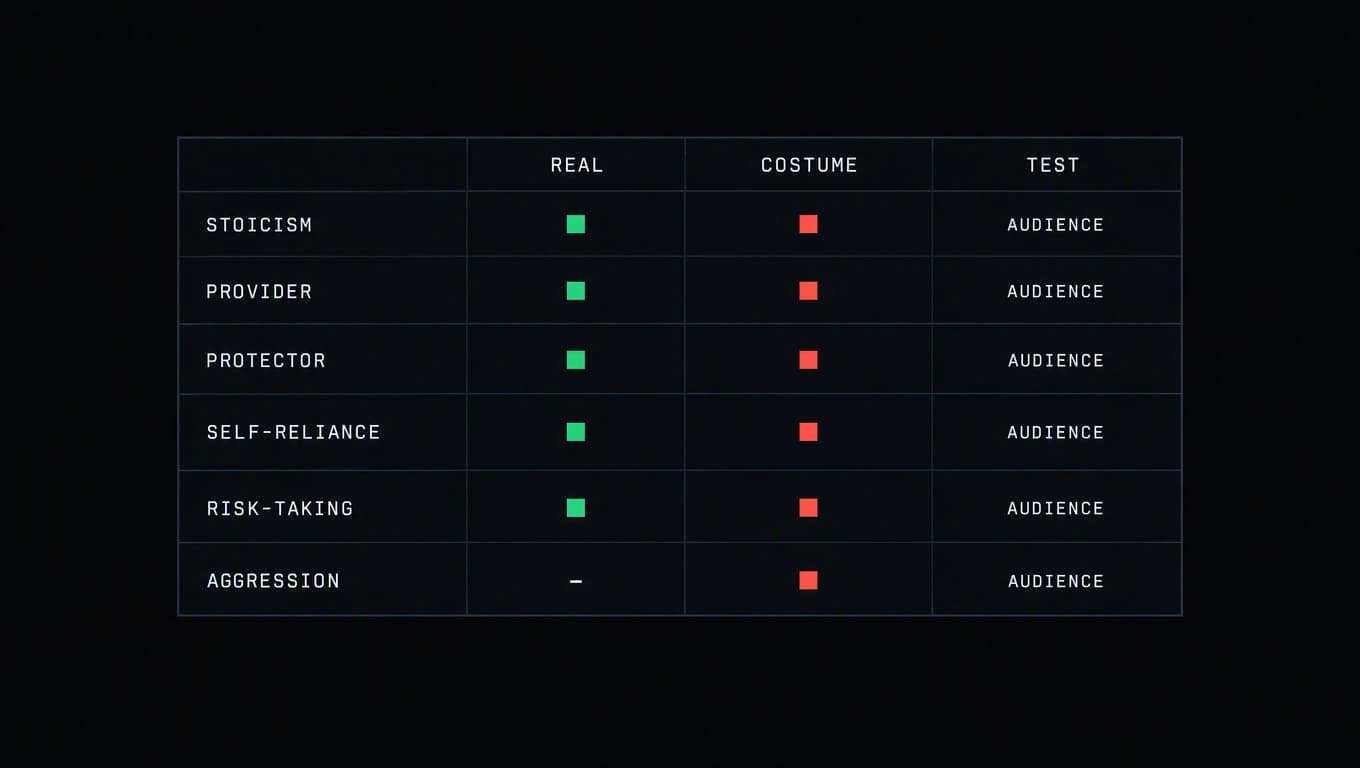
Run the two questions over the inventory.
- Stoicism. Real: a steady face so the people depending on you can work. Costume: telling nobody anything, which Day 5 priced.
- Provider. Real: a load with a name and a date on it, as on Day 3. Costume: income as identity, so a pay cut becomes a crisis about what you are.
- Protector. Real: standing between somebody and a cost you can absorb and they cannot. Costume: scanning for threats, because readiness with no threat is theater.
- Self-reliance. Real: not making your problems somebody else's default. Costume: refusing help you need, the most expensive item on this list.
- Risk-taking. Real: risks you have priced, with the premortem written down. Costume: risks taken in front of people.
- Aggression. Real: nothing. It is not one of the five criteria and never was.
Twelve halves, and one pattern across all of them: the costume half needs an audience.
Caution
Two ways the sort goes wrong
The first is declaring everything costume. It is the easier move, it feels clear-eyed, and it leaves a man with no obligations. If your sort produced six costumes and nothing real, you did not sort. You ran an argument you had already won.
The second is the reverse and more expensive. A man decides provision is costume because income as identity is a trap, then uses that to stop being load-bearing for a household that eats on his income. The identity half is costume. The mortgage is not. The people who pay for that confusion are not in the room when you make it.
Watch for a third: using the word costume about other men. The sort is for your own inventory. Run it on somebody else and you have invented one more way to rank people, which is the oldest costume here.
Aside
The objection this course cannot fully answer
Seven days of criteria is still a prescription. You were asked not to impose stereotypes and you have handed over five things a man must do, with a scoring page attached. More modest than the checklists, and the same kind of object.
Partly fair, and the honest reply is a narrowing rather than a defense.
What separates a criterion from a prescription is that it can be failed in public, which flattery cannot. It says nothing about what to want, who to be with, or what to earn. And it applies to anybody, so it cannot sort people into men and not-men, which is the job a stereotype exists to do.
What remains is that this course picked which five, and that choice is arguable. If your conclusion is that the word masculinity was doing no work here and these are simply conduct, you have lost nothing, and there is no rebuttal worth inventing.
Example
Dele and the contract he turned down
Dele is fifty-one. He ran the sort in May and then stalled for most of an hour on one line: what he would take a real loss to protect.
His first answers were the ones anybody writes: family, integrity, his children's future. None of them survived the follow-up, which was what loss he had actually taken for it in the last three years, with a date on it.
The answer he eventually wrote had a number in it. In 2024 he turned down a contract worth about a fifth of his annual revenue, because taking it meant moving the family in the middle of his daughter's last school year. He had never described that to anybody as a decision. He had filed it as a thing that did not happen.
That is what the criterion looks like when it is real. Not a value. A dated loss, on the record, that you would take again.
Action
What you are for, and the standing review
Write the sentence: the thing you would take a real loss to protect. Underneath it, the last loss you actually took for it, with a date and a number. If that second line is empty, the first one is a preference, and you can either accept that or start collecting evidence this month.
Then set the review. Ten minutes, once a week, same slot, five lines.
- Promises made, promises kept.
- Loads carried, loads dropped, and who was told.
- One rep on the competence, or none.
- The longest interval I held this week, and the shortest.
- One expensive true sentence, or none.
Read the numbers. Do not score yourself out of ten and do not write a paragraph about how the week felt. The record is the point. The feeling is what you arrived with on Day 1, and you now have something better to read.