Claim
Latency, not suppression
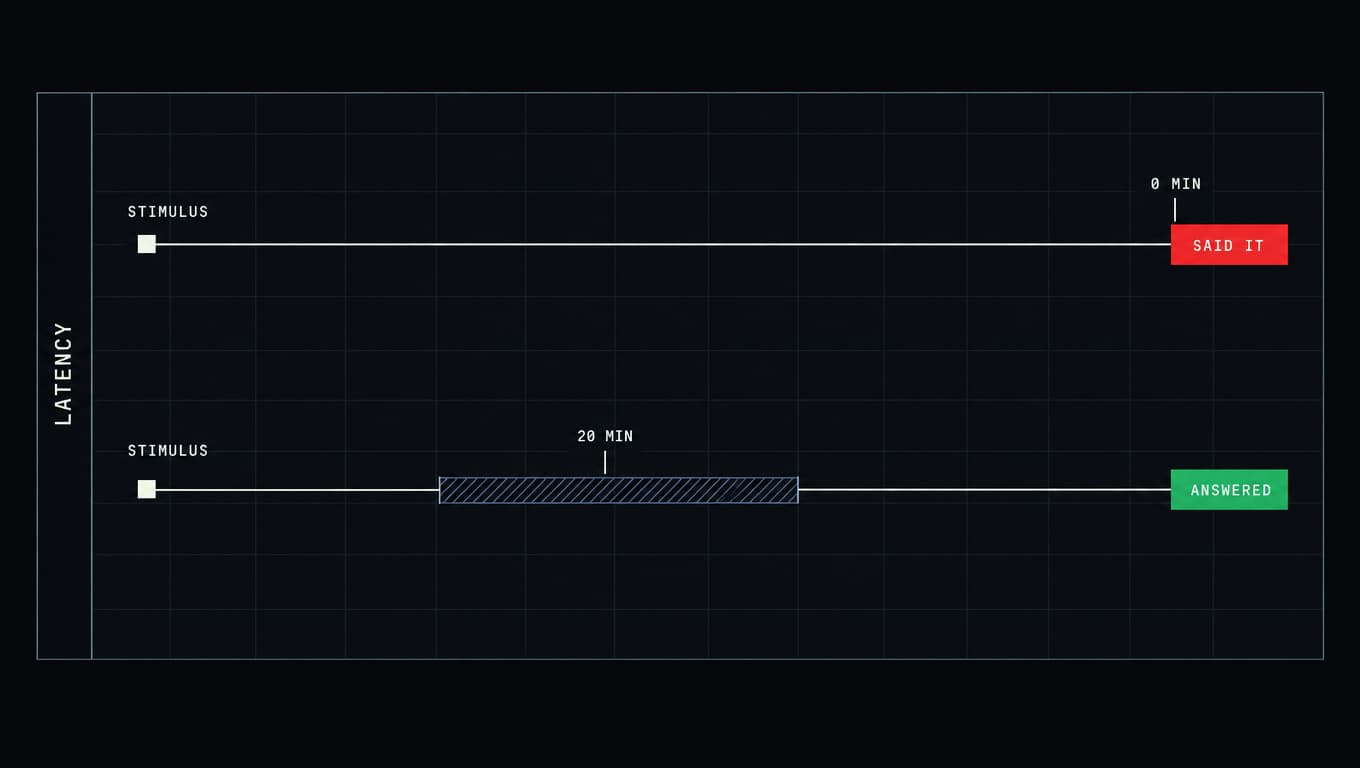
Self-command is the interval between what you feel and what you do. That is all it is. Not the absence of the feeling, not the size of it. The gap.
Two men get the same email at 4:50 on a Friday and both feel the same jolt. The first replies at 4:51. The second replies at 9:15 on Monday, having felt exactly as much. Nothing separates them except the interval.
Define it that way and the criterion becomes operable. The feeling arrives without your permission and you cannot argue it down. The next action is yours, and everything between the two is the part you can lengthen. Ordinary advice attacks the wrong variable: be calmer, which is an instruction about something you do not control, delivered at the worst available moment. The interval responds to mechanisms, and mechanisms work whether or not you are calm.
Which also tells you what to stop trying to fix. You will not stop feeling the jolt, and aiming there fails weekly and then reads back as weak discipline. Aim at the interval.
Evidence
Above about a hundred beats you are not in the conversation
John Gottman's lab measured heart rate while couples argued and named a threshold: diffuse physiological arousal, around 100 beats per minute in a reasonably fit adult and lower in an unfit one. Past it, hearing degrades first: you stop taking in what is being said and start assembling your next sentence. Then access to what you know about the person goes, which is why men say things at minute twelve they could not have generated at minute two.
Recovery is not quick. Bringing that arousal down takes roughly twenty minutes, and not at all if you spend the twenty minutes rehearsing the argument. So the break is not a courtesy or a de-escalation trick. It is a specification.
One caution, because the number is easy to over-read. It is a population finding recorded in a lab, not a dial on your wrist. Use it as a threshold you learn to feel, not a figure you check mid-argument or quote at anybody. A man watching his pulse during a fight has found a new way to be somewhere else.
Aside
The study you were about to quote at me
Everybody knows the marshmallow test. The children who waited for the second marshmallow did better decades later. That is the self-control literature and it is settled.
It is not. Watts, Duckworth and Quan re-ran it in 2018 on a much larger and more varied sample. The association survived, but at roughly half the size, and most of what remained was accounted for by family background and early cognitive ability rather than by willpower. A four-year-old's wait time partly measures whether food had reliably turned up in his life so far.
This does not make delay worthless. It makes delay something other than a fixed quantity you were issued at four and have been spending down since. Treat it as a skill with mechanisms attached, because the trait reading hands a man who scores badly a reason to stop. Every mechanism in this day is available to someone who would have eaten the marshmallow in nine seconds.
Caution
Command is not silence
The usual corruption of this criterion is that a man reads self-command and installs suppression. He stops reporting. He runs a flat face through a hard year, tells nobody, and calls the result discipline.
That is not command, it is loss of instrument. Emotion is information about stakes. Fear tells you what the cost is, anger tells you a line got crossed, dread tells you what you have not dealt with. A man who feels nothing knows nothing about his own situation and decides worse, not better. Day 7 has the numbers on what that particular norm costs.
The second corruption is the break rule with no return. You say you need twenty minutes, then you need them for three days. A break with no stated return time is a walkout wearing the technique as a coat. Name the time before you leave the room: twenty minutes, I will be back at nine forty.
Action
The three levers and one sentence
The levers first, because they set the size of the gap available before any technique applies. Sleep under about six hours narrows it. Alcohol removes it for the evening and part of the next day. A week with no training narrows it in a way most men only notice afterwards. None of that is a moral point. It is the same jolt arriving with less room around it.
Now the sentence. Write the exact words you will use when you notice you are over the threshold, and put a time in them. Say them out loud once, alone, so the first time you use them is not the first time you have heard yourself say them.
Tonight, log one instance: what happened, what you felt, how long the interval was, what you did. One line. The interval is the only part that matters.
Seven lines by the end of the week is a baseline. You will see the levers in it before you see any progress.