Claim
Leave when it drops, not when it peaks
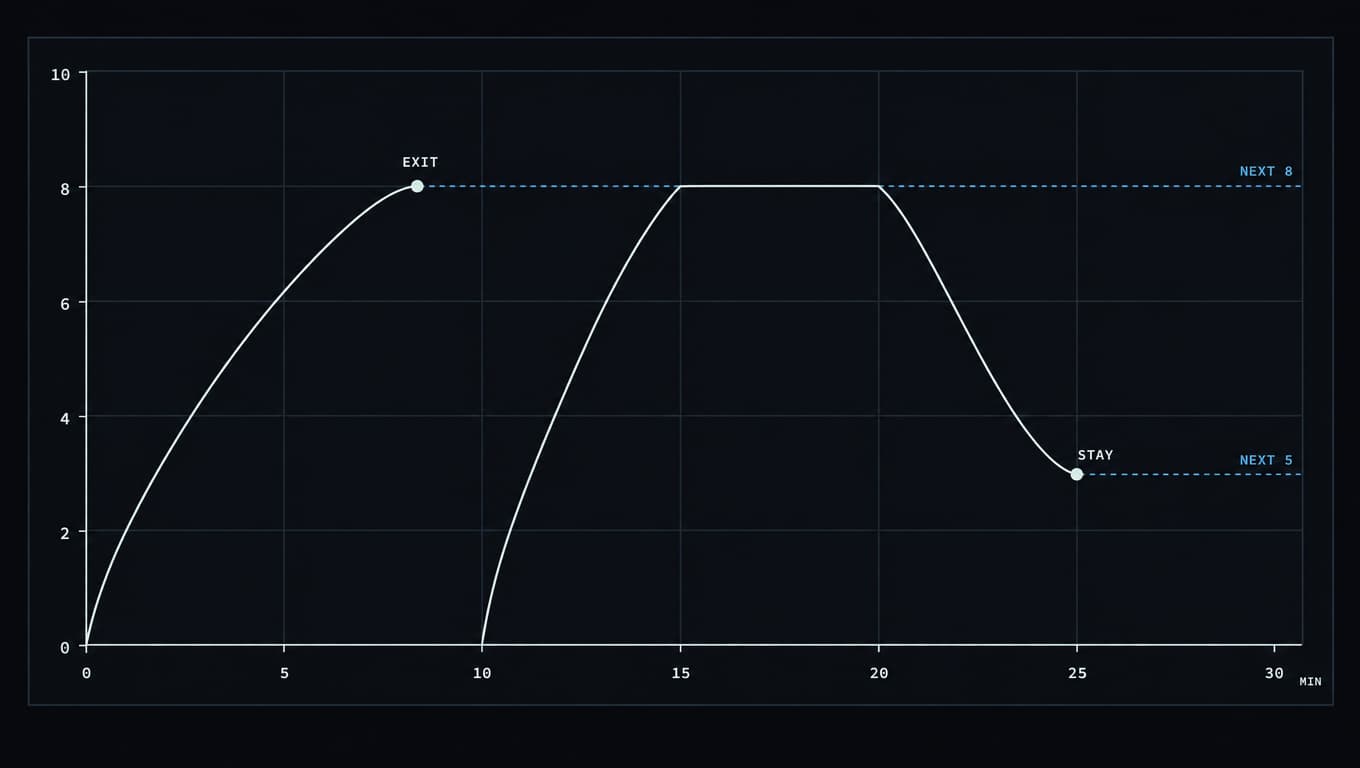
The most common way a self-run exposure goes wrong: he does the hard thing, the distress climbs, it becomes unbearable, he leaves, and he counts it as progress because he went.
He did go. He also delivered relief at the peak, which teaches precisely what escaping taught before. It was getting worse, and leaving fixed it.
The rule is to stay until the number has come down from its peak, then a little longer. Not until it reaches zero. Until it has clearly fallen. An 8 that becomes a 5 is enough, and it usually takes far less time than men expect.
Evidence
Two models, and they disagree
Foa and Kozak (1986) built the standard account. You stay in the situation, distress habituates within the session, and the baseline you start from next time is lower. Time in the situation is the active ingredient.
Craske and colleagues (2014) argued the habituation is largely beside the point. On their inhibitory-learning account, what makes exposure work is expectancy violation: you predicted something specific, it did not happen, and the new association competes with the old one. Whether you felt calmer by the end is a poor predictor of whether the fear moves.
The disagreement is not academic and it changes what you record. Under the first model you log a distress curve. Under the second you log a prediction and an outcome, and a session where you stayed frightened throughout but watched your prediction fail is a success. Log both. It costs one extra line.
Action
The session protocol
Before: write the prediction and the number you expect, out of 10.
During: stay. No checking your phone, no narrating it to a friend by text. You are there to collect one piece of information, and looking away is how men come home with none.
At the peak: write the number down. Keep going.
Once it has fallen: write the new number, how long it took, and one line comparing what happened with what you predicted.
Cap the session at 45 minutes whatever happens. If the number has not moved by then, stop, write that down, and step down a rung.
Then repeat the same rung, ideally inside three days. One rung done four times beats four rungs done once, and it is not close. Repetition is where the new association gets strong enough to compete with the old one under pressure.
Caution
The stop criterion this needs
"Stay until it drops" turns into dangerous advice if you leave out the cap, so here it is. A solo session gets 45 minutes. If the number has not moved at all in that time, you end it, write it down, and step down a rung.
White-knuckling for two hours in a situation that is not shifting is not discipline. It is an escalation, and it tends to produce a man who never goes back.
Two other endings count as done rather than as failure. Continuing stopped being possible for a practical reason. Or your body did something you were not expecting and could not settle, in which case the session is over and the question of whether to continue any of this goes to a professional.
Example
Arjun left the same voicemail four times
Arjun's rung was leaving a voicemail for a client, on a ladder built around calls.
Session one, 6 April. Predicted 7, peaked at 8 within twenty seconds of the tone, hung up mid-sentence at the peak. He logged it as done. It was not.
Session two, 8 April. Predicted 8, peaked at 8, stayed on until the message was finished, fell to 5 by the time he put the phone down. Ninety seconds in total.
Sessions three and four, 9 and 13 April. Peaked at 6, then at 4. His note on the fourth reads: "Prediction was that I'd freeze and they'd hear it. I did pause for about two seconds. Nobody has mentioned it."
Four sessions, four minutes of accumulated discomfort, one prediction that failed on the record three times running.
Aside
We are less sure about this than the confident version implies
The habituation model dominated clinical practice for two decades, and then the mechanism underneath it was substantially revised by people inside the same field. Craske's own summary is that within-session reduction is neither necessary nor sufficient for long-term improvement.
That should change how much weight you put on the instruction and how much you put on your own log. What survives both models is narrow: approach rather than avoid, stay long enough for something to be disconfirmed, repeat it, write down what you predicted.
Anything more specific than that, including the exact minutes and the exact shape of the curve, is a detail the field has already changed its mind about once.