Evidence
Why cutlery runs outside in
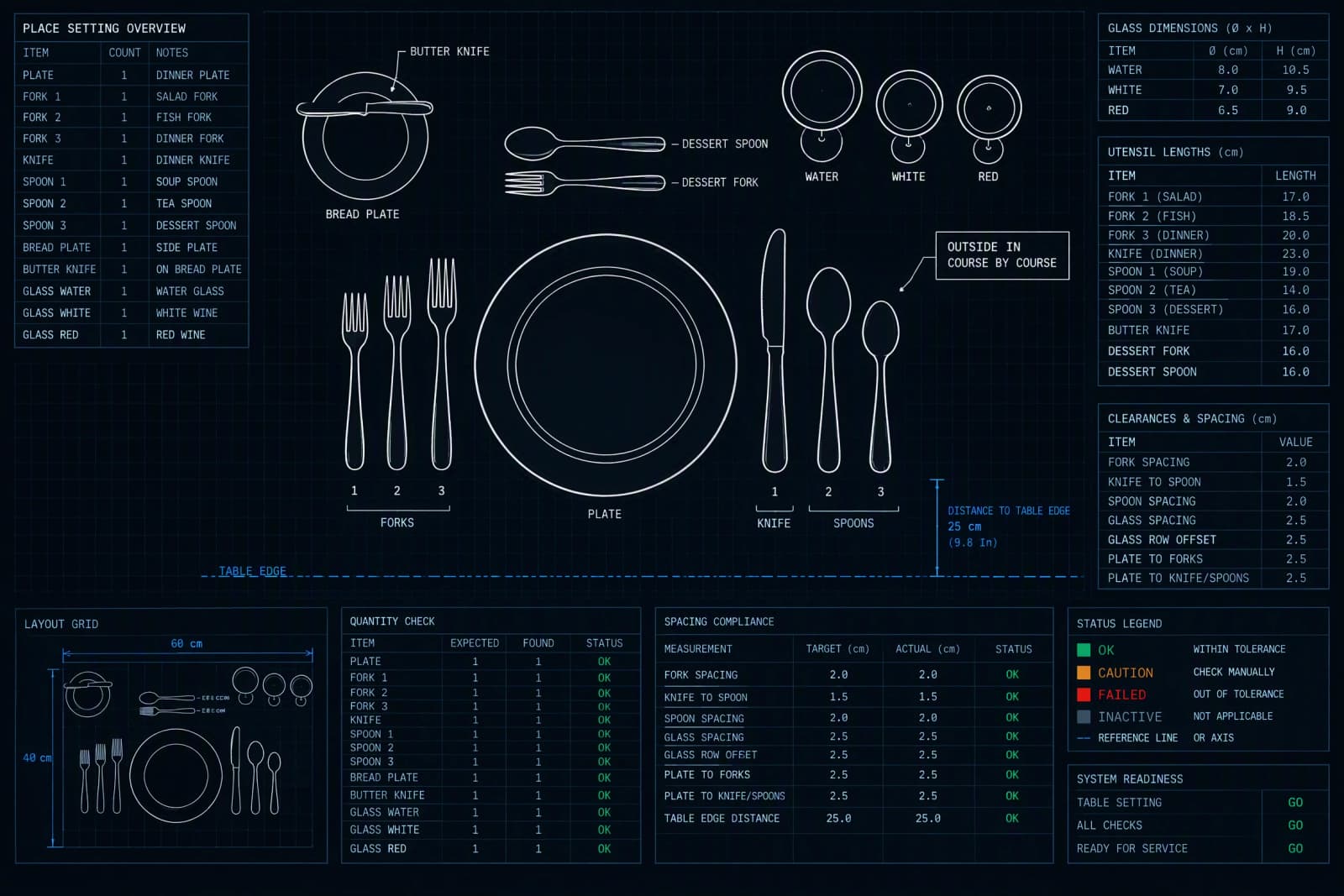
A formal place setting is not a code. It is an instruction sheet. Utensils are laid in the order the courses arrive, so you work from the outside toward the plate and never have to decide anything.
That single fact solves the question men are most afraid of. Glasses follow the same logic, arranged for the order of service, with water nearest. The bread plate is on your left, which is the source of the old trick about your left hand making a b and your right making a d: bread left, drink right.
Claim
The three rules that matter more than cutlery
Match the pace of the table, so nobody is left eating alone or waiting for you. Keep your phone off the table and out of your hands, because a visible phone announces that something else may be more interesting. And wait until everyone is served before you start, unless the host says otherwise.
Those three cover most real meals. Nobody at a normal dinner is auditing your grip on a fork. They will notice being watched while they finish alone, and they will notice the phone.
Action
Learn the two signals
Two positions worth knowing tonight. During the meal, if you pause, rest the knife and fork on the plate in an inverted V with the tips meeting, tines down. When you have finished, lay them together, parallel, across the plate at roughly four o clock.
That is it. In any restaurant with table service, those two positions tell the staff whether to clear, which saves them guessing and saves you being asked. Practice both once at home so your hands know them, because the point is that it becomes automatic and stops costing you attention. The whole reason to learn any of this is to free up the part of your mind that would otherwise be monitoring your own hands while someone is talking to you.
Claim
Hosting is a job with duties
If you are the host, the comfort of the table is your responsibility and nobody else's. Say where people should sit rather than making them negotiate. Start the eating, since everyone is waiting for you. Ask about allergies and what people do not drink before the day, not at the table.
And if something goes wrong, absorb it publicly. Burned food, a broken glass, a guest who says something awful: the host decides how much of a problem it becomes. Pour more wine for a man who breaks a glass and the evening continues. Make one comment about the glass and it does not.
Example
Kenneth took a client to a restaurant with a tasting menu and three glasses per person, which the client had clearly never encountered. Within a minute the client had picked up the wrong glass.
Kenneth picked up the same wrong glass and drank from it. Nothing was said. They spent the rest of the meal talking about the client's business. He told me later that the account was worth about 40,000 a year and he was not going to lose it over stemware, which is a sentence worth keeping: knowing the rule is worth very little next to knowing what the rule is for.
Caution
The traps that are actually noticed
A short list of things people genuinely register, none of which involve cutlery. Talking to staff in a tone you would not use with a guest, which is the single most watched behavior at any table. Reaching across someone instead of asking. Letting your own dietary preference become the subject. Ordering last and then changing it twice. Getting noticeably drunk at a meal where nobody else is.
How you treat waiters at dinner is the most reliable public information about you available in a single evening, and everyone present is collecting it whether or not they mean to.
Aside
Most of this only applies to one kind of meal
Everything above describes formal European and North American table service, which is one tradition among many and not the most common one on earth. In much of the world food is shared from communal dishes, eaten with the right hand or with chopsticks, and the rules are entirely different: which hand, whether you serve yourself last, whether finishing everything is polite or insulting, whether leaving rice is a compliment or a failure.
So do not mistake this day for a universal standard. If you are a guest in an unfamiliar tradition, say that you do not know the custom and ask. Everyone forgives ignorance that was declared. Almost nobody forgives confident wrongness delivered as expertise.