Claim
Failure is a rate, not a verdict
You have been treating each conversation as a test you pass or fail. It is closer to a rate. Some proportion of attempts land, the proportion is a property of the activity, and no level of skill takes it to one.
A failed conversation is a data point, and a man who has not had one recently is not good at this, he is not attempting anything. Same arithmetic the rest of this product runs on. You cannot judge a decision by one outcome and you cannot judge a skill by one Tuesday.
What practice changes is the rate and what a miss costs you. Not the existence of misses.
Action
The repair, once
You said something stupid. The entire repair goes like this.
Name it in one short sentence with no explanation attached. "That came out wrong." Then talk about something else.
Do not apologize twice. The second apology is not for him, it is for you, and it asks him to manage your discomfort about a thing he had mostly dropped. Do not explain the mechanism by which you came to say it either. Nobody wants the schematic.
If the room has gone cold, use yesterday's exit and go without a speech. One line, once, then moved on. That covers almost every case you will ever meet.
Evidence
The spotlight effect
Gilovich, Medvec and Savitsky (2000) ran the experiments that named this. In one, students walked into a room wearing an embarrassing T-shirt and then estimated how many people had noticed it. Their estimates came in at roughly double the number who actually had.
In a related study, participants who believed they had done badly in a group discussion overestimated how negatively the others rated them.
It generalizes to the thing you do at two in the morning. You are the only person on earth running a replay of your Tuesday, at high resolution, with the sound up. Everybody else was inside their own version of the same tape.
Evidence
Fifty, ninety, two hundred
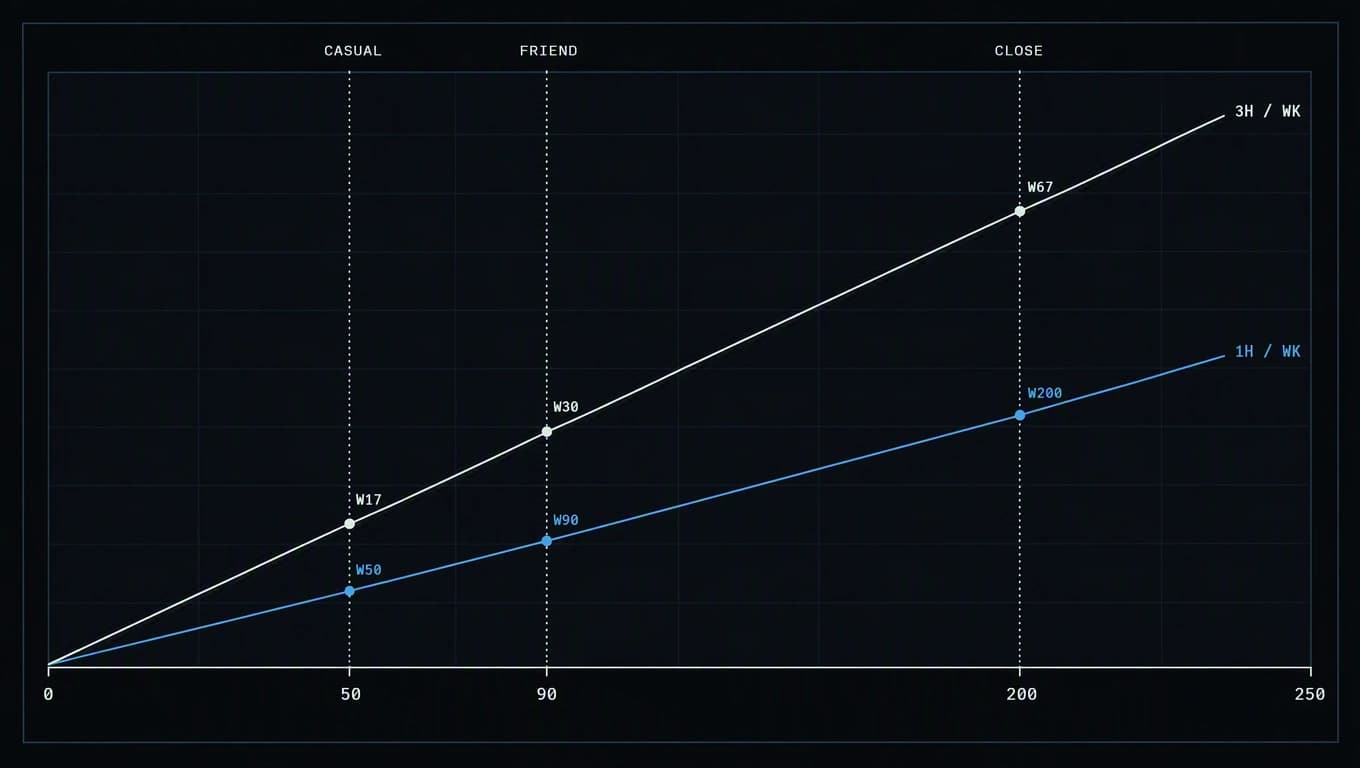
Hall (2019), in the Journal of Social and Personal Relationships, put estimates on how long friendship takes. Roughly 50 hours of time together to move somebody from acquaintance to casual friend, about 90 hours to friend, somewhere near 200 hours to close friend.
Run the arithmetic, because it is the most useful thing in this course. One coffee a month is 12 hours a year, so 200 hours at that rate is not a plan, it is a retirement project. A standing Tuesday that actually happens, two hours a week, is about 100 hours in a year.
Which means the thing you have been treating as a mystery of personal chemistry is, to a first approximation, a scheduling problem.
Aside
Those numbers are softer than the diagram
Take the hours as an order of magnitude and not as a specification. They come from self-report, people recalling how much time they had spent with somebody and then placing the relationship in a category, which is exactly the kind of data that rounds itself. The samples were largely students and adults in one country.
The direction survives the objection. Hours are the input, they cannot be skipped, and no amount of skill at the moves in this course substitutes for repeated contact with the same people. The thresholds are probably wrong in detail. Nobody has ever become close to anyone in four hours.
Example
Eighteen attempts, one friendship
Joel had stopped going to a climbing gym he liked because he had said something stupid to a man there, a wrong guess about the man's job, and had spent three weeks replaying it. When he finally went back in April, the man did not remember him. Not the remark, not the conversation, not his face.
He then ran the log for six weeks at three attempts a week. Eighteen attempts. Eleven were pleasant and went nowhere, four were flat, two turned into something, and one of those two is now a man he climbs with on Thursdays.
One friendship out of eighteen attempts is the rate, not a bad run. Nobody gets four. The eighteen is how the one gets found.
Action
Set the rate and log it
Pick a number of attempts a week and write it down. Three is defensible from a standing start: one stranger, one acquaintance moved forward, one person you already know, seen on purpose.
Then log it for six weeks in four columns. Date, who, how it went out of ten, whether you would do it again. That is the whole instrument.
At six weeks read the log rather than your memory of the six weeks. The memory will tell you it went badly, because the memory is the same biased read Day 1 told you to discount. The log knows how many attempts there were and how many landed. Only one of those two sources has numbers in it.