Claim
Write predictions with dates and numbers
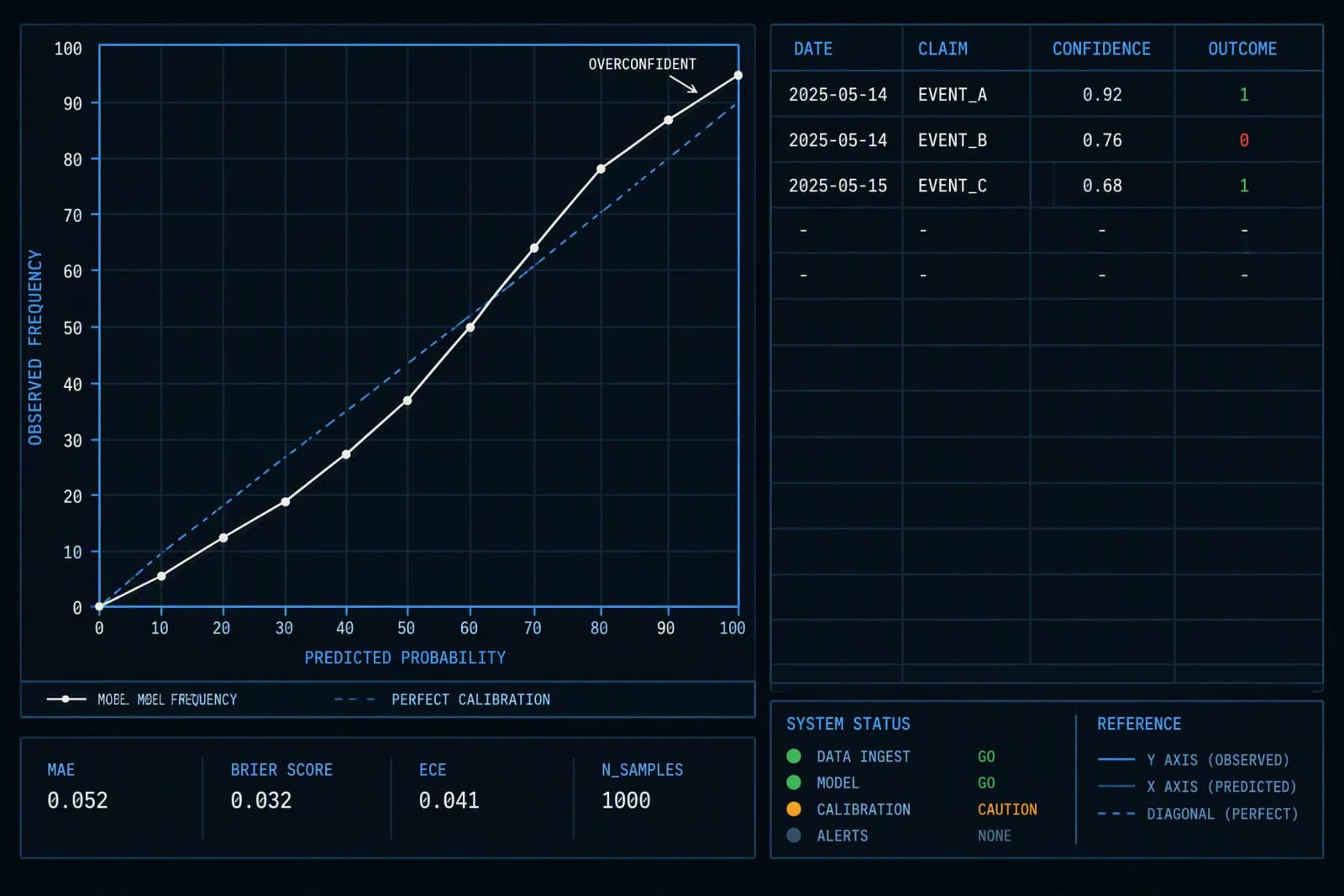
A prediction log is four columns: the date, the claim, your confidence as a percentage, and the outcome when it resolves. Ten entries a year is enough.
The requirement is that each claim be specific enough to settle: not the economy will struggle, but unemployment in this country will be above 6% in the official figures for December next year, 70% confident. Vague predictions cannot be scored, which is precisely why people make them, and a claim you cannot score is a claim you can never be shown to have been wrong about.
Evidence
What the forecasting tournaments found
Philip Tetlock spent two decades collecting expert political predictions and reported in Expert Political Judgment in 2005 that the average expert performed close to chance on questions with defined outcomes, and that confident, ideologically consistent experts did worse than hedgers.
The more useful half came later. In the forecasting tournaments run for the United States intelligence community between 2011 and 2015, Tetlock and Barbara Mellers found that a small proportion of ordinary volunteers substantially outperformed the rest, and what distinguished them was not intelligence or access. It was working in numerical probabilities, breaking questions into parts, seeking out disconfirming information, and updating in small steps as evidence arrived.
Claim
Calibration is a skill, not a personality
Calibration means your confidence matches your hit rate: things you call 70% happen about 70% of the time. It is measurable, it is trainable, and it is the only definition of good judgment in this area that can be checked.
Most people are overconfident at the high end, which shows up as claiming 90% and being right around seven times in ten. You cannot detect that without a log, because memory quietly edits the record: the predictions you remember making are the ones that came true, and the near misses get remembered as almost right. The log is not for anyone else. It is protection against your own editing.
Action
Write five predictions today
Five claims about the next twelve months, each with a resolution date and a confidence percentage. Two should be about politics, two about your own life or work, and one should be something you would be embarrassed to be wrong about.
Put a calendar reminder on each resolution date. When it arrives, mark it right or wrong without renegotiating the wording, which is the hard part and the whole point. After a year, group them by confidence band and compare with what actually happened. That single page will tell you more about your judgment than any amount of reading.
Action
Change your mind in public once
Find one thing you have said publicly, or repeatedly to people you know, that you now think is wrong or overstated. Say so, once, plainly, to the people who heard it.
No elaborate account of the process, no framing that makes the reversal into a display of virtue. I said X, I do not think that any more, this is why. The reason to do it is not integrity points: it is that saying it out loud is what breaks the link between a position and your standing, and once that link is broken you can update cheaply for the rest of your life. Most men have never done this once.
Caution
A log can become a way of being wrong more comfortably
Two failure modes. The first is writing only safe predictions, which produces beautiful calibration and no information. If everything on your list resolves the way you expected, the list is too easy.
The second is using the numbers as a shield: a man who assigns 60% to everything is not calibrated, he is uncommitted, and he will always be able to say he had allowed for it. Put some 90s on the list and let them be wrong occasionally. The value of the practice comes from the entries that are uncomfortable to write down.
Aside
What this course has not given you
Seven days of method will not tell you what is true about contested political questions, and it has deliberately taken no side on any of them. It gives you a way to find a primary source, four ways a number gets bent, a base rate habit, a name for the state you are in when you are being farmed, a five-row test for your own position, some moves for disagreeing without losing people, and a log.
The honest limit: none of this makes you right, and there is no evidence that better method reliably produces better politics at a population level. What it does do is make you cheaper to correct, which over twenty years is a considerable advantage and is available to anyone who keeps the page.