Claim
A position has five parts and most have one
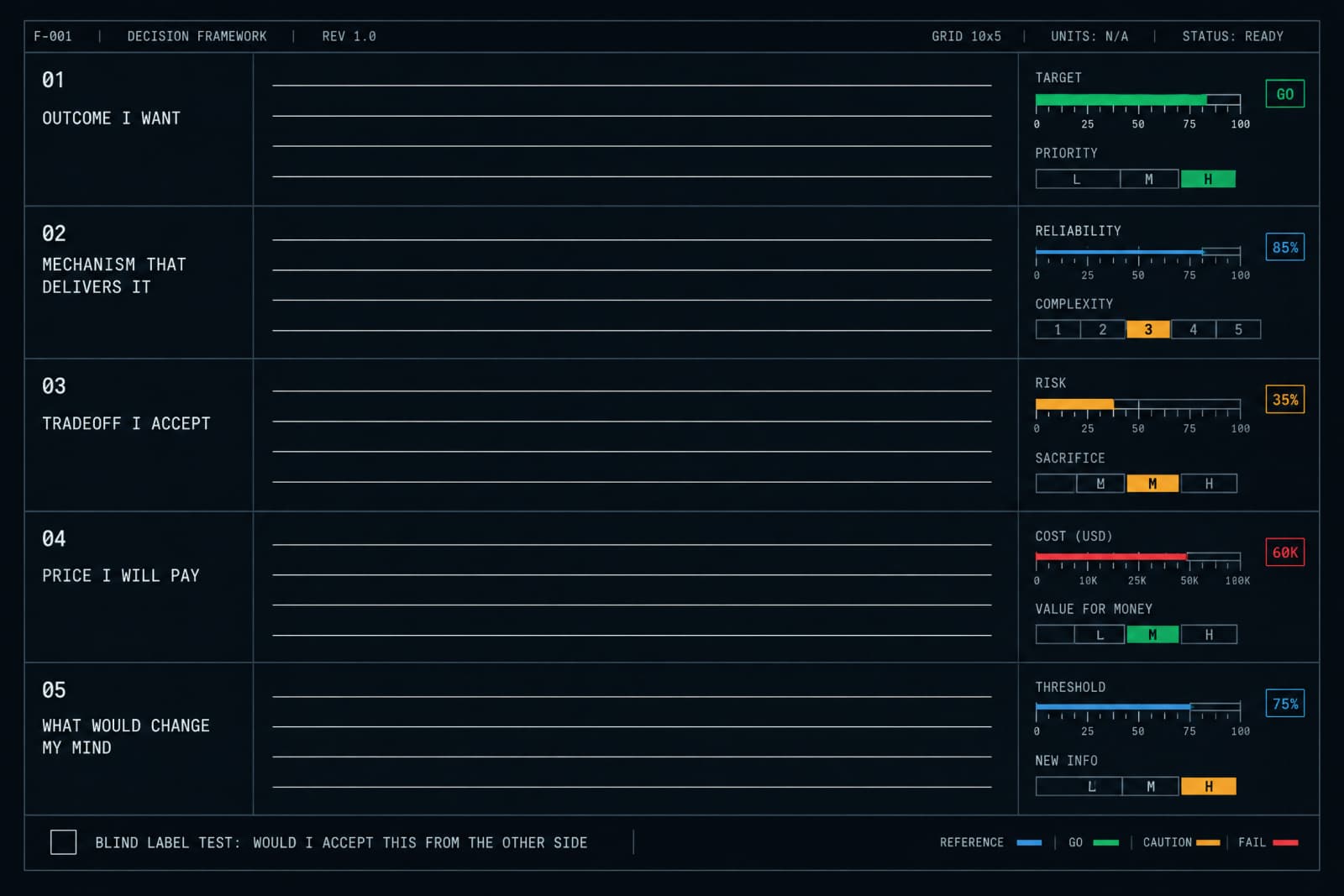
A usable position on any policy contains: the outcome you want, the mechanism by which the policy would produce it, the tradeoff you accept, the price you are willing to pay, and what would change your mind.
Most positions people hold contain only the first, and frequently not even that: they contain a side. If you cannot state the mechanism, you have a preference rather than a position, and a preference cannot be argued with or updated, which is why those conversations go nowhere and feel like they are about something else. They are about something else.
Evidence
Explaining the mechanism reduces extremity
Philip Fernbach and colleagues published a study in Psychological Science in 2013 with a striking result. Participants were asked either to give reasons for their position on a policy or to explain mechanistically how the policy would work, step by step.
Those asked for reasons did not move. Those asked to explain the mechanism reported less extreme positions afterwards and rated their own understanding lower. The authors connected it to the illusion of explanatory depth, described by Leonid Rozenblit and Frank Keil in 2002: people believe they understand how things work in far more detail than they do, and the belief collapses on contact with having to explain it.
Action
Fill in the five rows for one policy
Pick a policy that is currently being argued about where you live, ideally a local one: a bus lane, a school start time, a parking scheme, a licensing rule.
Write the five rows out by hand. Row two is the one that matters and the one that will take you twenty minutes: explain, step by step, how the policy leads to the outcome, including who changes their behavior and why. When you get stuck, that is the finding. Row five is the other hard one, and if you cannot name anything that would change your mind, you are not holding a position on a policy.
Action
Run the blind-label test
Now take your finished five rows, strip out every mention of who is proposing it, and read it back as though it came from the party or group you like least.
Do you still accept it. If the answer changes, the label is carrying weight your reasoning is not. This is the cheapest self-check in the course and the least comfortable, and it has a symmetrical version worth running once: take a policy you oppose, describe it in the words its supporters would use, and see whether your objection survives the rewording. Sometimes it does, which is a good sign. Sometimes it does not.
Claim
Most real disagreement is about tradeoffs, not facts
Two people can agree on every number and still want different policies, because they weight the outcomes differently: liberty against safety, present against future, the individual in front of you against the statistical many.
That is not a failure of evidence and no amount of data resolves it. Recognizing it changes the conversation from an argument about who is lying into a statement of what each of you is willing to pay, which is a discussion adults can actually have. It also stops you treating disagreement as proof that the other person is ignorant, which is the default assumption and is usually wrong.
Caution
Do not mistake a written position for a good one
Having filled in five rows, the temptation is to treat the document as authority. It is not. A neatly argued position can be wrong, and the fact that you wrote down a mechanism does not mean the mechanism is real.
The value is narrower: it makes your position inspectable, by you and by someone else. That is what lets you notice, three years later, that the mechanism you wrote down did not operate. Which is only possible if you keep the page with a date on it, which is day 7.
Aside
Where this course refuses to help you
This course cannot tell you what to want, and it is not neutral about pretending otherwise. Deciding how much you value liberty against safety, or your generation against the next, is not a question technique can answer. It is a question about what kind of person you are, and anyone selling a method that resolves it is selling their own answer with a method wrapped round it.
What the five rows do is separate the part you can be wrong about, which is the mechanism and the evidence, from the part you cannot, which is what you value. That separation is the whole contribution. Most political argument is the two halves being fought at once, which is why it feels endless.