Claim
Primary, secondary, and the chain between them
A primary source is the thing itself: the text of the bill, the dataset, the court judgment, the full paper, the transcript. A secondary source describes it: a news report, a summary, a commentary. A tertiary source describes the secondary ones.
Most public argument runs on tertiary material, and each hop drops something. The sample size goes, then the caveats, then the effect size gets rounded in the flattering direction, then someone converts a correlation into a cause because the headline needed a verb. Nobody has to lie for this to happen. It is what summarizing does.
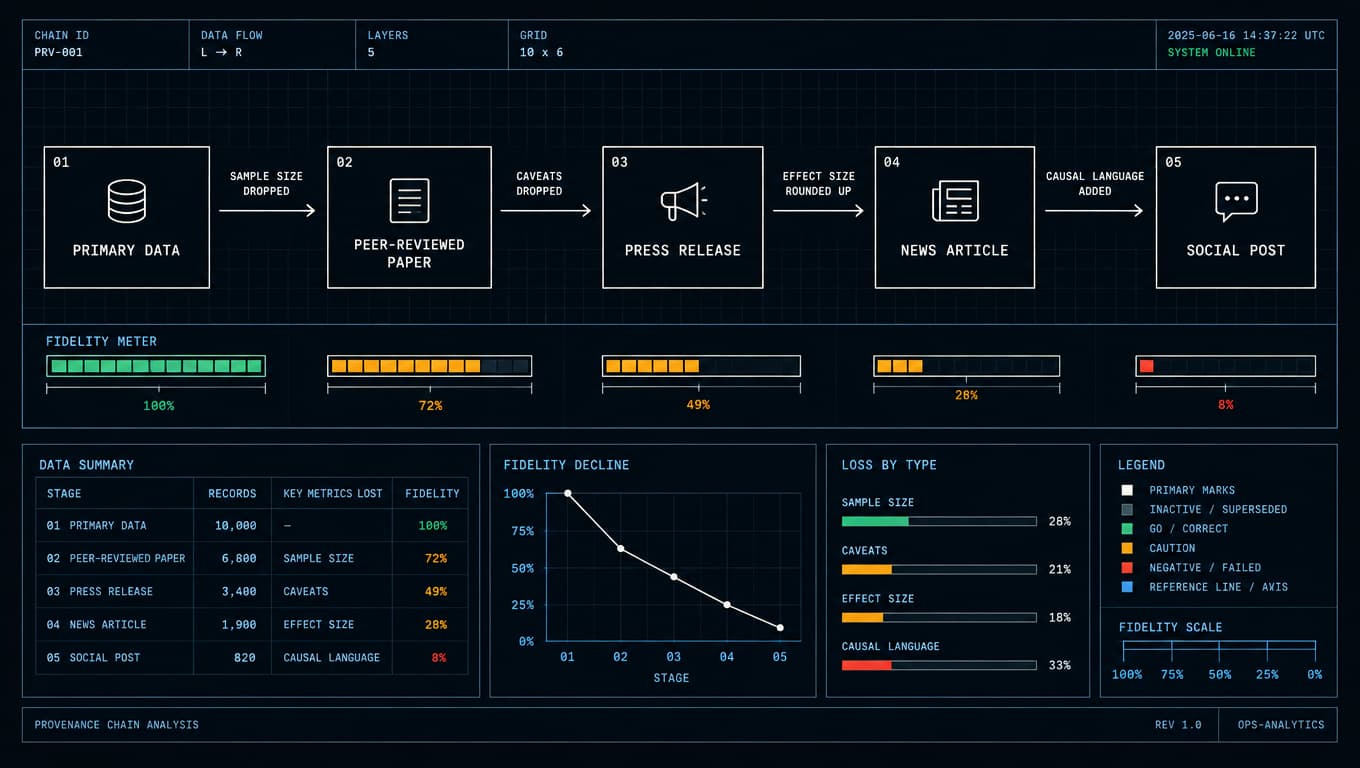
Action
Trace one claim back tonight
Take the last political claim you repeated to another person. Find the primary source, using these steps: search for the exact phrase plus the word study, paper, bill or report, find the publication it is based on, then open that publication rather than an article about it.
Read three things only: the abstract, the sample and method section, and the limitations paragraph. That is fifteen minutes. Write down whether the primary source says what you said it said. Some will. A fair number turn out weaker than the retelling, and a few turn out not to exist in the form being quoted. You will not know which kind you repeated until you look, and I am not going to put a figure on that here, because a quantity with no source in the block that teaches you to trace quantities would be the exact error this day is about.
Evidence
Where the primary sources actually live
This is a practical skill and the locations are boring and public. Legislation and its progress sit on parliament or congress websites, in full text, free, with the amendments visible. Court judgments are published by the courts. Official statistics come from a national statistics office with the methodology attached.
Research papers are the harder case because of paywalls, so use these in order: the journal page for the abstract, a preprint or author copy through a scholarly search engine, then the corresponding author, who will usually send it if you ask in two lines. And read the funding and conflict of interest statement every time, which takes nine seconds.
Claim
Three questions that survive any topic
When you reach the primary source, ask what it measured, on whom, and compared with what.
What it measured catches the substitution of a proxy for the thing: self-reported wellbeing standing in for health, arrests standing in for crime, test scores standing in for learning. On whom catches the sample: 300 undergraduates in one country is not a population. Compared with what catches the missing control: a program that improved an outcome may have improved it less than doing nothing differently elsewhere. Those three questions do most of the work of a methods training you do not have time to take.
Example
A neighbor told Frank that a new twenty mile an hour limit in their borough had cut collisions by 40%. Frank looked for the source and found a council press release, which linked to a monitoring report.
The report covered eleven months, compared against a three year average, and counted all reported collisions rather than injuries. The 40% was real and it was one figure in the document. Two others were in there too: serious injuries fell by a smaller proportion, and the neighboring borough without the limit had also fallen, by about half as much. Frank still thinks the policy worked. He now describes it with three numbers instead of one, and nobody has been able to argue him out of it.
Caution
Reading the source is not the same as understanding the field
An hour with one paper can produce a confidence that is worse than the ignorance it replaced, because a single study is a data point in a literature and you have read one.
So hold the finding at the size it is. One trial is not a consensus, and a paper that contradicts the general view is much more likely to be an outlier than a breakthrough. Where you can, look for a systematic review or meta-analysis, which pools studies, and read its own limitations section. The correct output of fifteen minutes is often a smaller opinion rather than a bigger one.
Aside
The honest objection to all of this
Nobody can do this at scale. There are hundreds of claims a week, the method takes fifteen minutes each, and a man who ran it on all of them would have no life. Any advice that requires infinite diligence is a way of making you feel guilty rather than better informed.
So apply it selectively, with a clear rule: trace the claims you intend to repeat, and the ones you would act on. Everything else can stay at the confidence level of something you heard. That is not intellectual laziness, it is the only sustainable version, and it has the useful side effect of making you repeat fewer things.