Claim
Criteria, not the feeling on a Tuesday
The question "should this end" is almost never answered by how you feel about it this week, because how you feel about it this week is the least stable input you hold.
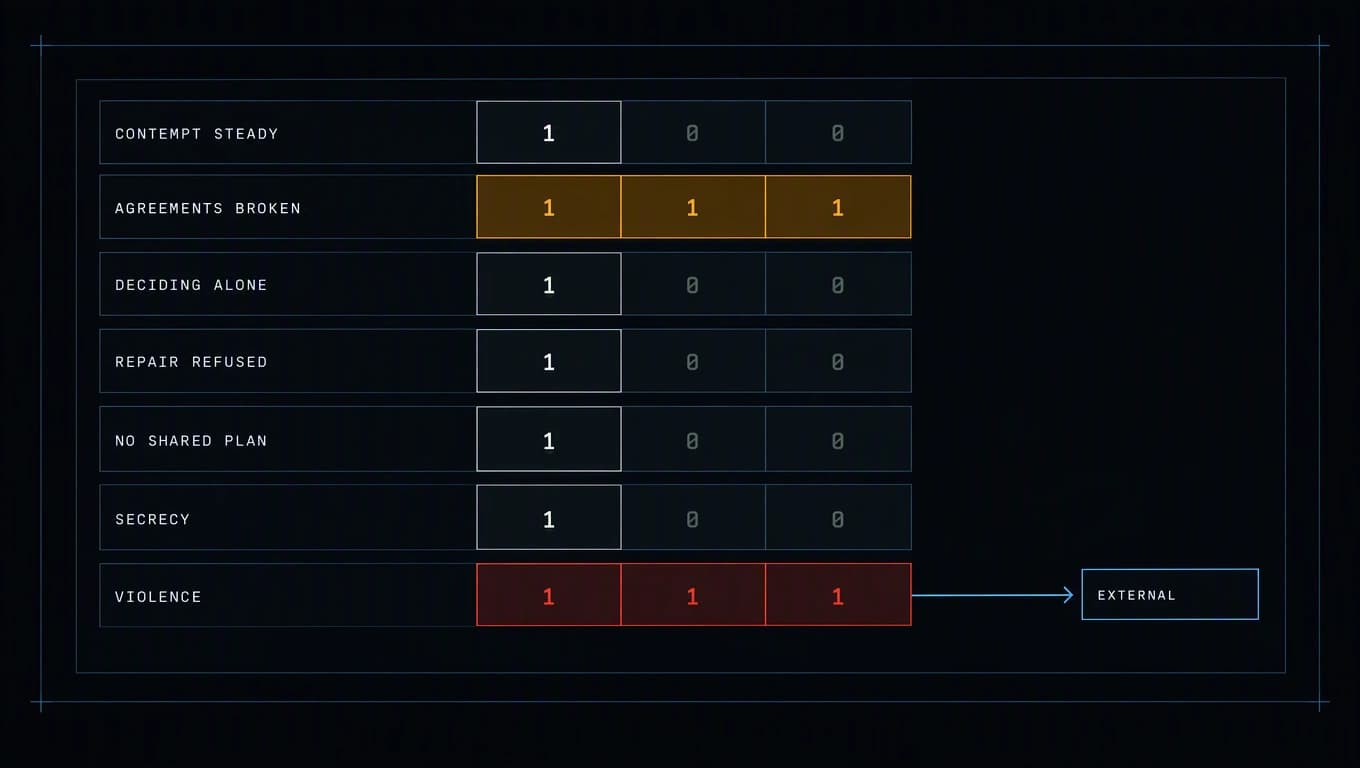
Four conditions are worth more than the mood, and each can be checked against a record rather than against a memory.
- Contempt as the house style rather than as a bad February.
- Agreements broken repeatedly after being renegotiated, which is a different thing from broken once.
- One person carrying the decision alone for years while the other is not told there is a decision.
- Unwillingness on either side to attempt repair at all, which is the one that makes the other three permanent.
None of the four is a verdict. All four are things you can go and look up.
Caution
One category this course does not handle
If there is violence, coercion, or fear of your partner in this relationship, stop using this course for it. That includes fear of what she will do and fear of what you will do, and it applies whichever of you is the one doing it. This is not a harder version of the problem the last six days describe, it is a different problem, and it goes to a professional service or a local hotline or the police, today, rather than to a seven-day reading exercise or to an instrument that returns a position with a confidence number. Nothing here was written for that situation, and following it there could make things worse.
Example
Rob spent eighteen months deciding whether to leave Hannah. The library has a piece about a man in that exact position, and the number is the useful part: roughly eighty repetitions of the same weekly argument with himself, no new facts after month three.
Rob's situation had one detail the article does not. Hannah had known for about a year. She had been waiting for him to say it, and her read was that raising it herself would have been doing his work for him.
They separated over nine weeks. They split the lease as arithmetic, told people in the same week rather than in a drip, and Rob's note at day 60 reads: the decision was right and the eighteen months were the expensive part. He also said that Hannah's account of those eighteen months would be harsher than his, and that she would be entitled to it.
Claim
Waiting is defensible when you can name what it buys
Eighteen months of deliberation is not automatically avoidance, and a course that told you otherwise would be trading your situation for a cleaner argument.
Slow is defensible when you can say what the slowness is purchasing. Counseling the two of you started in March. Her job situation resolving in June. A child finishing school in two years. Those are events, they carry dates, and holding on purpose until one of them arrives is a position rather than a drift.
What does not survive is "I will know more later." You will not. The distinction is mechanical and you can apply it tonight: a date is an event, a feeling is not, and a hold with no named event on the end of it is the same argument still running.
Evidence
Nobody can forecast this, and the record says so
Before you take a decision rule from anyone, including this course, look at what the research on this question can actually do.
The famous divorce-prediction accuracies come from small observational samples, coded by hand, with the model fitted on the same couples it then predicted. Day 2 flagged that problem with the four horsemen and it applies with more force here: describing which couples already ended is a different task from telling a particular man in week three what his will do. There is no instrument with a demonstrated record at the second task.
So the confident frameworks sold on this question are selling certainty that has never been produced. This course has seen none of your file either. It does not know what she said in the car in November, or which of those conditions you are underweighting because it is the one that implicates you.
Distrust anyone who hands you a decision rule here. The honest output is a shorter list of things to check and a date by which you will have checked them.
Aside
Leaving is not automatically the braver option
The counter-case, and it is strong enough that it belongs here rather than in a line at the bottom of the page.
Men in a particular mood read exit as decisiveness. Ending something is legible, fast, and feels like agency after a long stretch of having none. The same man who could not raise one subject for two years can end the whole thing in a weekend.
That is not courage arriving late. It is the same avoidance, taking the one exit that requires no conversation.
The test cuts both ways. If you cannot name the specific change you asked for, on a date, and the specific answer you got, you have not yet run the cheaper experiment. Leaving after that is a decision. Leaving instead of it is also a decision, and it is not the one you will later tell yourself it was.
Action
The monthly review, and ending well if it comes to that
Whatever the answer turns out to be, put a review on the calendar for the same date each month, twenty minutes, both of you. Read the two or three standing agreements you actually have. Change what needs changing. Write the date on it.
That is the practice this course leaves you with. It replaces a background argument that runs all week with a scheduled one, which is the same trade the instrument makes with a decision: a window instead of a loop.
If it does end, the conduct from the last six days still applies. You give the honest account once instead of nine times, you settle the load as arithmetic rather than as punishment, and you say nothing about her worth that you would want kept out of the retelling. You will be in a room with her again one day, at a wedding or a hospital, and you will meet the version of you that handled this.