Claim
A repeat argument is a missing agreement
If the same argument about money or time has run more than three times, stop treating it as an argument. It is a policy gap.
Without a standing agreement, every instance gets renegotiated from zero, at the worst available moment, by two tired people holding different assumptions about what was settled last time. The specific purchase or the specific Saturday is not the disagreement. The disagreement is that no rule exists, so each of you has been operating a private one and finding out at the till.
The test is quick. Can each of you, separately and without asking the other, write down the amount above which you check before spending? If the two numbers differ, you have located the argument, and it was never about the jacket.
Action
Write the standing agreement
A standing agreement on money has three parts and fits on an index card. A threshold, above which you talk before committing. A figure each of you spends without reporting at all. A review date.
Time takes the same shape. How many evenings a week are committed to each other, what counts as committed, which nights are yours alone by default, and when the two of you look at it again.
Write your versions cold, alone, before you compare them. That step is not ceremony. Comparing two written positions is a different conversation from producing one under pressure, and the gap between the drafts is the actual subject.
Then set the review date ninety days out, because an agreement with no review becomes a grievance.
Evidence
The unpaid load is the argument you lose on the facts
The American Time Use Survey, run by the Bureau of Labor Statistics, asks a large sample of Americans what they did yesterday, hour by hour. Its housework numbers have leaned the same way for as long as it has been collected: on an average day, roughly half of women report doing housework against about a fifth of men, with a gap in hours as well as in participation.
Those are national averages and your house is one data point. The reason to know them is narrower than it looks. If your read is that the split at home is about even, you are making a claim that happens to be cheap to check, and that a lot of men have checked and lost.
The response is an audit rather than a debate. Two weeks of logging beats any amount of arguing from memory, in both directions.
Action
Run the two-week audit
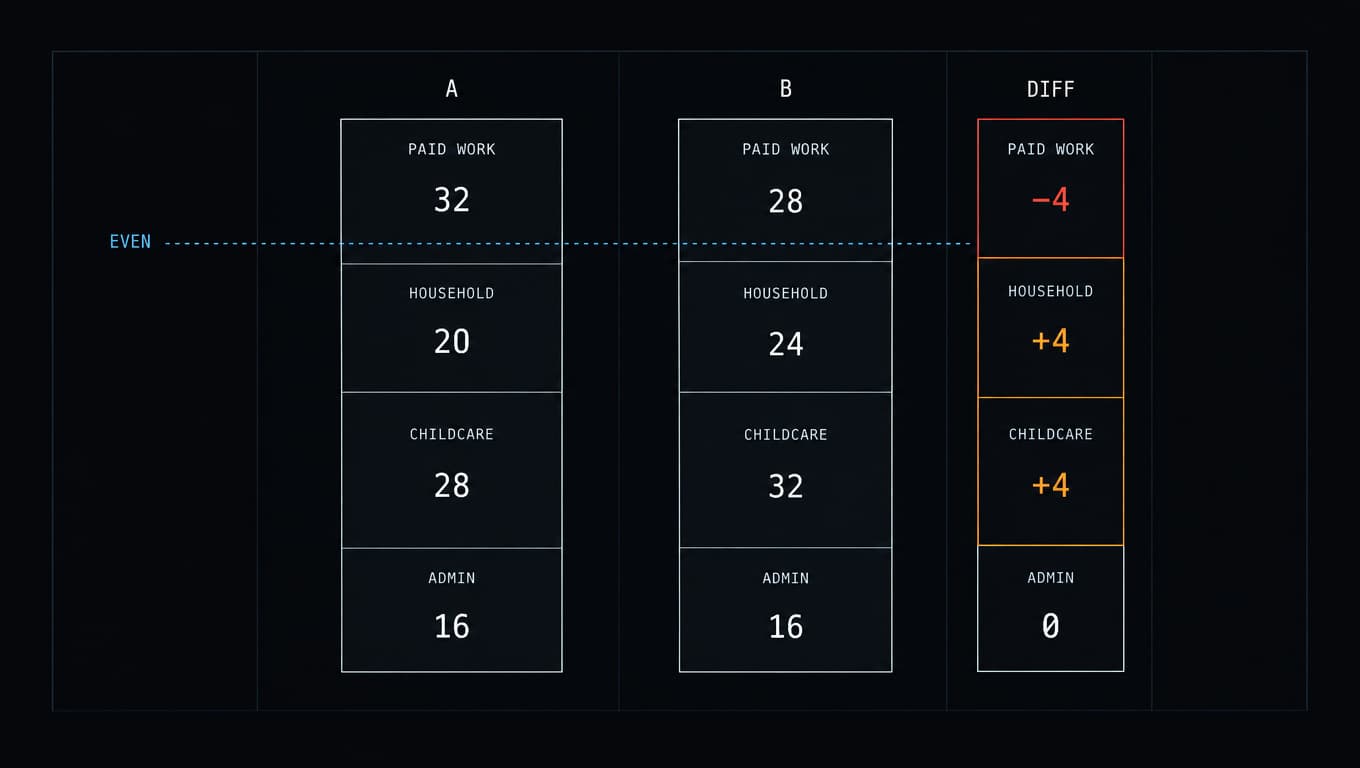
Both of you log, separately, for fourteen days.
- Paid work, including the commute and the evening email.
- Household work: cooking, cleaning, laundry, repairs, shopping.
- Care of a child or a relative, counted as hours where you are the one responsible.
- Admin: appointments, forms, insurance, and remembering that any of it exists.
Log minutes, not feelings. Log the invisible items: who noticed the milk, who booked the dentist, who was carrying Saturday around in their head all week.
At the end you compare totals once, as arithmetic. The conversation after it is about what changes, not about who was right in the previous nine arguments. If it comes out roughly even, say so out loud, because that is also a result and you have just retired a recurring fight with evidence.
Caution
The audit as an exhibit
The way this goes wrong is predictable enough that I will name it before you do it.
You run the audit, the numbers come out in your favor on one category, and you produce the page in an argument six weeks later. The audit is now a weapon, and you will never get another one agreed to.
Two rules keep it usable. The numbers get looked at on the day you agreed to look at them, never mid-fight. And the audit covers all four categories, including the ones you already suspect you will lose, because an audit scoped to the category where you are winning is not an audit.
Aside
Hours are not the whole load
An honest objection to the audit: a minute of work is not a unit of load, and a tally can flatten something real.
What hours miss is who holds the plan. Two people can spend the same forty minutes on a child's birthday, and one of them spent three weeks knowing the birthday was coming. That is a different job, it does not show up in a time log, and it is why the admin category above is written to include remembering.
There is a second miss. Some work is worse than other work at the same duration, and people disagree about which. Do the count anyway. A rough number both of you can see beats two confident impressions, and the things the count misses get much easier to discuss once the countable part is no longer in dispute.