Claim
Three different objects
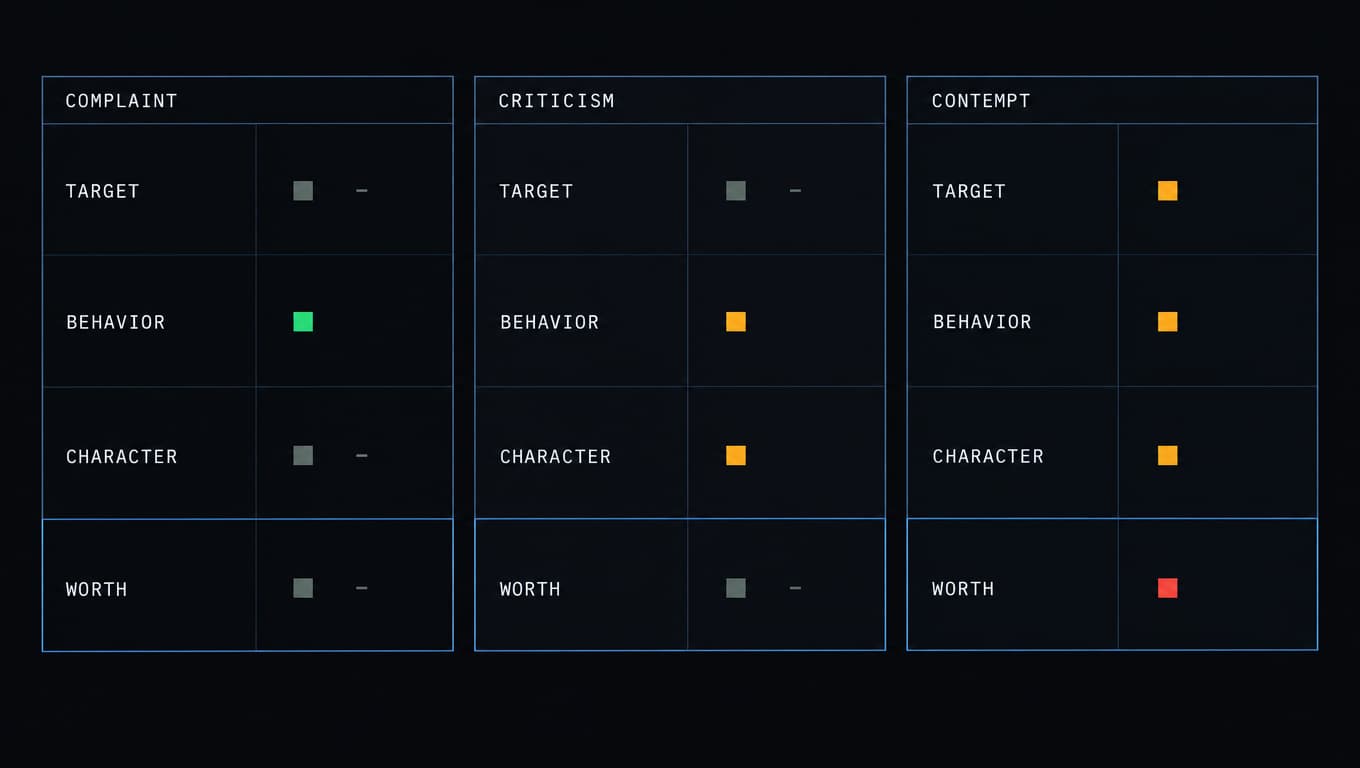
A complaint is about a behavior and its effect. "You got home at nine and I ate alone." It has a time in it, an action, and a consequence, and it can be answered.
A criticism is about character. "You never think about anyone but yourself." Same underlying irritation, but the target has moved from what you did to what you are, and now there is nothing to answer. Nobody in the history of the world has conceded a criticism.
Contempt is about her worth. Mockery, an eye-roll, a nickname, sarcasm aimed at who she is rather than at what happened. It is a different act rather than a louder complaint, and it does something the other two do not: it tells her she is beneath the argument.
Men run all three together under one word. They are not the same weather.
Evidence
Why contempt is the one to watch
John Gottman and Robert Levenson spent years coding videotaped conflict between married couples and sorted the corrosive moves into four categories: criticism, contempt, defensiveness, and stonewalling. Across that body of work, contempt is the one that most strongly marks relationships heading for the exit.
The mechanism is not mysterious. A complaint asks for a change and assumes she is the kind of person who would make it. Contempt withdraws that assumption. Once it is in the room regularly, the ordinary business of a shared life stops working, because every request now arrives with a message about her standing attached to it.
The practical consequence is a rate rather than a rule. One sarcastic line in a bad February is not a diagnosis. Sarcasm as the house style is.
Action
The conversion
Take the last thing you said that you would not want played back, and convert it.
The move has two steps and no third. Name the behavior with a time attached. Name the effect on you. Then stop talking.
"You never think about anyone else" becomes "you told me at six you would be back by eight, I sat with the food until nine-thirty, and I felt stupid." Notice what you gave up: the part where she is a certain kind of person. Notice what you kept: everything that actually happened.
Do it on paper, for one line, today. The reason to write it down is that the conversion is easy cold and close to impossible hot, and the only version available to you at nine-thirty is one you have already built.
Example
Anton had a running joke about Priya's job, the kind that is funny for about four months. He was two years in.
She had stopped mentioning work at home, which he read as her losing interest in her own career. Her account, once he finally heard it: she thought the joke meant he considered her job a hobby, and she had decided to stop handing him material rather than say that out loud. That decision cost them both roughly a year.
He dropped the joke on a Tuesday without announcing that he had dropped it. Eleven days later she told him about a project she was up for. What he wrote down afterwards: I thought I was being told nothing because there was nothing.
The only thing he changed was one joke, and it did not undo the year. The months of her saying nothing about work did not come back.
Caution
Honesty as cover
The common failure here belongs to the man who reads this and decides his contempt was accuracy.
It runs like this: the criticism was true, she does do the thing, so saying it plainly was honest, and her reaction proves she cannot take honesty. Every part of that can be correct and the sentence is still not a complaint. Truth is a property of the content. Contempt is a property of the target. You can be entirely right about a behavior and still aim the sentence at her worth, and men are unusually good at hearing their own accuracy and missing their own aim.
The check is who bears the cost of the sentence. A complaint costs you something to say. Contempt costs her something to hear and costs you nothing, which is exactly why it is the one that arrives when you are tired.
Aside
The prediction number is weaker than it sounds
You will see those four categories sold with a headline accuracy figure, usually somewhere above ninety percent, for predicting which couples divorce. Treat that number with suspicion.
The criticism, made most sharply by Richard Heyman and Amy Slep, is that the models were fitted on the same samples they were then reported as predicting. That is description wearing forecasting's clothes, and the figure does not survive being handed a couple the model has never seen.
What does survive is the vocabulary: four named moves, distinguishable on video by trained coders, with contempt behaving differently from the other three. That is genuinely useful and it is all I am claiming. If a source tells you a checklist predicts your relationship to one decimal place, the checklist is not the part they are selling.