Claim
Cash is a position, not a neutral state
Holding cash feels like not deciding. It is a decision with a price, and the price is inflation.
Two words worth separating now, because everything later depends on them. A nominal amount is the number printed on the money: 10,000 is 10,000. A real amount is what that number buys. If prices rise 4% in a year and your 10,000 sits in an account paying nothing, the number has not changed and you are poorer by about 4% in the only sense that matters, which is groceries and rent.
Evidence
The rule of 72
You do not need a calculator to see the size of this. Divide 72 by an annual percentage and you get roughly the number of years for a doubling or, run backwards, a halving of purchasing power.
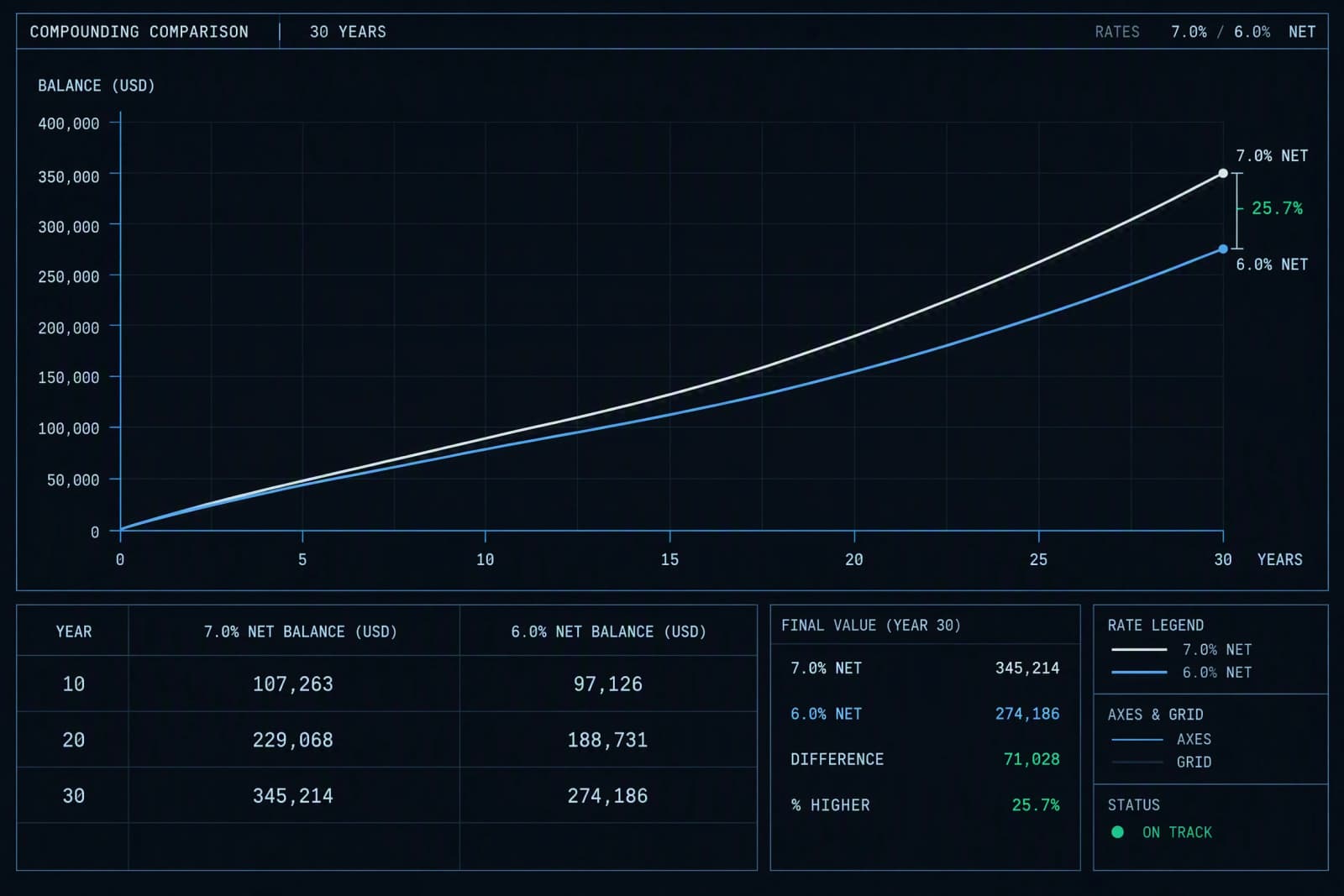
At 3% inflation, 72 divided by 3 is 24 years to halve what your cash buys. At 6%, twelve years. This is arithmetic, not a forecast: it tells you what a given rate does if it persists, not what the rate will be. Central banks in most rich countries target roughly 2% a year, which is 36 years to a halving. That is slow enough to ignore for a month and fast enough to matter across a working life.
Example
Nadir kept 18,000 in a checking account for six years because he did not trust himself to invest it and did not want to think about it. The account paid 0.1%. Over those six years prices in his city rose by roughly a fifth.
His statement still said 18,000, so nothing ever alarmed him. In purchasing power he had given away something close to 3,000 in exchange for not having to make a decision. He is not careless with money. He was careless with one specific idea: that a flat number means a flat value.
Action
Find your own number
Open every account you hold and write down two figures for each: the balance, and the annual interest rate it actually pays you. The rate is usually in the account details, not on the front screen.
Then look up the most recent annual inflation figure for the country you spend your money in. Your national statistics office publishes it; search the office name plus consumer price index. Subtract the inflation rate from each account rate. A negative result is what that money is losing per year in real terms. Write the number down in currency, not in percent, because 2.9% is abstract and 640 a year is not.
Evidence
The rate you were sold is not always the rate you hold
When you look up what your account pays, look for two figures rather than one. Many savings accounts advertise a bonus or introductory rate that runs for twelve months and then reverts to something much lower, and the reversion happens silently.
The same pattern appears in current accounts with a headline rate that applies only up to a balance cap, so the first 2,000 earns the advertised figure and everything above it earns almost nothing. Neither of these is a scam. They are priced on the assumption that most customers will not check again, and that assumption is correct often enough to fund the offer. Find the ongoing rate and the balance cap, and write those down instead of the number on the advert.
Caution
The over-correction
Men who understand this for the first time often do something worse than nothing: they move the whole balance into something volatile on a Tuesday afternoon because cash is "losing money".
Cash has a job. It pays for a broken car and a lost contract without forcing you to sell anything at a bad moment. The point of today is not that cash is bad. It is that cash above what that job requires is a slow leak, and you cannot size the leak until you have measured it. Day 4 sizes the job.
Aside
Where this argument is weaker than it sounds
National inflation figures are averages across a basket of goods nobody actually buys in that proportion. If your rent is fixed by a long lease and you do not own a car, your personal rate may be well below the headline. If you are paying for childcare and a mortgage that resets, it may be well above.
So treat the published number as a rough instrument. The claim that survives is narrow: cash held with no purpose loses value at a rate you can estimate, and estimating it badly is still better than assuming it is zero.