Claim
Load-bearing, defined
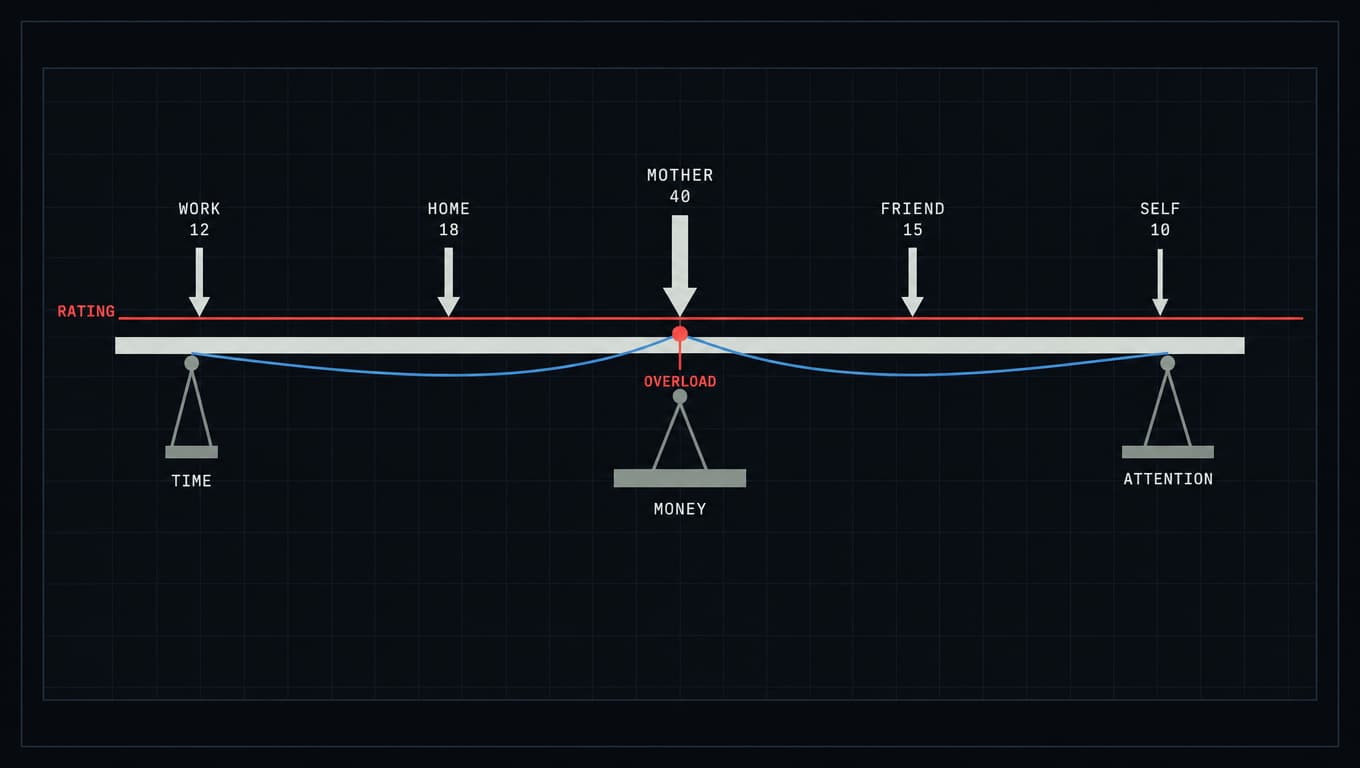
A load is load-bearing when somebody else's plan rests on your part of it. If you fail, their plan fails, not only yours. Your own rent is a cost. Your sister's childcare on Wednesdays is a load.
The criterion has nothing to do with how much you carry. It asks whether the things resting on you are rated for the weight, and whether the people resting on you know the rating. A support that holds nine times in ten is not a support. It is a hazard with a good record.
This is the part of the subject that the words provider and protector are usually pointing at, and it is the part that survives contact with evidence. What does not survive is the idea that the amount is the measure.
Evidence
Why one failure costs more than ten successes buy
Dependence is a bet other people place on your failure rate, and the bet is asymmetric. Successes update their estimate slowly, because a support holding is what a support is for and nobody notices it. A failure updates it fast, because the cost lands on them, and it arrives with a second cost attached: they did not make the other arrangement they would have made if they had known.
That second cost is the one men consistently miss. When you drop something at the last minute, the damage lands somewhere other than the task. The person had no time to route around you, and the reason they had no time is that they trusted the estimate you gave them.
Which yields a rule you can apply with no self-knowledge at all: the earlier you say no, the cheaper your no is. A no in week one is information. A no on the morning is a failure with the same name.
Action
The capacity audit
List everything currently resting on you. Beside each one, write the name of the person whose plan fails if you do not deliver, and the date it is due. Anything with no name beside it is a wish rather than a load, and it belongs on a different page.
Now mark the one you already know you are not going to do. There is one. Every man who runs this finds one.
Message that person today. Two sentences: this will not happen from me, and here is when I knew. The message costs less than the six weeks you have spent avoiding it, and you can check that claim tonight.
Aside
Carrying weight and being carried on
There is a version of this that ends with a man drained by everybody around him because a course told him to be load-bearing.
There is, and it is common enough to name. The test is who assigned the load. Weight you took because it was yours to take is one thing. Weight you took because being needed is the only way you know to be valued is another, and it produces a man who is exhausted, quietly resentful, and impossible to refuse anything.
Being indispensable is usually a symptom. Either you have built a system only you can run, which is a competence problem and tomorrow's business, or you are buying your position with labor because you do not believe it holds any other way. Both are fixable. Neither is a virtue, and the men who have it tend to describe it as one.
Caution
The load you put down does not vanish
When you decline a load it goes somewhere, usually to the person with the least room to refuse it: your wife, your mother, the quietest person on your team. Declining is often correct. Declining while telling yourself the work evaporated is not, and the tell is that you never ask who picked it up.
So the audit gets a second column. For anything you put down, write who has it now and whether you asked them. If the answer is that you did not ask, you have not reduced a load, you have transferred one and left out the notification.
The too-literal reader gets this exactly backwards. He announces a capacity limit, treats it as a rated specification, and declines everything unpleasant while the pleasant loads mysteriously stay inside the rating. Your rating is real. It is also the most convenient number you own, so it is the one to trust least.
Example
Stefan and the nine days in March
Stefan is thirty-eight. He came to this while trying to decide about a promotion, and the promotion turned out to be the smaller problem.
He listed eleven loads. Four were work, three were his brother's house move, two were a friend's product launch he had volunteered for in November, one was the school run on Tuesdays and Thursdays, and one was his father's appointments.
Then the date arithmetic. The move, the launch and two work deadlines all landed inside the same nine days in March. Nobody had told anybody, because each item had been agreed separately with a different person, and no single person could see the stack.
He withdrew from the launch on 3 February, eight weeks out, and the friend replaced him inside a day. He kept the rest and delivered all of it. As he put it: the only thing he actually did was look at the dates in one place.