Claim
An apology has four parts and no fifth
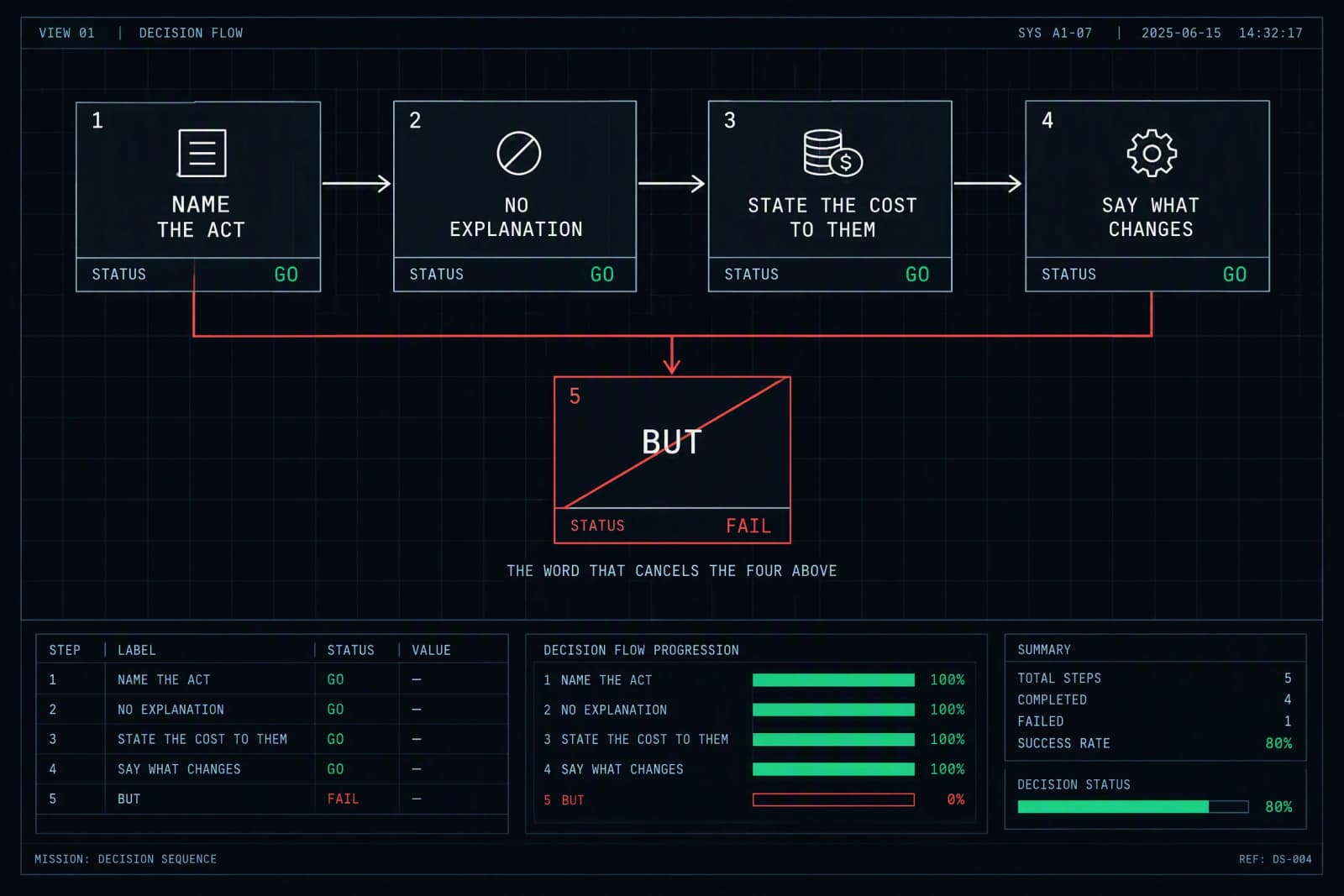
Name what you did, plainly. Do not explain why. Say what it cost the other person. Say what you will do differently. That is the whole structure, and almost every failed apology fails by adding a fifth part.
The fifth part is the explanation, which the apologizer experiences as context and the recipient experiences as a defense. I was late because the traffic was bad is an account of your innocence. I was late, you sat alone in a restaurant for half an hour, I am sorry, I will leave earlier next time is an apology. Note that the second one contains no reason at all.
Evidence
What the word but does to a sentence
But functions grammatically to cancel the clause before it. I am sorry I snapped, but I had been up since four tells the listener that the apology was preamble and the real message is the excuse.
You can test this on yourself in ten seconds by reading both halves of any apology you have given. This is also why sorry you feel that way is heard as an insult: it apologizes for their reaction rather than your act. If you need to explain the circumstances, and sometimes you genuinely do, separate them completely. Apologize fully. Then, later or in another paragraph, give the context as information rather than as mitigation.
Caution
Two ways repair turns into its opposite
The first is correcting someone in public to demonstrate standards. Correct in private, defend in public, and reverse that order only when the error is harming someone in real time. Otherwise make the mistake smaller: repeat the right information without marking the correction, use the wrong fork with them, answer the question they meant to ask.
The second is the man who, having learned this, apologizes for everything. Constant small apologies are inflation: they cost the recipient something to absorb, they read as a request for reassurance, and they leave you with no currency when you owe a real one. Apologize for what you actually did, then stop.
Action
Write the one you owe
You already know whose it is. You thought of a name in the first paragraph of this day.
Write four sentences using the structure above and send them today. No explanation, no request to be forgiven, no framing of yourself as someone who feels terrible, because that quietly asks them to comfort you. If the act was serious, do it by voice or in person rather than in writing, and use the same four parts. Then leave them alone about it, because pressing for a response is one more thing you are asking them to give you.
Claim
Disagreeing without wrecking the evening
Disagreement is not rude. Treating the other person as stupid for holding their position is. The distinction lives in the smallest details: whether you argue with the strongest version of what they said or the weakest, and whether you can state their case in a sentence they would accept.
Two useful moves. Ask what would change their mind, and answer the same question about yourself honestly, which is a real check on whether you are having an argument or a fight. And know how to stop: I do not think we are going to agree on this one, and I would rather talk about something else. Said without sarcasm, it ends the topic and not the friendship.
Example
Two brothers disagree about a political question hard enough that Christmas had become dangerous. In 2023 they made one rule: either of them can say pass, once per visit, on any subject, and the other drops it immediately with no comment.
They have used it perhaps six times. Neither has changed his mind about anything. The visits are fine again, and both of them report that the rule made the subject less interesting rather than more forbidden. The mechanism is not clever conflict resolution. It is that one of them gets to end it unilaterally, which removes the need for either to win.
Aside
Where manners should lose
Politeness is a default, not a duty, and treating it as absolute makes you useful to the worst person in the room. Some situations require you to be the one who makes things uncomfortable: someone being humiliated at a table, a colleague being talked over every meeting, a joke that is cruel to a person who cannot object, a man who has had too much and is about to drive.
In all of those, the polite move is the wrong one. Day 1 gives you the test and it still works here. Ask whose discomfort you are protecting. If your silence is keeping the room comfortable at the expense of one person in it, the room can be uncomfortable for a minute.