Claim
Introducing people is a service, not a formality
When you introduce two people you are handing them the material for a conversation. Doing it badly leaves them with two names and nothing to do.
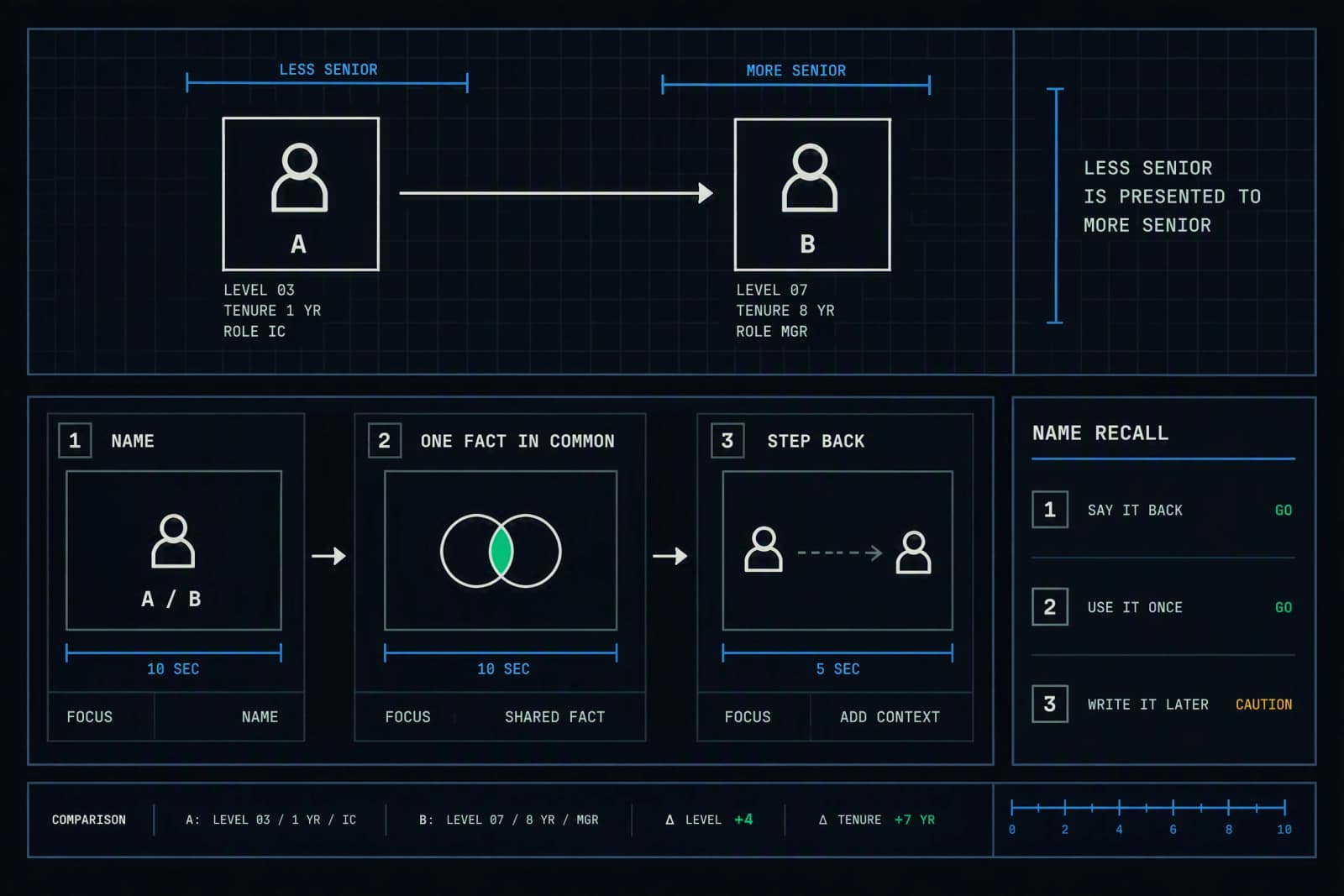
The form that works has three parts. Give each name clearly. Add one fact that gives them somewhere to start, ideally something shared. Then stop talking and let them take it. The convention in most English-speaking settings is to present the less senior person to the more senior, and the reason is simply that seniority is where the room expects deference to flow. If you cannot tell who is senior, introduce the one who arrived later.
Evidence
Why saying the name back works
You do not forget names because you have a bad memory. You forget them because you never encoded them: at the moment of hearing, you were thinking about what to say next.
The repair comes from retrieval practice, which is one of the better established findings in learning research. Henry Roediger and Jeffrey Karpicke showed in Psychological Science in 2006 that actively retrieving something produces far better retention than re-reading it. Applying that to names is an extrapolation rather than a direct finding, and it costs nothing to test: say the name aloud once when you hear it, use it once in the first two minutes, and write it down within the hour.
Action
The four things to do on arrival
Find the host first and greet them, before you get absorbed by whoever is nearest the door. Thirty seconds, then release them; they are working.
Second, join a group of three rather than a pair. Interrupting two people mid-conversation costs them more. Third, when you join, say your name unprompted rather than making anyone reconstruct it. Fourth, when you want to leave a conversation, say a true sentence and go: I am going to get a drink, it was good to meet you. No manufactured excuse, no drifting away mid-sentence.
Claim
Ask for the name again immediately
If you lose a name in the first minute, ask in the first minute. Sorry, your name again? costs you nothing at minute one and is excruciating at minute forty.
The same applies to pronunciation. Asking someone to say their own name again, then repeating it until you have it, is respectful in every culture I know of. Quietly avoiding the name for an entire evening, which is what most men do instead, is worse for both of you and they can tell.
Example
Omar hosts a monthly dinner for eight, and half the guests never meet before they arrive. His entire method is a sentence he prepares for each pairing.
It is nothing clever: Lena, this is Ben, he rebuilt the kitchen in that restaurant you were telling me about. Both of them then have a working conversation for the next ten minutes and neither has to do the small talk archaeology that usually eats the first half hour. He writes the sentences in his phone while cooking. Guests routinely tell him he is unusually good at gatherings. What he is actually good at is two minutes of preparation.
Caution
Handshakes, cheeks, bows and hugs
Physical greeting is the most local convention in this course and the one men most often get confidently wrong. Grip strength is not a personality test, and the man who crushes a hand to signal something has signalled it.
The workable default is to let the other person set the form, and to watch what they do with the people ahead of you in the queue. If you offer a hand and they lean in for a cheek, complete their movement rather than yours. In workplaces where any contact may be unwelcome, a nod and a name works everywhere and needs no explanation.
Aside
When you genuinely cannot do this
The advice above assumes a room is a mildly uncomfortable place rather than an unbearable one. For men who are seriously anxious in groups, or autistic, or both, generic confidence advice is not only useless, it is another thing to fail at.
Two adjustments that survive that. First, arrive early. An empty room lets you meet people one at a time as they trickle in, which is a different task from entering a full one. Second, take a job: pour drinks, man the grill, carry things. A role gives you a reason to move between groups and an exit from every conversation, and nobody expects the person carrying plates to perform charm.