Claim
The window is narrow and specific
Leverage in pay is not constant. It is concentrated at two moments: when a company has decided it wants you and has not yet signed you, and when you hold something they need and cannot easily replace.
Outside those moments, asking is a request. Inside them, it is a negotiation. This is why an internal raise conversation is usually harder than a change of employer, and why the strongest internal case is built the way day 2 describes, then raised when the company is about to lose you or about to give you more scope.
Evidence
The first number sets the field
In negotiation experiments, the first offer strongly predicts the final settlement. Adam Galinsky and Thomas Mussweiler reported this pattern in the Journal of Personality and Social Psychology in 2001: whoever anchors first pulls the outcome toward their number, and the effect survives participants knowing about it.
Two practical consequences. Do not name a figure before you know the market range, because an anchor you invented low is hard to undo. And be careful with the question about your current salary: a majority of US states and several countries now ban employers from asking for salary history, and a number of jurisdictions require the employer to publish the range instead. Look up your own before the call. Where the ban applies, they should not be asking, and where it does not, answer with what you are looking for, sourced from the range rather than from your history.
Action
Source a real range from three places
Before any conversation, get three independent numbers for your role, level and city: a public salary survey or government wage data, two or three current advertisements that state a range, and one human being who does your job elsewhere.
Write the range down with its sources and date. Then set three figures for yourself: the number you will ask for, which sits near the top of the range, the number you would accept, and the number below which you walk. Naming that third one in advance is the part that keeps you calm, because you already know what you will do.
Example
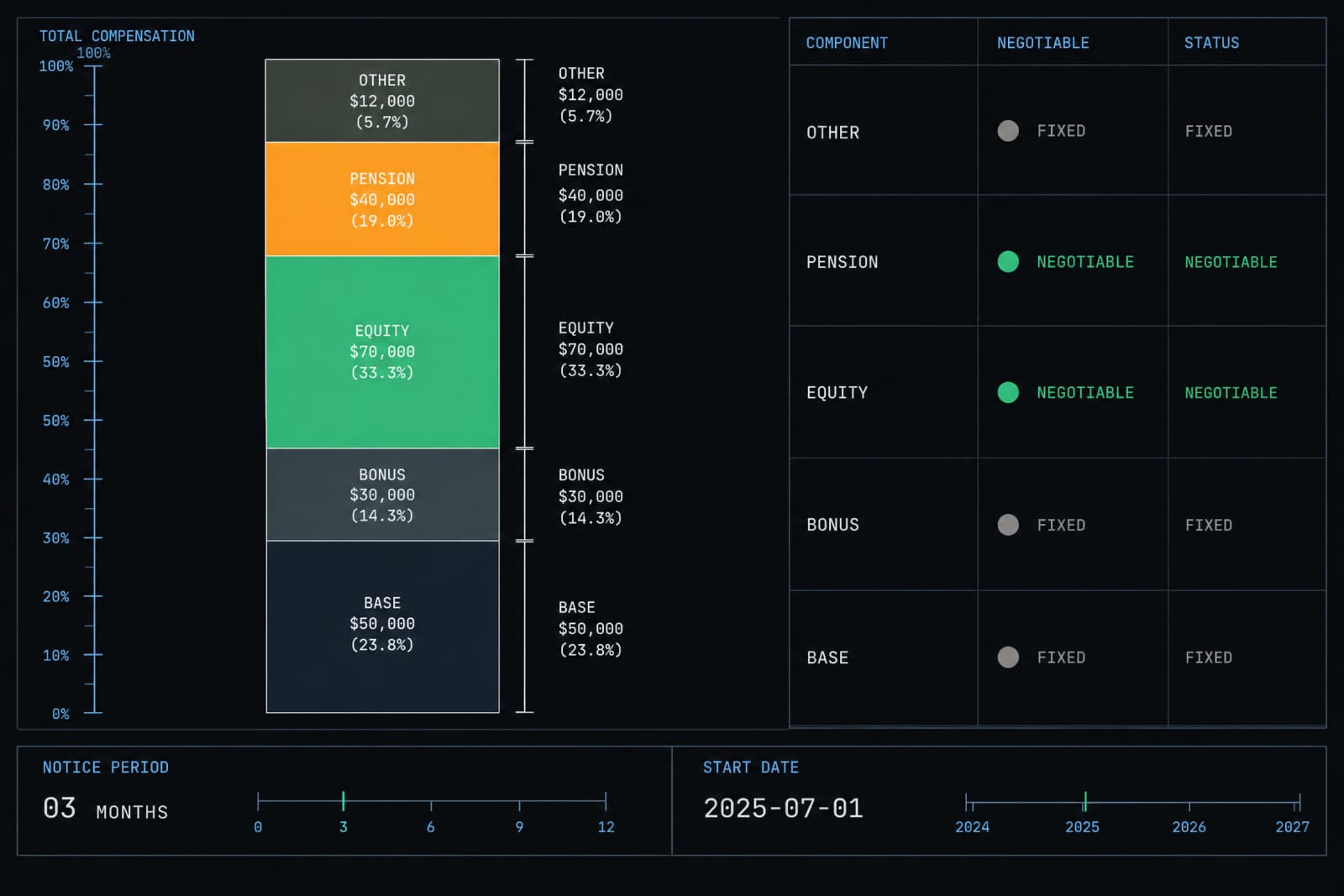
Hakim was offered a role at the top of its band, which the recruiter told him plainly: the base cannot move, it is the ceiling of the level. He had sourced a range that said the base was fair, so he believed her.
What he said next was one sentence: understood, then can we talk about the things that are not the base. He asked for four items and got three. A signing amount of 4,000, a written review at six months with the promotion criteria named in the offer letter, and a certification paid for. The leave request was refused. Base pay is capped by the band; a signing sum, a review date, training and equipment often come from a different budget or no budget at all, and a recruiter whose job is to close you will usually tell you which has room if you ask in those words.
Evidence
Your alternative is the only real leverage
In Getting to Yes, published in 1981, Roger Fisher and William Ury named the thing that actually gives you power in any negotiation: your best alternative to a negotiated agreement. Your walk away option.
Which means leverage is built before the conversation, not during it. A second live process, a current job you would be content to keep, or savings that make a bad offer refusable are all the same asset. It also means bluffing about a competing offer is a bad trade: it is checkable, it is remembered, and the downside is losing the offer you have for a number you might not get.
Caution
How this goes wrong on both sides
Under asking is common and expensive, because a lower base compounds through every future raise and every future offer anchored on it.
Over asking has a shape too: the candidate who negotiates hard on seven items, wins six, and arrives with a manager who now expects a genius and remembers the process. Pick two or three things that matter. Be explicitly pleased when they move. And say yes clearly when you are done, because the man who keeps finding one more item is the man whose offer gets withdrawn.
Aside
The advice that assumes you can afford it
Every negotiation guide is written for someone with an alternative. If you need this job to pay rent next month, your leverage is genuinely near zero, and pretending otherwise is how people lose offers they needed.
In that position, negotiate the cheap things: start date, review date, a written development commitment. Take the job. Then treat the buffer from the money course as a career tool rather than a financial one, because three months of fixed costs in an account is what converts your next salary conversation from a plea into a negotiation. That is the real reason to have it.